


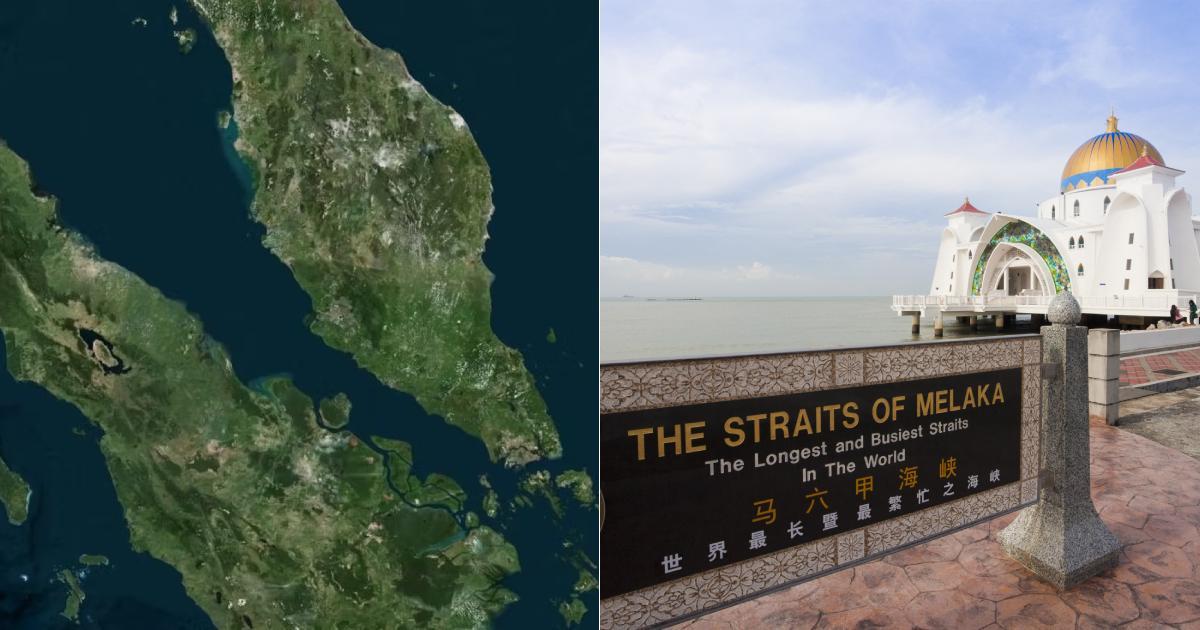
 Cover image via The Geostrata & Calle Montes/Photononstop/AFP
Follow us on Instagram, TikTok, and WhatsApp for the latest stories and breaking news.
A single offhand remark by Indonesia's finance minister this week has reopened questions that most people never thought to ask
When Purbaya Yudhi Sadewa "floated the idea" of charging ships for transiting the Strait of Malacca, referencing Iran's wartime toll system at the Strait of Hormuz as a possible model, it triggered immediate pushback from Malaysia and Singapore.
It also prompted a much older question to resurface: who actually "owns" the Strait of Malacca?
The answer is more complicated than it sounds. And understanding it requires going quite far back.
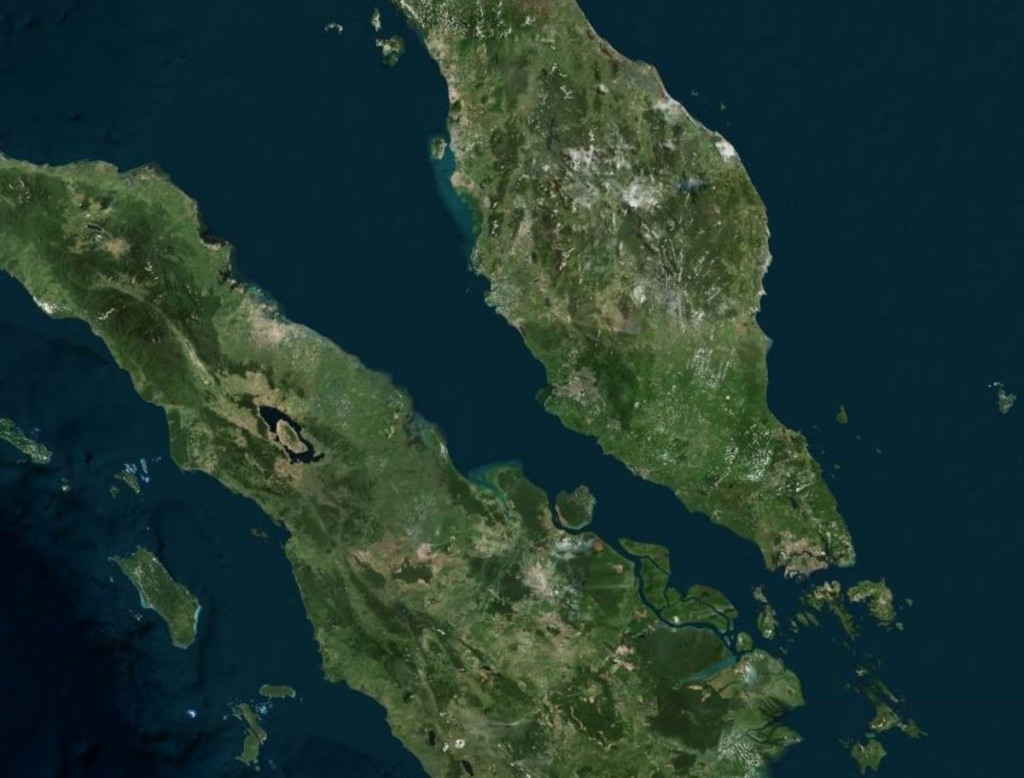
A high-angle satellite photograph capturing the narrow Strait of Malacca.
Image via The GeostrataWhy is it called the Strait of Malacca if Indonesia has the longest coastline?
This is the question that confuses people most.
Indonesia's island of Sumatra forms the entire southwestern flank of the Strait. The Malay Peninsula, shared by Malaysia and, at its very tip, Thailand, forms the northeastern side. By sheer length of coastline, Indonesia's presence along the Strait dwarfs everyone else's.
So why isn't it called the Strait of Sumatra, or the Strait of Indonesia?
The answer is historical, not geographical.
The name "Malacca" is traditionally associated with the Malacca tree, known in Malay as Melaka. Many early Southeast Asian toponyms, meaning place names, were derived from trees or plants in this way. Majapahit, the great Hindu-Buddhist empire that once dominated the region, takes its name from pokok maja, a tree whose fruit is notably bitter, pahit in Malay.
A pokok melaka, which is Malay for Indian gooseberry, grows across the Indian Ocean rim and Southeast Asia. In Sanskrit, the plant is called amalaka, and it is not difficult to see how "amalaka" could become Melaka over centuries of trade, migration, and linguistic drift, particularly given that Malays also call the tree laka.
According to historical tradition, Parameswara, a Sumatran prince and the founder of the Malacca Sultanate, selected the site for his new kingdom where the city of Malacca now stands, and named the location after the tree under which he had rested. Whether the story is literally true or retrospectively mythologised, the name took hold.
Here is the irony: Parameswara was himself of Hindu descent from Palembang in Sumatra, Indonesia, by modern geography, and a prince of the Srivijayan royal line, a dynasty steeped in Hindu religion and culture. His very name is Sanskrit. The Sultanate he founded controlled a section of global trade on a vital chokepoint, the very strait that today bears its name. The port city of Melaka, on the Malay Peninsula, became so dominant as a trading hub that the entire waterway took its name. The geography of Sumatra didn't matter. The commercial and political power of the port did.
The strait was successively controlled by the Arabs, the Portuguese, the Dutch, and the British, each colonial power cementing the name further into navigational charts, maritime law, and international usage. By the time modern nation-states drew their borders, "Strait of Malacca" was the name the world knew, and it stuck.
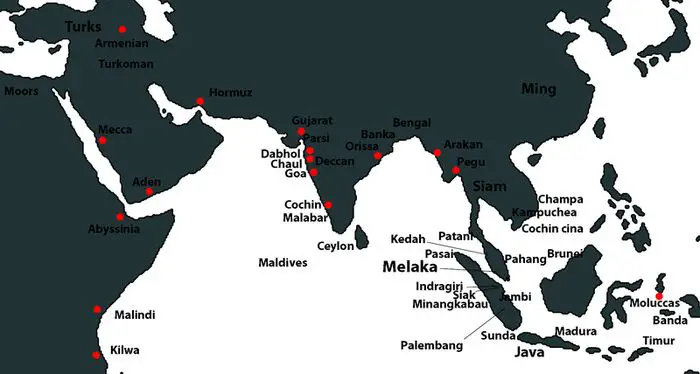
Map of 1400s Malacca.
Image via New World EncyclopediaSo who owns the Strait of Malacca?
Nobody owns it outright, and that is precisely the point.
The Strait of Malacca is an international strait. It sits within the overlapping territorial waters of three sovereign states: Malaysia, Indonesia, and Singapore.
Each country has sovereignty over its own portion of the waterway.
But sovereignty over territorial waters is not the same as ownership of the strait as a whole, and it does not come with the right to control, restrict, or charge for passage through it.
This distinction is the foundation of modern maritime law, and it is enshrined in the United Nations Convention on the Law of the Sea, better known as UNCLOS.
What is UNCLOS?
UNCLOS is the international treaty that governs everything that happens at sea: territorial boundaries, fishing rights, deep-sea mining, environmental protections, and, critically, the rules around maritime passage.
UNCLOS is an international treaty signed in 1982, which came into effect in 1994. It is sometimes called the "constitution of the oceans".
Nearly every country in the world has ratified it, including Malaysia, Indonesia, and Singapore. Notably, the US has not formally ratified it, though it has declared it will abide by its provisions.
Under UNCLOS, the world's oceans are divided into different legal zones, territorial seas, exclusive economic zones, and international waters, each with different rules about what coastal states can and cannot do. The Strait of Malacca falls into a particularly important category: a strait used for international navigation.
What is "transit passage" and why does it matter?
This is the legal concept at the heart of the levy debate.
Articles 37 to 44 of UNCLOS establish a right of transit passage which may not be suspended and do not permit the imposition of transit tolls or charges as a condition of passage.
Article 38(1) provides that all ships enjoy the right of transit passage, which shall not be impeded. Article 44 is unqualified, stating that bordering straits shall not hamper transit passage and shall not suspend it.
Transit passage is a stronger right than what's called "innocent passage", the more limited right ships have when crossing a country's ordinary territorial waters.
In a strait used for international navigation — like the Strait of Malacca, ships don't just have the right to pass through; they have the right to pass through continuously, swiftly, and without interference. Warships, submarines, and aircraft are all covered. Just like the USS Miguel Keith did last week.
Article 42 sets out the laws and regulations that Strait states may adopt, covering safety of navigation, pollution prevention, and customs controls limited to loading or unloading. Tolls are absent from that list.
The distinction between a natural strait and a constructed canal is crucial here. Tolls are permissible on constructed canals, such as the Panama Canal and the Suez Canal, as they were built as commercial infrastructure within a single state's territory.
Natural straits are different.
Nobody built the Strait of Malacca. It exists by geography. And UNCLOS says geography alone does not give a bordering state the right to charge for it.
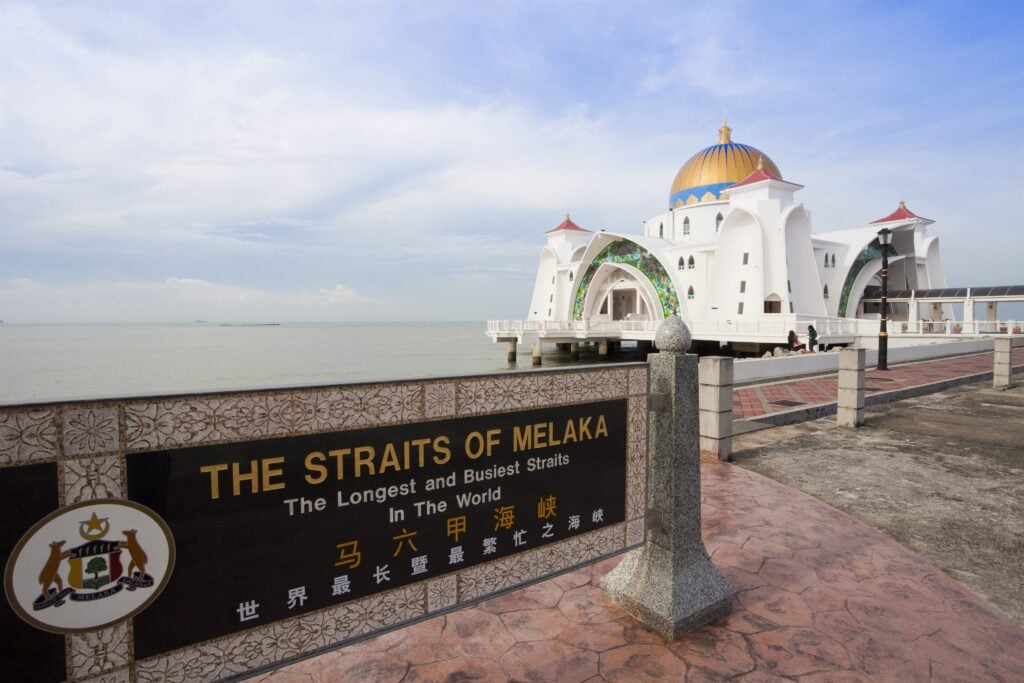
Why would Singapore have more practical control than Malaysia or Indonesia?
This is another question worth answering properly.
Singapore doesn't "own" the Strait any more than Malaysia or Indonesia does. But geography has given it a disproportionate role in how the Strait actually functions, particularly at its most critical point.
At its narrowest point in the Phillips Channel of the Singapore Strait, the Strait of Malacca is only about 1.7 miles wide, creating a natural bottleneck. Every ship that transits the Strait must pass through this channel. Singapore sits right at that bottleneck.
The Phillips Channel is just 2.7km wide and requires precise navigation. The waters are shallow, the Strait's minimum depth is 25m, and the draught of some of the world's largest ships exceeds this limit. The largest supertankers cannot pass through at all and must reroute thousands of nautical miles via the Lombok Strait instead.
Managing that bottleneck requires real infrastructure: vessel traffic services, mandatory ship reporting systems, pilotage services, and real-time monitoring.
Singapore, with one of the world's most sophisticated port authorities and the second-busiest port on earth, has built and maintained much of that infrastructure. Its control is operational, and it is grounded in the fact that the most technically demanding part of the Strait happens to sit in its waters.
Malaysia and Indonesia participate in joint patrols and coordination through the Malacca Strait Patrol framework, but Singapore's position at the Strait's narrowest and most complex exit gives it a practical influence that exceeds its physical size.
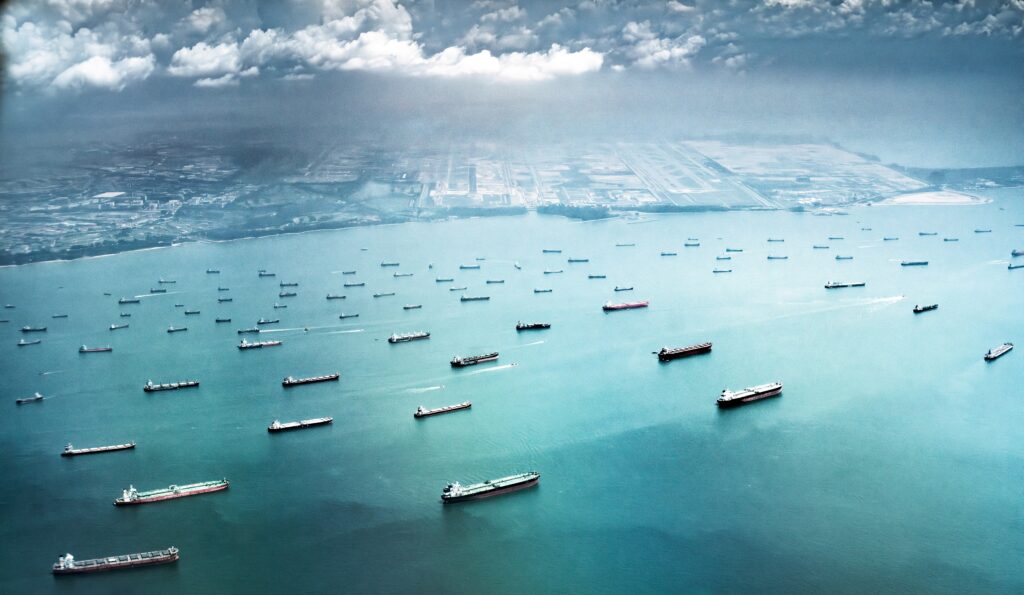
Congestion of waiting transport ships off the coast of Singapore.
Image via Armand Patoir/Biosphoto/AFPSo why is Indonesia proposing a levy if it would be illegal?
A few things are worth separating here.
First, Purbaya's remarks were notably casual. As Bloomberg reported, he said, "I don't know, is that right or wrong?", the language of someone thinking aloud at a symposium, not announcing policy. He acknowledged that the idea is in its early stages and faces steep hurdles.
Second, Indonesia is watching the Iran-Hormuz situation and drawing a political lesson, even if the legal lesson points in the opposite direction.
Iran's toll system, however illegal under UNCLOS, has not been immediately dismantled. It has been contested, resisted, and worked around, but it exists.
The fact that a country can impose a toll in defiance of international law and not face immediate consequences is, for some governments, an instructive precedent.
Third, there is a genuine grievance underneath the proposal.
Indonesia controls the longest coastline along one of the world's most economically significant waterways, and receives no direct revenue from it. That frustration is real, even if the proposed remedy is legally untenable.
But here is where the proposal becomes self-defeating for Indonesia specifically, and this is the sharpest legal irony in the whole debate.
UNCLOS transformed a collection of islands separated by open international waters into the unified archipelagic state that Indonesia is today. A country that has benefited so enormously from UNCLOS should be its most steadfast defender.
A levy on Malacca Strait transit would not be a toll in the Panama Canal sense, but an act of Indonesia sawing at the very legal branch it sits on.
Indonesia's status as a single sovereign nation, stretching across 17,000 islands from Sumatra to Papua, rests on UNCLOS recognising it as an archipelagic state.
Without that recognition, its internal waters between islands would revert to international waters, fragmenting its territorial integrity.
The same treaty that Indonesia would need to violate to impose a toll is the treaty that holds Indonesia together as a country.
The bigger picture
The levy proposal, however offhand, didn't emerge in a vacuum.
It landed in the middle of a broader moment in which the rules governing the world's critical waterways are under visible stress. Iran charging tolls at Hormuz. The US blockading Iranian ports. Washington pushing for military overflight access through Indonesian airspace. A US warship transiting the Strait of Malacca days after that proposal was walked back.
The Strait of Malacca has always been governed by a simple consensus: three countries, one waterway, shared rules. That consensus is grounded in international law, in UNCLOS, and in the practical reality that all three states benefit enormously from keeping the Strait open and free.
What the last few weeks have made clear is that consensuses, however legally solid, require active maintenance. Especially when the world around them is getting louder.
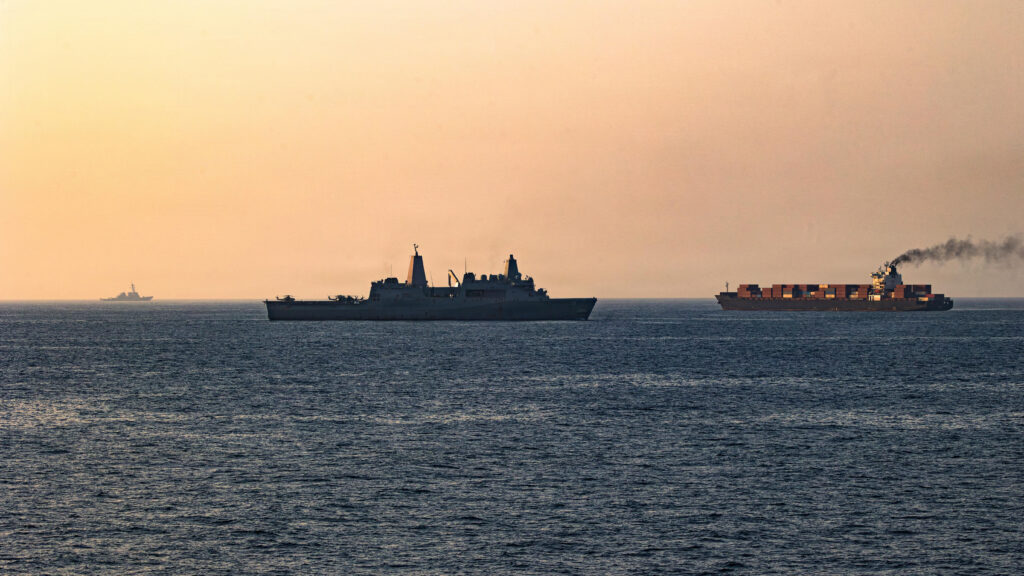
This US Navy handout photograph released on 21 April by US Central Command Public Affairs shows US forces patrolling the Arabian Sea near the Touska, an Iranian-flagged cargo ship.
Image via AFP Photo/US Central Command Public Affairs