


 Cover image via Saul Loeb/AFP & Roslan Rahman/AFP
Follow us on Instagram, TikTok, and WhatsApp for the latest stories and breaking news.
When the US and Indonesia signed a Major Defence Cooperation Partnership (MDCP) in early April, it looked like a straightforward deepening of ties between the two countries
But what didn't appear in the official statement — and later surfaced in reports — was what US President Donald Trump and his administration had allegedly requested behind closed doors: blanket overflight access for US military aircraft through Indonesian airspace.
The proposal, reported by Indian outlet The Sunday Guardian, would have allowed American planes to pass through Indonesian territory on a notification basis rather than requiring case-by-case approval.
The fact that it was Indian media that broke the story is itself notable.
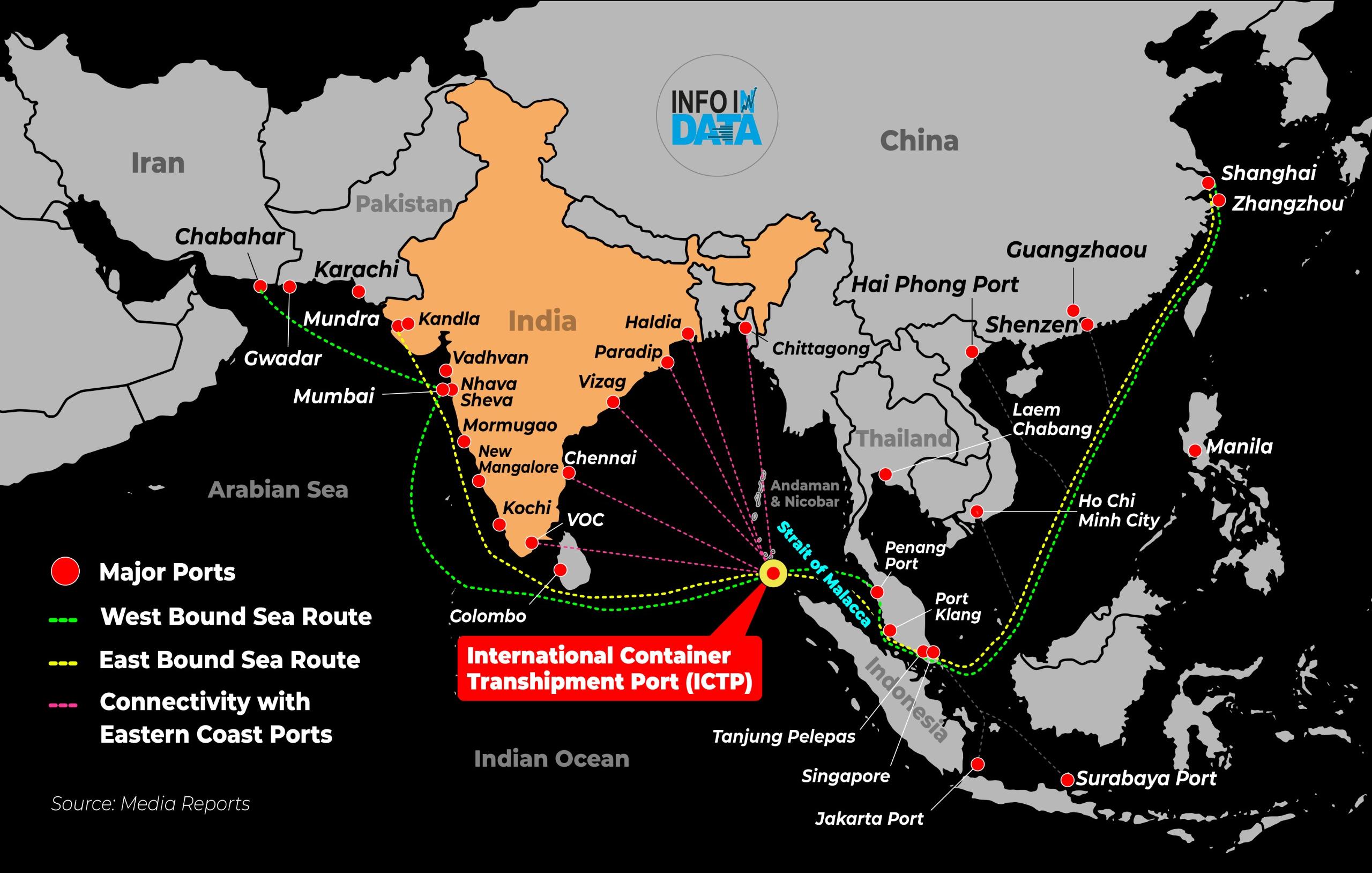
The Strait of Melaka sits, geographically, at the eastern mouth of the Indian Ocean. Roughly 60% of India's sea-based trade and a significant share of its LNG imports pass through it. India has sought a formal role in patrolling the Strait since as far back as 2004.
The Indian government watches this waterway as closely as any country in the region, arguably more so than most. A reported US-Indonesia arrangement that reshapes military access to the Strait isn't just Southeast Asia's problem. It lands squarely in India's strategic backyard.
The revelation caused enough of a stir domestically that the Indonesian government was forced to clarify that the overflight clause sought by the US was a preliminary draft, not a binding agreement, and that it was still under discussion.
But that clarification may have done as much to raise questions as it did to settle them. Because if Washington was pushing for that level of access, and Jakarta resisted the pressure, it signals something about how the US is currently thinking about this part of the world.
For Malaysia, that thinking hits close to home.
The Strait of Melaka, the narrow stretch of water between Peninsular Malaysia and Sumatra that carries roughly a third of global trade and more than half the world's oil and gas shipments every year, isn't just on our doorstep. It's a waterway the country depends on.
International trade plays a central role in Malaysia's economy, and the country is home to two of the world's top 20 busiest ports — Port Klang and Port of Tanjung Pelepas — both of which owe their existence to the Strait's traffic. Any disruption here isn't a distant geopolitical problem. It's a direct hit to how this country earns and moves its money.
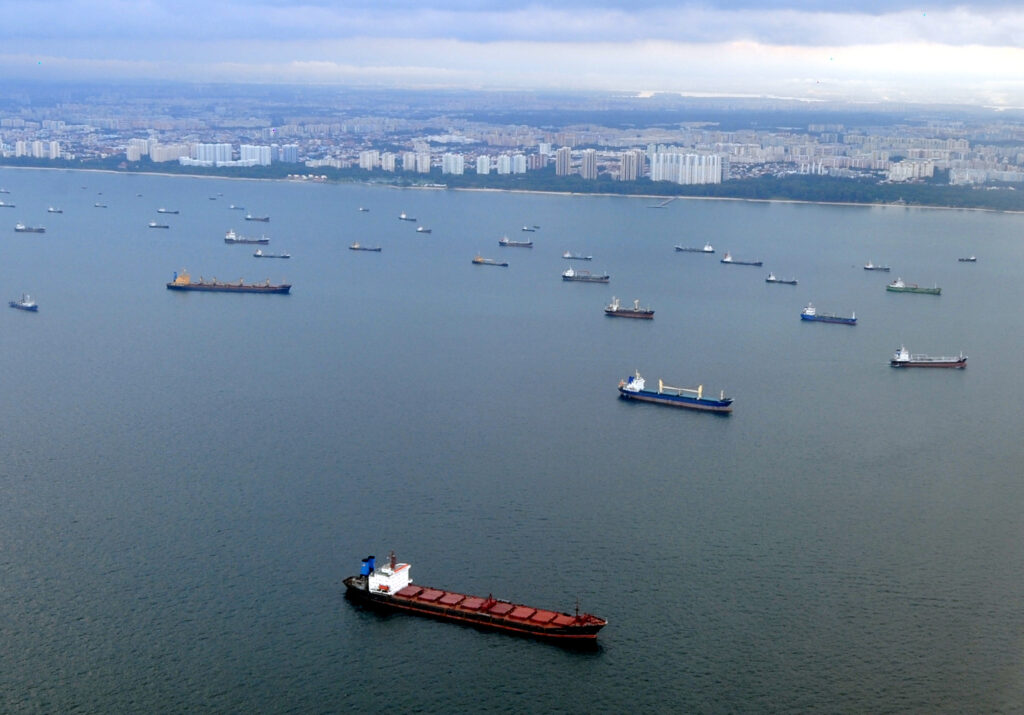
This aerial file photo shows a vessel (bottom) sailing past ships anchored along the coast of Singapore at the mouth of the Strait of Malacca.
Image via Roslan Rahman/AFPWhy Melaka, and why now?
To understand the American pivot toward the Strait, you have to start somewhere else: the Strait of Hormuz, at the mouth of the Persian Gulf, where an Iranian blockade and a US counter-blockade have turned one of the world's most critical shipping lanes into an active pressure point.
Munira Mustaffa, founder and principal consultant of Chasseur Group and Senior Fellow at Verve Research, one of Malaysia's most recognised voices on private and public security, sees a clear line between the two chokepoints.
"My read is that the US is pivoting to where it thinks it can actually win," she told SAYS.
"Hormuz is contested, too costly to hold, and Washington sees itself as doing the heavy lifting for Asian and European energy interests, not its own. Melaka is the next logical pressure point."
The connective tissue, she explained, is what's known as the "dark fleet", vessels that move sanctioned Iranian oil under the radar, often with falsified documentation and switched-off tracking systems.
"Iranian oil doesn't stop moving just because Hormuz is contested. Melaka is the choke point for alternative routing, and that's where Washington hopes to apply counter-pressure."
Whether this represents a permanent strategic shift or a temporary posture is harder to call.
"That depends as much on Washington's political stability as on how the conflict resolves," Munira noted.
"[The Trump] administration has not exactly demonstrated a commitment to operational rationality before announcing strategic intent."
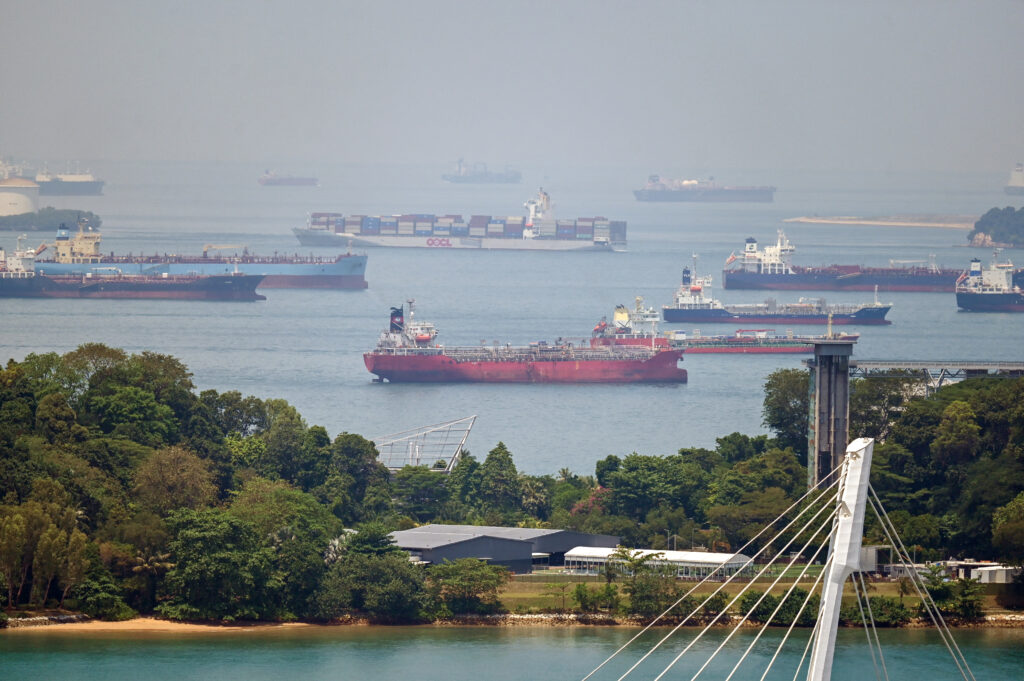
A container ship (top C) sails past oil tankers anchored along Singapore straits in Singapore on 14 April 2026.
Image via Roslan Rahman/AFPWhat the Indonesia deal actually changed, and what it didn't
The framing around the US-Indonesia MDCP as a done deal, Munira said, requires some correction.
"It's important to note that [Indonesian President] Prabowo [Subianto] didn't actually concede blanket access. Washington pushed for it, and Jakarta resisted internally, and it was quietly dropped from the final MDCP statement."
The furore, domestically within Indonesia and across the region, erupted before anything was formally signed. And that timing matters.
"The simultaneous pressure across multiple nodes, expecting immediate compliance… that's the Trump administration's operating mode right now, and it isn't particularly calibrated to what's operationally or diplomatically realistic."
For Malaysia, the ambiguity that followed Indonesia's walkback doesn't simplify things.
"Jakarta's calculus may have a way of becoming Putrajaya's problem," Munira said, adding, "regardless of whether Malaysia is at the table".
Is ASEAN still relevant here?
There's been a lot of talk about what all this means for ASEAN Centrality, the principle that ASEAN, not outside powers, should set the agenda for regional security. If Indonesia is making bilateral security arrangements with Washington, does the bloc still mean anything?
Munira pushed back on the more dramatic readings.
"ASEAN member states still see the platform as having value for cooperation and diplomacy, but that's always been distinct from collective defence. ASEAN never really had a collective defence architecture to begin with."
The comparison often made to NATO, she said, misreads what ASEAN was designed to be.
"ASEAN is not like NATO, which is a military alliance, while ASEAN has always been focused on diplomacy and economic growth. Bilateral side-deals aren't new; states have always hedged. What's changed is the visibility and the pressure."
That visibility carries its own weight. Sovereign states acting in their own security interests while remaining members of ASEAN isn't a contradiction, she noted, "it's just how it has always operated".

Munira Mustaffa, Senior Fellow at Verve Research.
Image via Munira MustaffaMalaysia in the grey zone
Malaysia has long maintained a careful balance with both the US and China, avoiding formal alignment with either. It's a posture that has served the country reasonably well, but Munira is measured about how much room remains to hold it.
"Malaysia is already in the grey zone," she said.
"Has been navigating it for years. The real risk isn't getting caught in the conflict. It's losing the room to stay ambiguous."
That ambiguity, in large part, is about China.
Beijing has long worried about what strategists call the "Melaka Dilemma", the risk of a naval blockade cutting off its energy supplies through the Strait. A larger US footprint here tightens that pressure. And when two major powers are circling the same waterway, the countries sitting along it don't get to simply observe.
"Malaysia has managed this balancing act before, so there's no immediate reason to think that's changed," Munira said.
"But the space for deliberate ambiguity is narrowing, and [the Trump] administration has shown a pattern of turning strategic interest into transactional pressure. Whether that eventually reaches Putrajaya is an open question, but it's not an unreasonable one to ask."
For many Malaysians, geopolitics can feel distant, something that plays out in briefing rooms and press statements, not in daily life.
However, Munira rejects that separation.
The thinking that Malaysia is insulated from all this, that the conflict stays "over there", doesn't match the reality.
"The Hormuz crisis has already done that. Supply chain disruption and fuel volatility aren't hypothetical downstream risks. They're the present reality of any major conflict touching a critical chokepoint," she noted.
The assumption that geographic distance provides some kind of buffer, she argued, is one Malaysia keeps making, and keeps being proven wrong about.
"Malaysia sits in the middle of some of the most consequential maritime corridors in the world. That's not a buffer. If anything, it's exposure. Conflicts don't respect the boundaries we draw around ourselves."
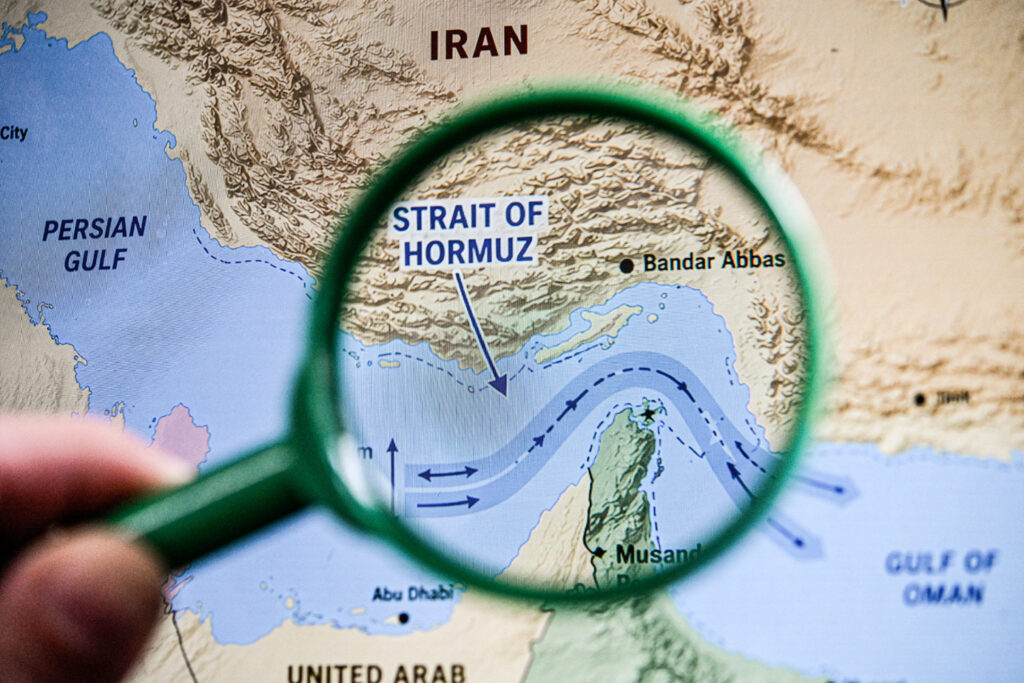
Close-up image of a magnifying glass highlighting the Strait of Hormuz on a map.
Image via Joao Luiz Bulcao/Hans Lucas/AFPSo what should Putrajaya do?
The instinct in a moment like this is to look for a middle path, to stay non-aligned, maintain relationships on both sides, and avoid being cornered.
Munira doesn't dismiss that instinct, but she sharpens it.
"The middle path only works if we can enforce it," she said.
"Ambiguity without the capacity to impose costs is just a position others test and override."
The real question, she argued, isn't which diplomatic lane Malaysia chooses.
"It's what Malaysia can credibly deny and deter. The capability to do that is still a work in progress."
She pointed to Iran as a case study in what that looks like in practice.
"Holding out costs something, but the capacity to hold out has to exist first."
And that capacity — military, diplomatic, economic — has to be built before the pressure arrives, not in response to it.
"At the trajectory the Trump administration is going, the countries that retain autonomy will be the ones that made capability decisions before the pressure arrived."
