


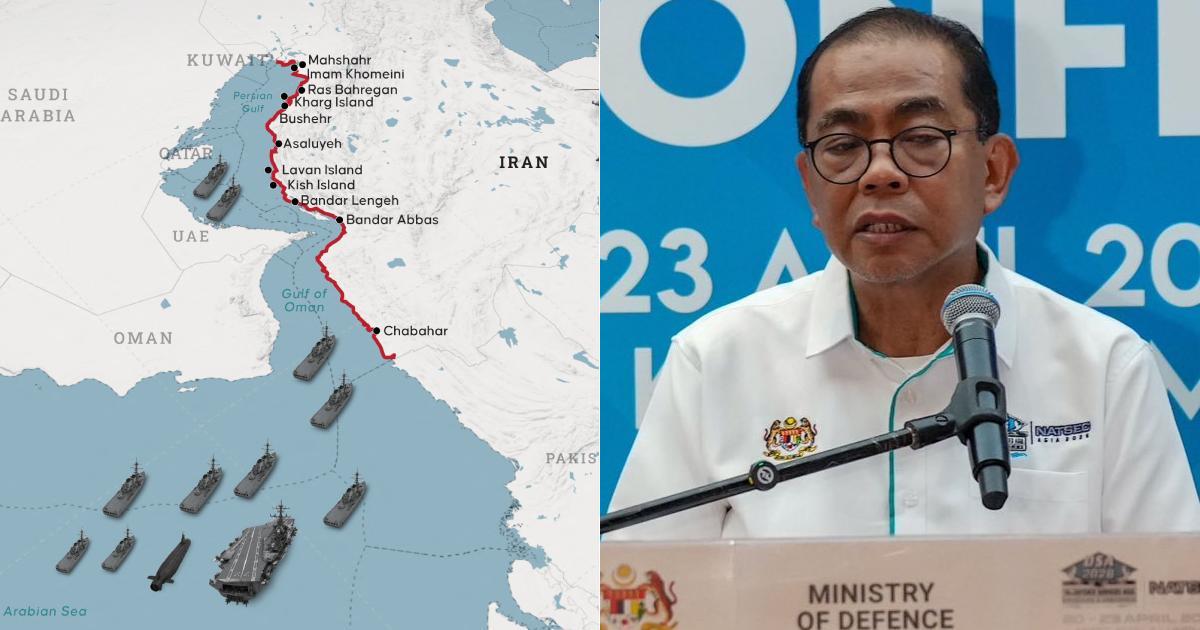
 Cover image via Yasin Demirci/Anadolu/AFP & Khaled Nordin
Follow us on Instagram, TikTok, and WhatsApp for the latest stories and breaking news.
As tensions escalate in the Strait of Hormuz, closer to home, questions are emerging over whether the Strait of Malacca could face a similar disruption
Defence Minister Datuk Seri Mohamed Khaled Nordin has dismissed that possibility outright.
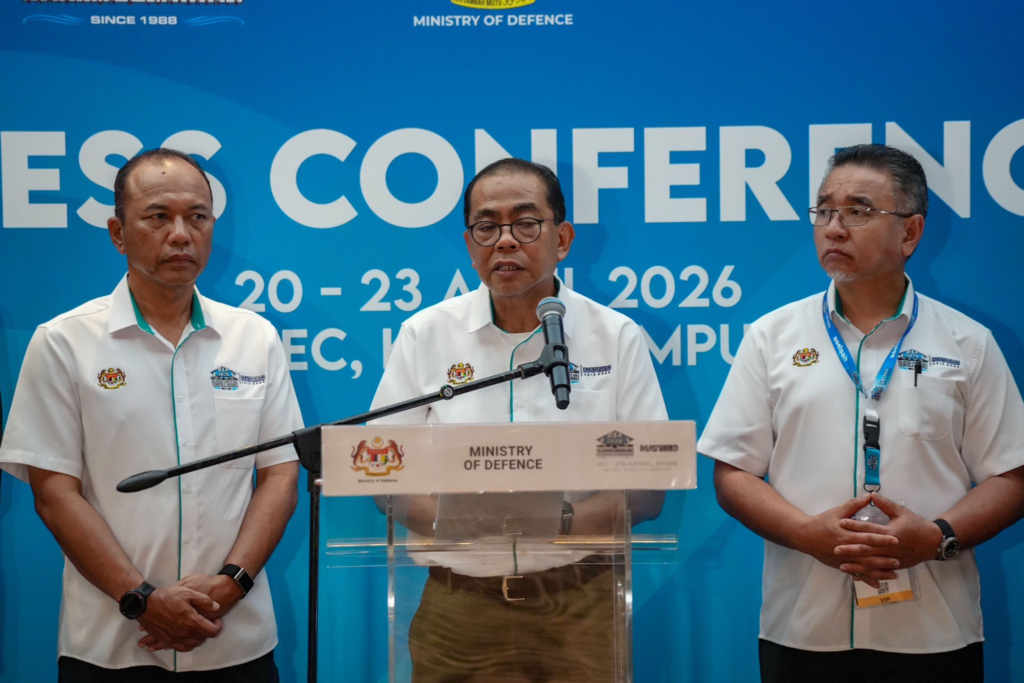
Speaking on 19 April at the Defence Services Asia (DSA) and National Security (Natsec) Asia 2026 exhibition at the Malaysia International Trade and Exhibition Centre, he made it clear that what is unfolding in the Middle East is not a model Southeast Asia would follow.
"What happened in Hormuz is not something to be emulated. We will try as far as possible to ensure that it is not repeated in the Strait of Malacca," he said.
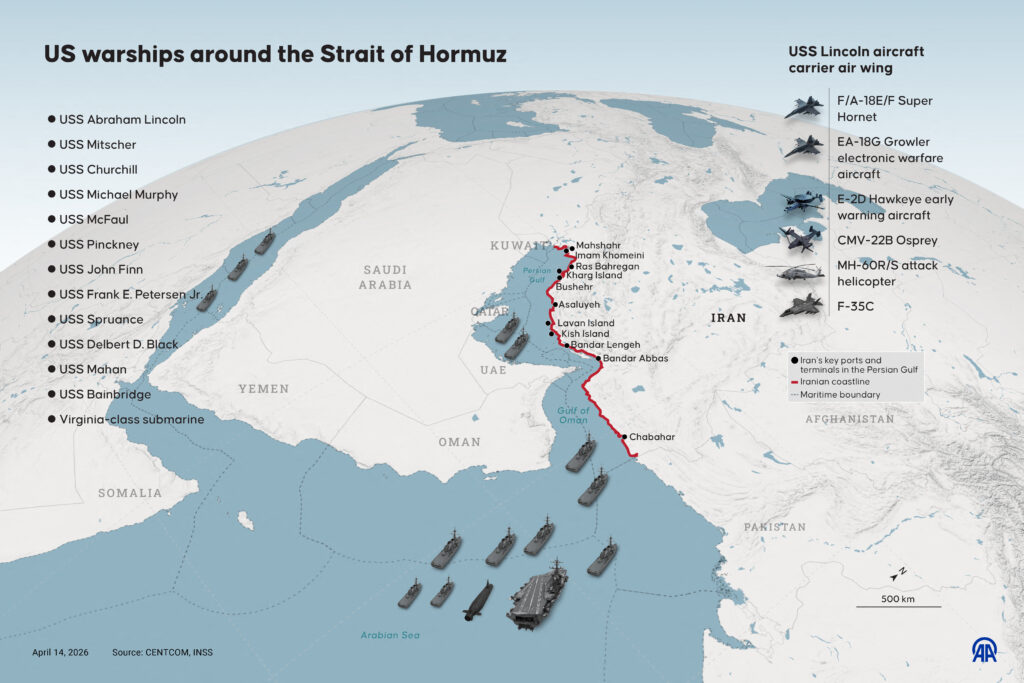
US warships around the Strait of Hormuz.
Image via Yasin Demirci/Anadolu/AFPKhaled argued that drawing parallels between the two waterways overlooks a key point — the underlying conditions are entirely different
Iran's control of the Strait of Hormuz comes against a backdrop of prolonged international sanctions, geopolitical isolation, and an ongoing confrontation with the US. That environment, the minister said, simply does not exist in Southeast Asia.
"What is happening to Iran now is not what it has faced all these years, sanctions and similar pressures. Malaysia, Indonesia, Singapore, we are not facing the same circumstances as Iran," he said.
Because of that, he added, there is no basis to expect the Strait of Malacca to follow a similar trajectory.
Instead, Malaysia and its neighbours, Indonesia and Singapore, operate under a shared commitment to international norms.
"The three countries strongly uphold the principles of the United Nations, including free flow of trade and freedom of navigation in the area," Khaled said.
Beyond immediate comparisons, Khaled framed the stability of the Strait of Malacca as something built over decades, rather than something that requires urgent stabilisation
Malaysia, Indonesia, and Singapore jointly oversee one of the world's busiest shipping routes, with established coordination mechanisms to ensure safety and openness.
"Malaysia, Indonesia and Singapore share the responsibility of ensuring that this route remains safe, stable and open for global trade," he said.
He added that Southeast Asia has historically relied on diplomacy and regional frameworks to manage tensions, a contrast to the more confrontational dynamics currently seen in the Persian Gulf.
Khaled's remarks come at a time when the Strait of Malacca is drawing increased geopolitical attention
Recent developments, including the US-Indonesia Major Defence Cooperation Partnership (MDCP) and reports of a proposed American push for military overflight access through Indonesian airspace, have raised broader questions about regional security dynamics.
While Khaled did not directly address those developments, his comments signal Malaysia's position that the Strait of Malacca operates on cooperation and international law, not power plays or military brinkmanship.
