 Cover image via
 Follow us on Instagram, TikTok, and WhatsApp for the latest stories and breaking news.
You may have noticed that sometimes you have more vaginal discharge, and sometimes less. And that's completely normal.
This is because vaginal discharge naturally changes throughout your menstrual cycle.
In this article, we break down what's normal, what's not, and what these changes can actually tell you about your body.
Whether you're trying to conceive or simply want to better understand your body, learning about your discharge can help you recognise the different phases of your cycle more easily
Most of the time, vaginal discharge is simply cervical mucus.
This fluid helps protect the vagina from infections, keeps the tissue healthy, and clears out old cells. It's mostly made up of water and proteins, and its texture changes throughout your cycle.
These changes are driven by hormones, especially oestrogen.
Typically, cervical mucus goes from thick and sticky (lower oestrogen) to clear and watery (higher oestrogen). Around ovulation, it becomes thinner to help sperm travel more easily. After ovulation, it thickens again to form a barrier.
In general, normal discharge is clear, white, or off-white. Yellow, green, gray, or chunky discharge with a strong odour may indicate an infection.

Types of discharge by cycle phase
(Note: Based on a typical 28-day cycle — your experience may vary.)
- Immediately after period (days 1–5): Discharge is usually minimal, dry, and may be white or yellow-tinged.
- Pre-ovulation/follicular phase (days 6–10): As oestrogen rises, discharge becomes more thick, sticky, and white.
- Ovulation (days 11–14): Discharge becomes abundant, clear, watery, and stretchy — often compared to egg whites. As a reproductive function, this helps sperm move more easily.
- Post-ovulation/luteal phase (days 15–28): Progesterone increases, causing discharge to become thick, sticky, and white again, gradually decreasing before the next period.

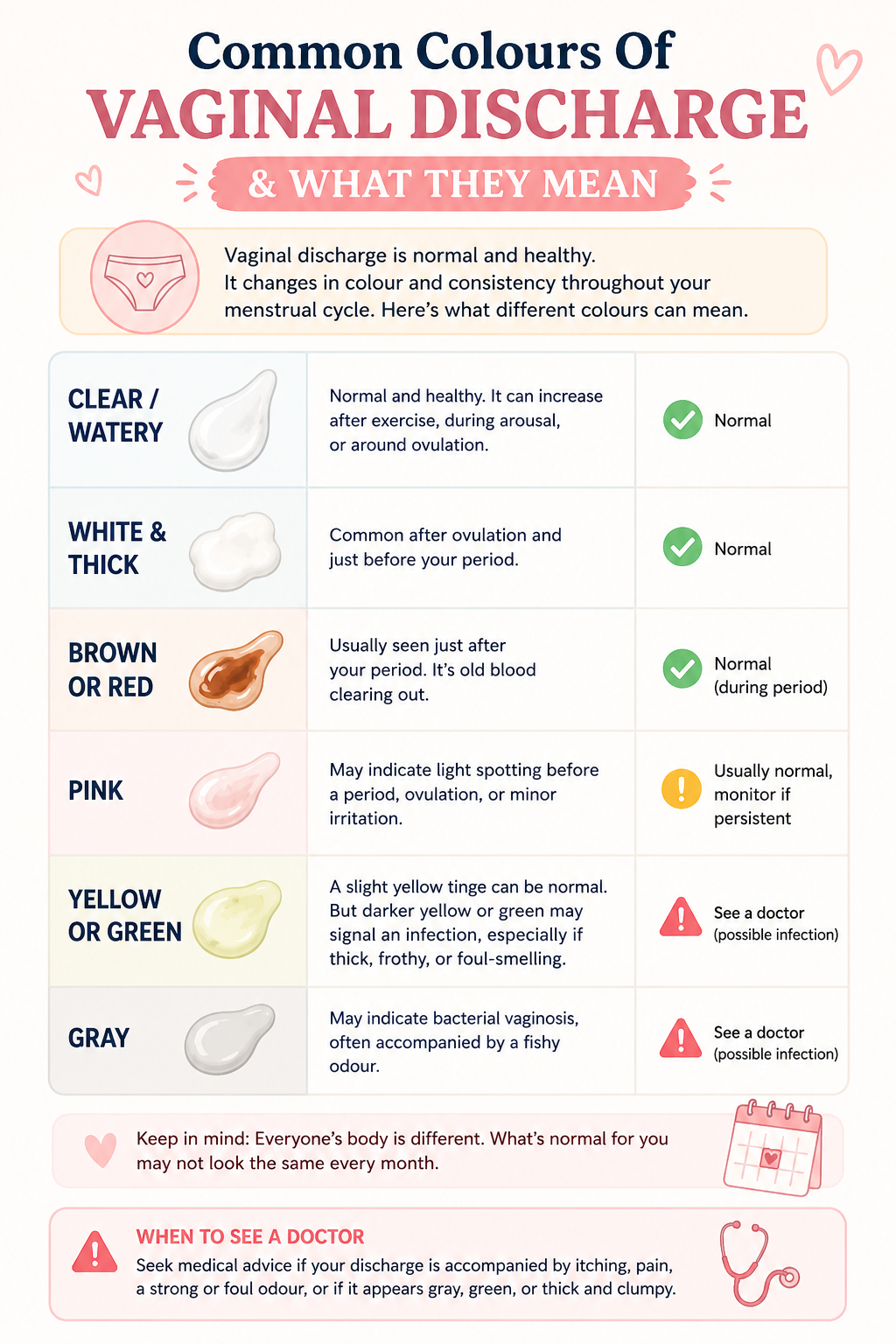
Common colours & meanings
- Clear/watery: Normal, often increases after exercise or during arousal.
- White/thick: Common after ovulation and just before a period.
- Brown or red: Usually seen just after your period (old blood).
- Pink: May indicate light spotting before a period, ovulation, or minor irritation.
- Yellow or green: A light yellow tinge can be normal, but darker yellow or green, especially if also thick, frothy, or foul-smelling, may signal an infection.
- Gray: May indicate bacterial vaginosis, often accompanied by a fishy odour.
When to see a doctor
Seek medical advice if your discharge is accompanied by intense itching, pain, a strong, fishy, or foul odour, or if it is gray, green, or thick and clumpy.
The information provided is for educational and communication purposes only and it should not be construed as personal medical advice. Information published in this article is not intended to replace, supplant or augment a consultation with a health professional regarding the reader's own medical care.
Sources: Cleveland Clinic, Clue, Pantai Hospital
Let's normalise conversations around women's health through education, community, and action
Click here to Just Flow With It.