


 Cover image via
Follow us on Instagram, TikTok, and WhatsApp for the latest stories and breaking news.
Malaysians with a passport can travel to many countries with little to no hassle, and it's something we often take for granted
The Malaysian passport was recently ranked 12th strongest on the Henley Passport Index, placing it on par with the US. Our passport allows holders to enter close to 180 countries without a visa, or at least with a visa-on-arrival or an electronic travel authorisation (ETA).
But what actually makes a passport "powerful"?

Overall, a country's passport is "stronger" if it's built on trust, stability, and technological security
In essence, a passport's "strength" reflects how much trust other governments place in that country's citizens.
Malaysia scores well thanks to its relatively stable politics and balanced foreign policy. For the most part, nations don't see Malaysians as high migration risks. If they think a visitor from a particular country is likely to overstay (or worse, stay indefinitely), then the visitor is far less likely to get visa waivers.
Also, Malaysia has been ahead of the curve with passport security. We were among the first in the world to introduce biometric passports all the way back in 1998, which reassured foreign authorities that our documents are difficult to fake.
And being part of ASEAN, APEC, and the Commonwealth has also boosted confidence in the value of Malaysian passports.
Malaysia's passport has consistently ranked among the global top 20, with indexes often placing it between 15th and 20th
In Asia, only Singapore and Japan have regularly placed higher, while countries like China, India, and Indonesia lag behind due to political restrictions and migration concerns.
However, "visa-free" doesn't always mean a completely open door. For example, Malaysians still require an Electronic System for Travel Authorisation (ESTA) to enter the US or go through the European Travel Information and Authorisation System (ETIAS) to enter Europe.
Another reason Malaysia's passport is so strong is that it got off to a good head start

When Malaysia gained independence in 1957, Commonwealth membership handed us a strong start with travel privileges in the UK, Australia, and Canada.
Then through the Cold War, Malaysia navigated East-West tensions by joining the Non-Aligned Movement (NAM), staying neutral while building trust with both sides.
Additionally, being a founding ASEAN member in 1967 helped make regional travel smoother, while the "Malaysia, Truly Asia" campaign boosted our nation's reputation as a safe, multicultural destination.

Arguably the biggest leap came in 1998, when Malaysia rolled out biometric passports. This security innovation placed us ahead of many developed nations.
By the 2000s, our carefully-handled diplomacy with both Asian and Western powers ensured consistent access and credibility for years to follow.
Beyond that, several other facts continue to strengthen Malaysia's passport:
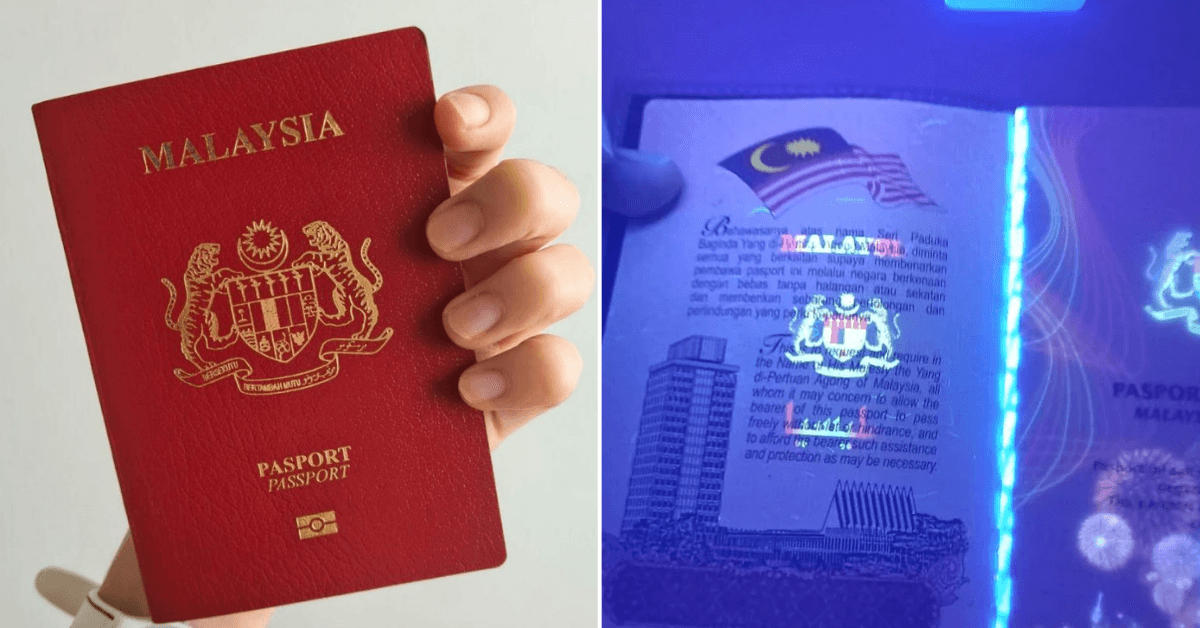
1. Security features: Today, Malaysia's passport is International Civil Aviation Organisation (ICAO)-compliant and packed with features such as encrypted biometric (fingerprint and iris) data and special ultraviolet (UV)-illuminated designs that make forgery extremely difficult.
See what these images look like under a UV light:
2. Positive migration flows: Malaysia is mainly a migrant destination more than a source of mass emigration. Lots of foreign workers come here, but Malaysians themselves aren't leaving en masse.
This reassures other countries that Malaysians are less likely to overstay their visits abroad.
3. Soft power and spending clout: Malaysia's growing middle class means more people are travelling (and spending) on holidays, education, and business. This makes Malaysians economically valuable visitors, encouraging other nations to be more welcoming.

Malaysia's role as a regional education hub and its reputation for tourism hospitality also add an extra layer of soft power that helps our passport stay strong.
In short, Malaysia's passport owes its strength to decades of clever diplomacy, reputation-building, and tech innovation
On a global level, Malaysians can count themselves lucky to visit nearly 180 countries with little to no hassle. And to keep it that way, Malaysia has to continue advancing technology, maintain stable diplomacy, and protect its reputation abroad.
