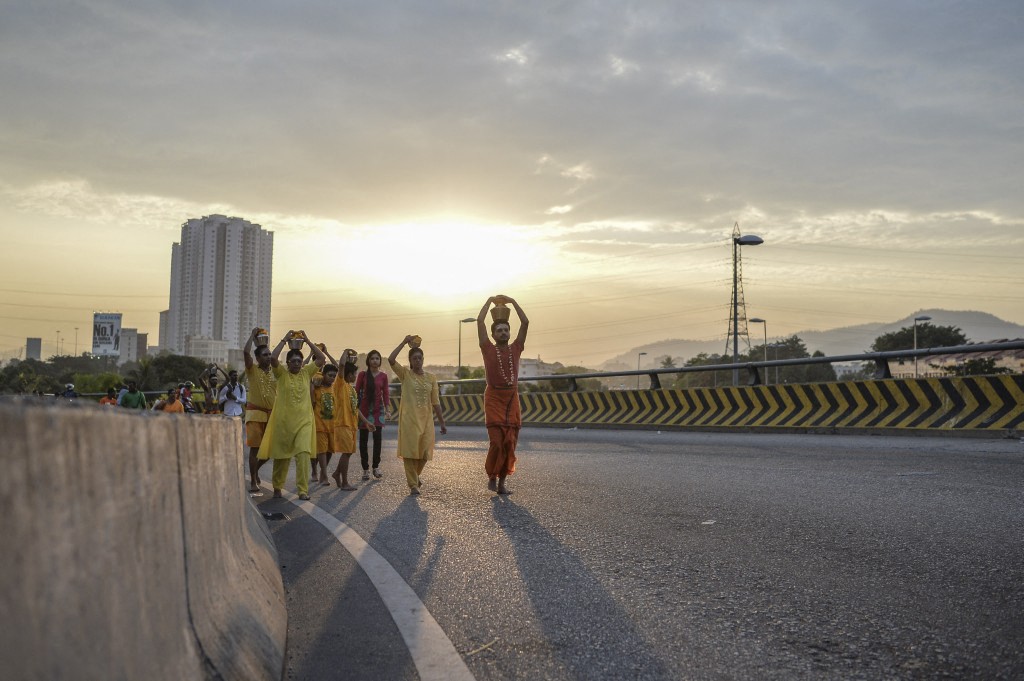
 Cover image via Sadho Ram/SAYS
Follow us on Instagram, TikTok, and WhatsApp for the latest stories and breaking news.
I grew up in a Marwari household in eastern India
My family traces its roots to the Marwar region of Rajasthan, and my early understanding of Hinduism was shaped by that geography and by the eastern part of India in which I was raised. Ours was a faith practised through Rajasthani customs and eastern Indian beliefs. We prayed to Surya, the Sun God, among a number of other deities.
At home, we spoke Marwari, one of the many Rajasthani languages, and outside, I switched easily between Maithili, Hindi, Bengali, and Urdu, picking up languages as if they were hobbies; a common trait when you grow up in that part of the country. I'm very much Indian-from-India in the most literal sense.
Tamil, however, was not a language I heard growing up. And Thaipusam was not a festival I knew existed. Before moving to Malaysia to continue my work with SAYS, it simply wasn't part of my world.
And until I met Navina, a Tamil Malaysian, this entire universe — Lord Murugan, the Vel, chariot walks, kavadi carriers, urumi melams — existed somewhere outside my lived experience.
That changed when I married her.
Being part of my wife's Tamil Malaysian family meant stepping into a culture that I had never encountered growing up in India
In her family, Thaipusam has been celebrated, year after year, from her late grandfather to her retired mother, across generations. Stories of past walks, past vows, and past chariot journeys surface casually, the way other families might talk about old weddings or hometowns.
For me, everything was new. I was an Indian from India, thousands of kilometres from where I grew up, learning about a form of devotion I hadn't encountered before, not in my childhood, not in the temples I knew, not even in the India I came from.
I had heard stories of the Thaipusam walk, but I had never imagined the scene
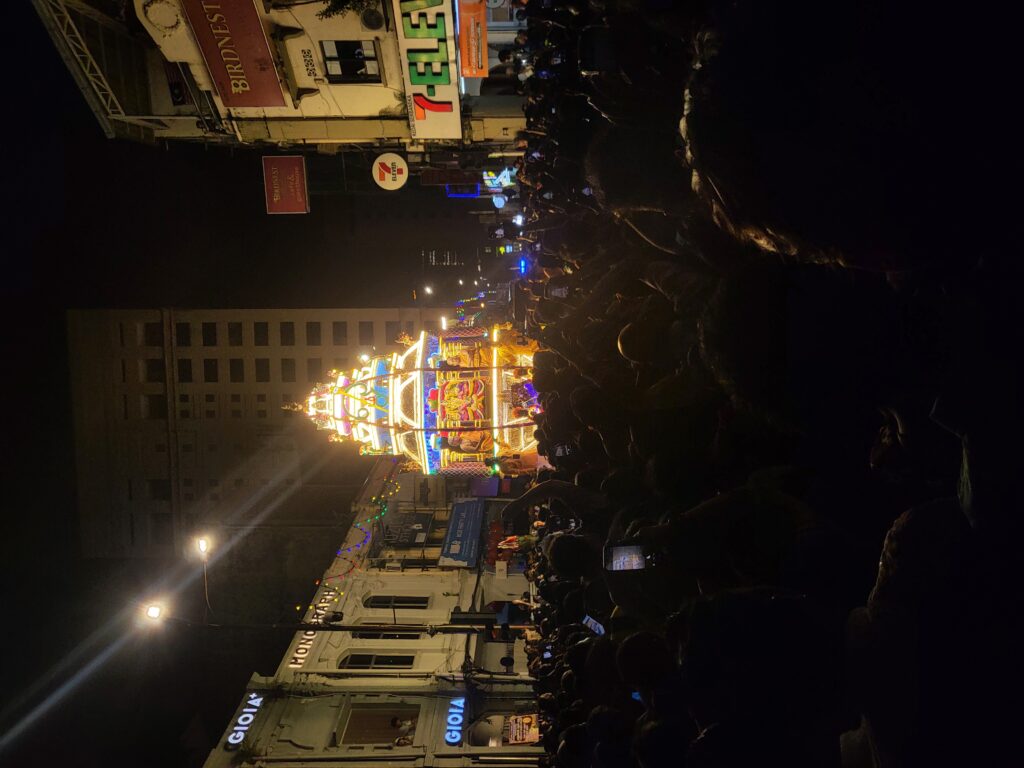
Walking alongside the chariot with my wife, I was struck by how many people emerged for Thaipusam that night. On ordinary days, Indian Malaysians are dispersed, hidden even. At most, they are folded quietly into the city's background, barely noticeable. That night, on 30 January, at the Pasar Seni LRT station, it was different.
As Navina and I stood there, facing the Silver Chariot, gleaming under the night sky, outside the Sri Maha Mariamman Temple, we stood in a sea of people so vast it felt infinite, and neither of us wanted to be anywhere else. Indian Malaysians were everywhere — families, elders, children, first-timers, veterans, and moving together with a common idea. It felt like watching a community reveal itself in full.
What I didn't expect was how much care went into the night. As we slowly walked past the chariot, which was making stops to allow devotees to offer prayers, we noticed how volunteers moved along the route with trash bags, while also guiding traffic to keep the devotees safe. Barefoot devotees making space for one another, others pouring water onto barefoot devotees' feet to soothe them. I noticed how the devotion was in the collective effort to keep the journey clean, orderly, and dignified. No one was hindered. The idea that the path itself mattered seemed deeply ingrained.
Before that night, I had spent weeks reading, asking questions, interviewing people, trying to understand Thaipusam well enough to report on it for SAYS. I knew the meanings, the symbols, the explanations. But walking there, surrounded by Indian Malaysians who had grown up with this, whose parents and grandparents had done the same walk, felt different from learning about it.
Coming from India, where devotion takes countless forms and overwhelms you by sheer variety, I was struck by how rooted this felt. This wasn't a diluted version of something left behind. It was sustained and alive, carried carefully, year after year, by a community that clearly knew why it was still doing this. This wasn't culture being preserved for display. It was culture being lived, in numbers large enough to fill streets and small enough to show up in selfless acts of care. It taught me what devotion looks like when a culture refuses to fade.
I didn't arrive at those realisations during the walk itself
That night, I wasn't analysing anything. I was simply present, walking alongside my wife, swept into a current of people, sound, and intention that had been passed down her community long before I joined it.
When I think back to that night now — as the month of Thai, the 10th month of the Tamil calendar, ends this week — what has stayed with me isn't the distance we covered or the number of hours it took us. It's how quickly the city I thought I knew had disappeared that night.
Kuala Lumpur, as I experience it most days, gave way to something else entirely, a moving corridor of devotion, sound, and care that stretched through the night. Streets that usually belong to vehicles and routine felt transformed, held together by drums, chants, and people moving with a shared purpose.
Along the route, thanneer panthals — refreshment shelters — appeared every few hundred metres, with volunteers handing out water, tea, coffee, and food without asking questions or expecting thanks.
We unexpectedly ran into people we knew, friends, relatives, and former teachers, brief moments exchanged in passing before each of us returned to our walk. Children carried small milk pots. Young men and women bore kavadis, their focus inward, their steps steady.
That night, while the city's asphalt roads tested the limits of a community's faith, no one turned back
They slowed down, took breaks, but didn't give up. And — I would like to believe — we were all rewarded for it when, from a distance, Lord Murugan appeared.
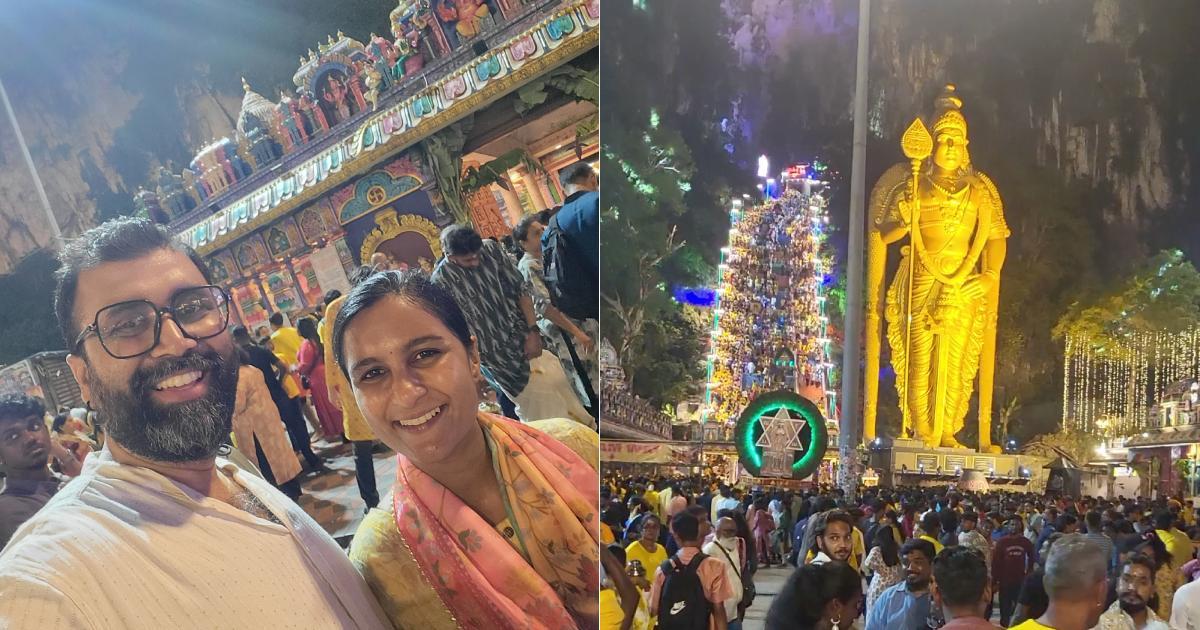
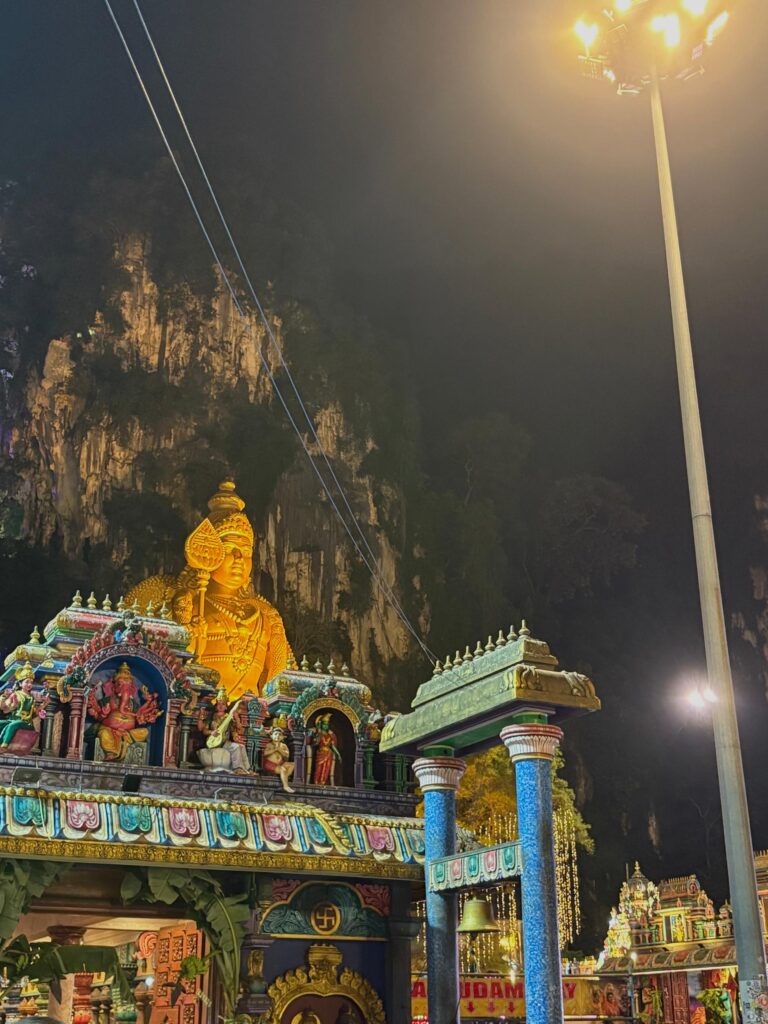
At first, He was only a shape against the night, the familiar outline above the limestone cliffs. But with every step forward, His presence grew. By the time we reached the gates of Batu Caves, He no longer felt part of the landscape. He stood apart from it, towering, magnified, unmistakable.
Whatever weight we had been carrying in our bodies loosened. The ache in our feet, the stiffness in our legs, and the fatigue of the night faded away. Standing there, beneath His feet, we took a simple photo to remember the moment, knowing even then that it would never fully hold what we felt.
Our journey home was silent. The city was still asleep. Streetlights flickered off, and just before dawn, the koel began to call. From the back seat of the cab, it felt as though we were returning from another world, one that exists alongside the everyday but reveals itself only to those willing to walk into it.
What has stayed with me was not the endurance of the walk, but the way devotion expressed itself, in patience, in generosity, in care for strangers, and the idea that no one makes this journey alone.