


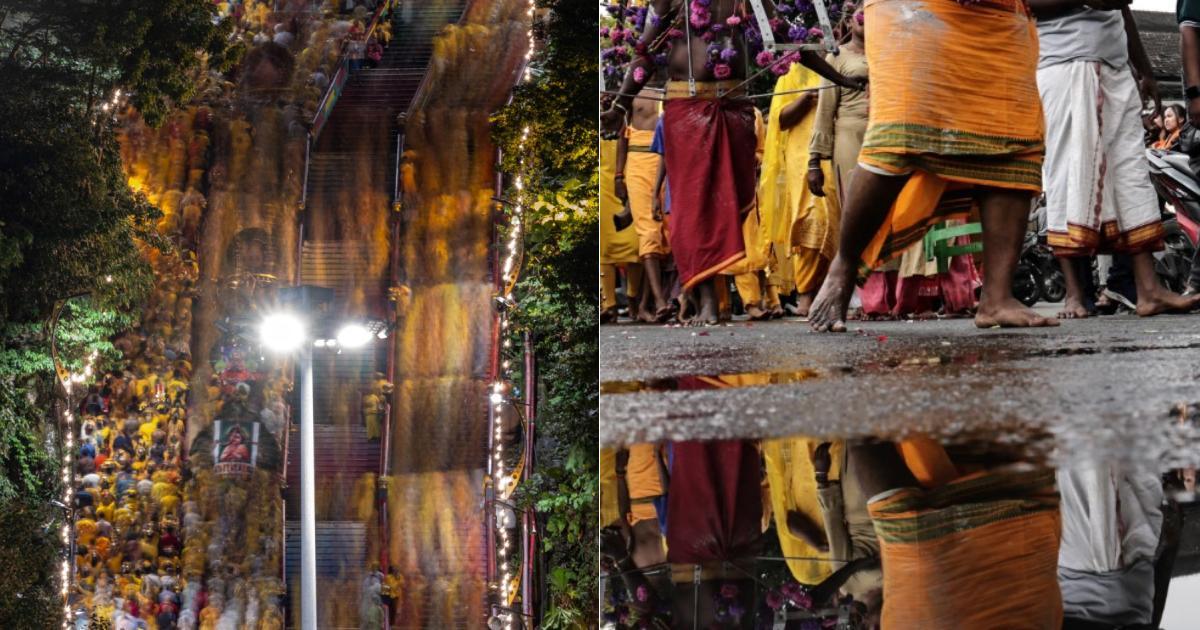
 Cover image via Mohd Rasfan/AFP & YT Hariono/AFP
Follow us on Instagram, TikTok, and WhatsApp for the latest stories and breaking news.
Every Thaipusam, while much of the country is asleep, Malaysia's roads quietly transform. From Kuala Lumpur to Penang, from Johor to Kuantan, ordinary streets turn into pilgrimage routes.
Hundreds of thousands of barefoot devotees walk through the night towards hilltop temples dedicated to Lord Murugan, including Batu Caves, Waterfall Hill, and many others across the country.
Some journeys stretch over 15km, especially the route that starts from Sri Mahamariamman Temple to the Sri Subramaniar Swamy Temple in Batu Caves. Others are shorter, about 9km. All are undertaken barefoot, guided by chants of "Vel Vel", the beat of drums, flickering oil lamps, and the slow procession of temple chariots ahead.
By the time the sky brightens, thousands have already completed a journey measured not just in distance, but in devotion.
This year, more than 2.5 million people are expected at Batu Caves for Thaipusam celebrations, surpassing last year's figures thanks to the long weekend.
For devotees, the walk has never been just a procession or about reaching a temple. It's about vows, a test of endurance, a spiritual offering, faith carried step by step through the night, and a shared cultural experience that returns year after year.
SAYS spoke to several Malaysians, including veteran walkers, casual participants, and a first-timer, to understand the personal significance of the walk.
Manjulaah first walked to Batu Caves when she was 14.
She is now 53, a public school counsellor, and has made the barefoot pilgrimage nearly every year since.
For nearly four decades, she has carried a milk pot on her head, walked barefoot from KL's oldest Hindu temple at the edge of Chinatown on Jalan Bandar, joined the midnight procession, and walked through the dimly lit streets towards Batu Caves.
"Every year, I go to Mariamman Temple, we wait for the prayers, then I follow the chariot," Manjulaah told SAYS during an exclusive interview at her home in Kepong.
She would reach Batu Caves by around 4am.
For years, she has never stopped, even when her health faltered. She recalled a time when her knees were bad enough that most people would have taken a break from the pilgrimage. She refused.
"When I first got sick, I had problems with both my legs. They were swollen for almost two years. But I never stopped. I still walked. I just say 'Muruga Kaapathu' (Murugan, protect me) and the strength comes," she said.
"I feel Lord Muruga never stopped me from walking."
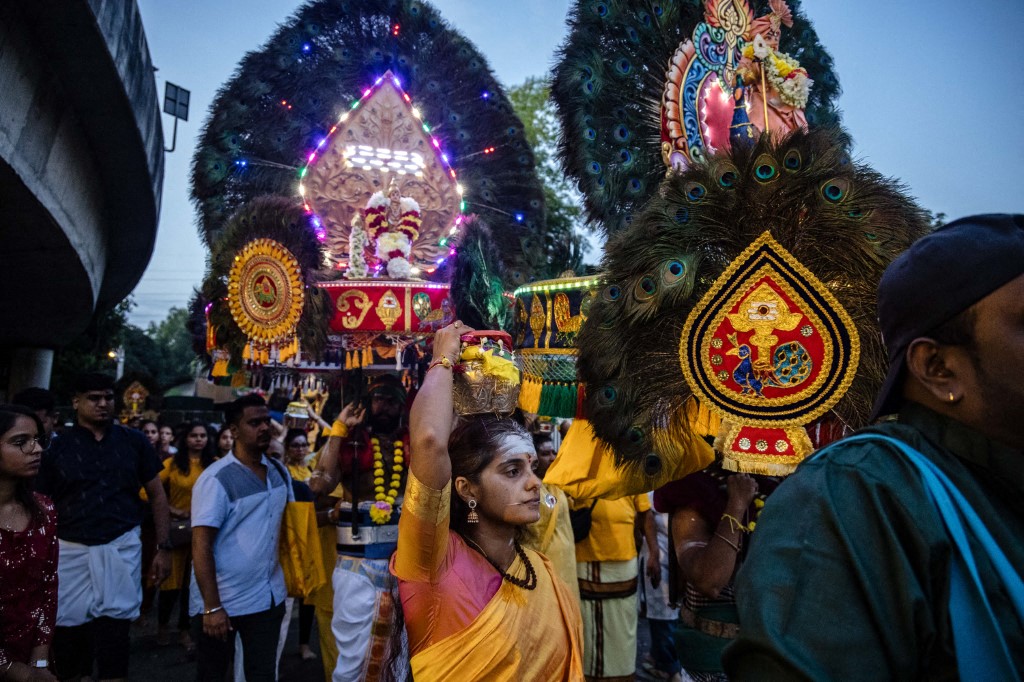
A Malaysian Hindu devotee carries a pot of milk on her head as she makes her way towards the Batu Caves temple during the Thaipusam festival last year.
Image via Mohd Firdaus/NurPhoto/AFPMost years, Manjulaah walks alone, seeking blessings from older women at the temple, asking them to place the milk pot on her head. But one particular year has stayed with her the most.
She and her daughter joined the walk late, exhausted and on the verge of giving up. That's when a stranger appeared, an older woman she had never met before, walking beside them.
"When I stop, she stops. When I walk, she walks," Manjulaah shared.
"I told her I'm very tired, maybe I will stop. But she said, 'No, we walk, we walk.'"
The older woman followed Manjulaah and her daughter all the way up the steps of Batu Caves. Inside the hill temple, she began singing Murugan hymns.
"This was the first time I was singing the Tevaram — Tamil Shaiva devotional poetry — inside the temple," Manjulaah said, tears welling in her eyes.
"I felt very happy. I don't know who she was, but to me, she was nothing short of a divine intervention."
When asked how it felt to finally reach Batu Caves after the long walk, Manjulaah did not hesitate.
"I felt blessed."
She describes the walk as a ritual, a journey of spiritual discipline, and not simply a physical act.
"For us, it's a holy walk. Everybody has their own intention to walk. I walk because I want to say thanks to my God. "It's not susahkan diri sendiri [about making life hard for myself]. It's something I can do for my God."
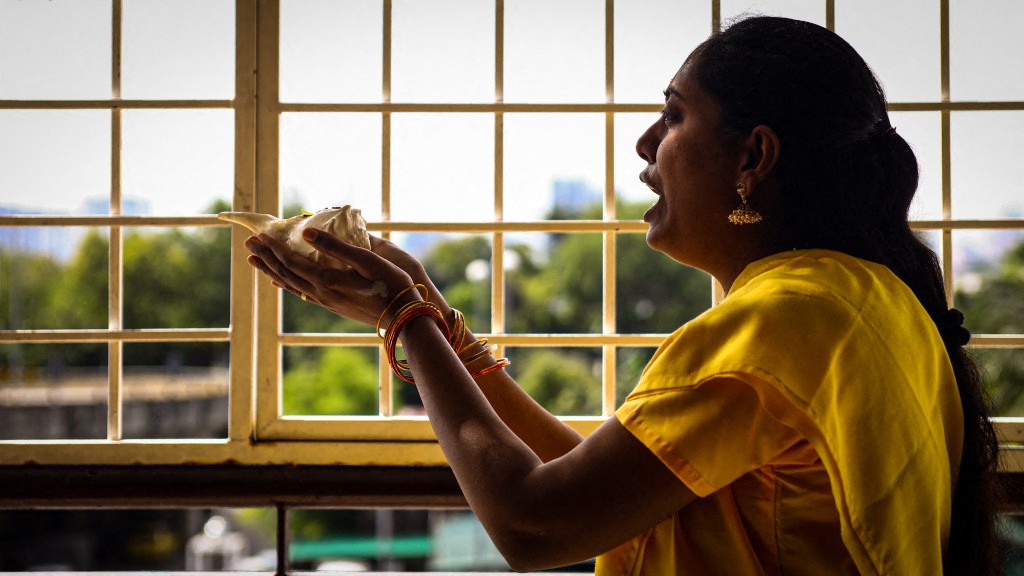
A devotee, Vicneswari Ramasamy, performs prayer in her house in Batu Caves for Thaipusam.
Image via Syaiful Redzuan/Anadolu Agency/AFPKalbana Perimbanayagam, a senior journalist, has walked alongside the Thaipusam chariot at least five times over the last two decades.
Each journey, she told SAYS, has been a lesson in patience, humility, and focus.
While the walk from Sri Mahamariamman Temple to Batu Caves is about 15km, "some stretches along the way have shortcuts," she explained.
On one occasion, she and a childhood friend noticed the chariot slowing near Jalan Ipoh for the bullocks to be changed and ritual stops. Following behind would have meant arriving at noon under the punishing sun, so they chose to overtake the procession instead.
Kalbana told us that she carries a medium-sized milk pot kavadi — which literally translates to burden in Tamil — when she walks, a personal act of devotion and penance.
"Walking barefoot keeps you grounded," she shared.
"It reminds you that devotion isn't about showing off or dressing up lavishly… It's the small sacrifices we're willing to make."
The toughest stretch, she recalls, is always the last, when fatigue sets in, and the crowd thickens.
"In the beginning, you feel the pain. But after a while, you enter a kind of zone, not a trance", she explains, describing it as a "deep concentration".
"The chants and rhythm help you move past the discomfort."
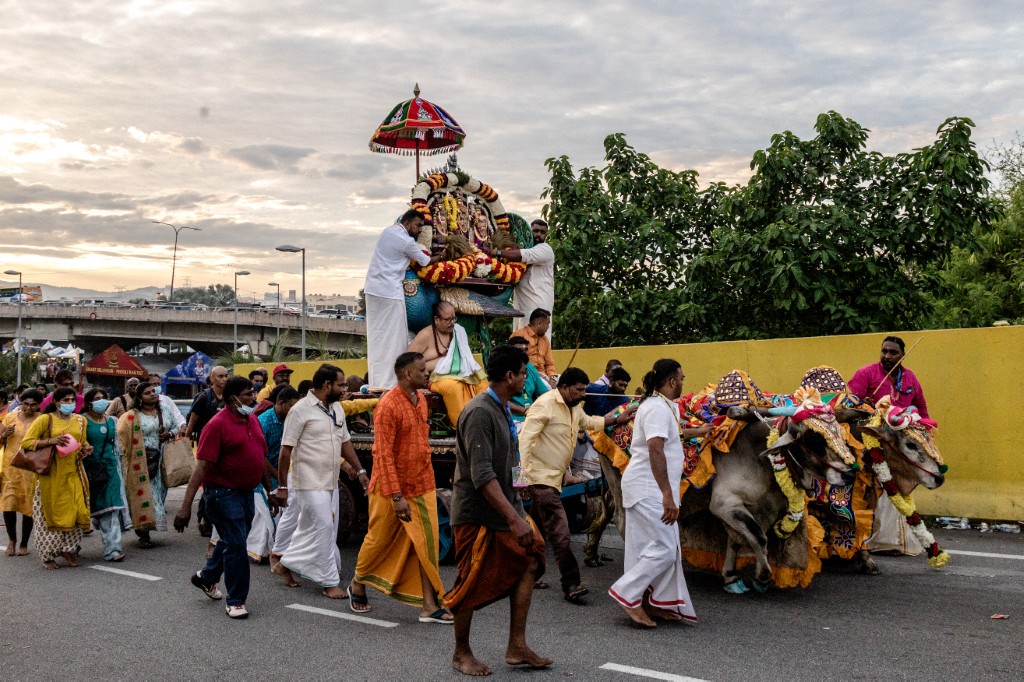
Hindu devotees are seen carrying a kavadi with cows during the Thaipusam festival.
Image via Mohd Firdaus/NurPhoto/AFPUnlike some devotees, Kalbana doesn't do the full 48-day fast, though she observes a seven-day fast before Thaipusam
"The fast changes everything. By Thaipusam, the body feels lighter and more disciplined, and the walk becomes less about physical endurance and more about mental focus and faith," she explained.
Describing the barefoot walk, Kalbana said it's a reminder of discipline, gratitude, and faith, and a way to put everyday struggles into perspective.
Over the years, she's also formed lasting friendships with others walking alongside the chariot, bonds that extend far beyond the festival itself.
Her advice to anyone preparing for the walk is simple.
"Prepare your mind before your body. Don't compare your journey with others. Walk at your own pace, stay sincere, and respect your limits and those walking with you."
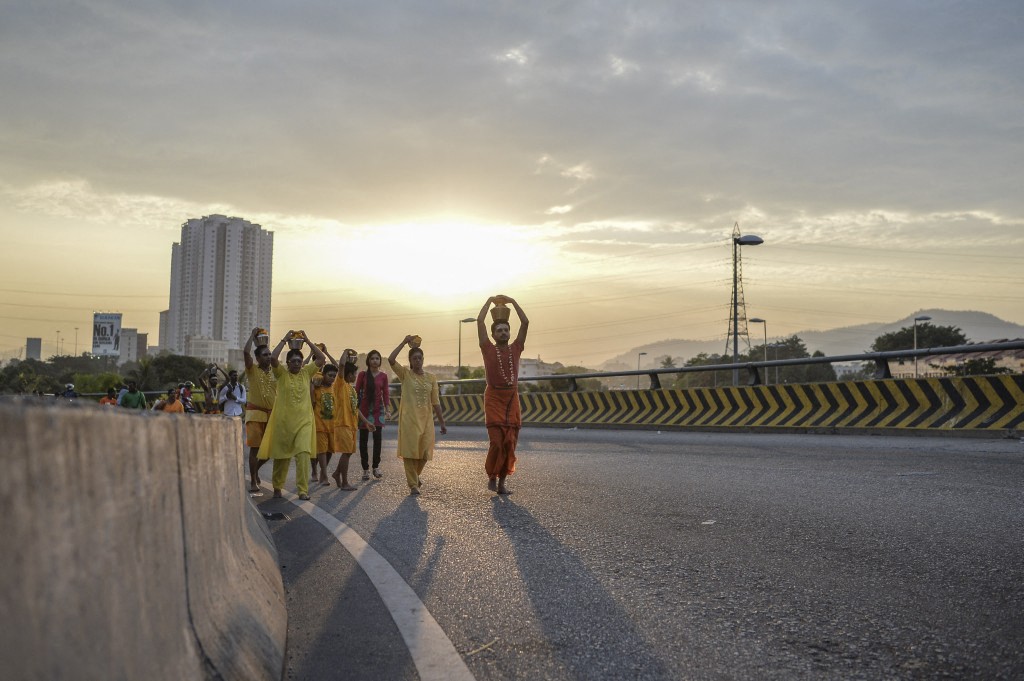
Hindu devotees carrying milk pots on their heads as they walk to the sacred Batu Caves temple.
Image via Mohd Firdaus/NurPhoto/AFPShanta, a former school teacher in KL, didn't grow up walking the Thaipusam procession
Her parents, she said, simply didn't allow her to walk when she was a child. Instead, she would tag along with her brothers on Thaipusam day, going to Batu Caves to watch the celebrations from the sidelines.
Her father, however, was a different story.
He not only carried the kavadi, but also observed strict fasting over 48 days, and led groups of devotees along the path.
"He was the one who used to pierce other kavadi carriers and then apply the vibhuti — holy ash."
It wasn't until decades later, in her late forties, that Shanta began the barefoot walk herself. Her first walk was a personal decision; a decision that would eventually turn into discipline that her father exemplified, the devotion he inspired.
Now, retired from decades of teaching primary school pupils, she has quietly become one of the hundreds of thousands of steady, familiar figures moving through the night towards Batu Caves each Thaipusam.
She estimated that the walk usually takes her about six hours. She doesn't follow the chariot all the way. Instead, she waits for the moment Lord Muruga is placed on the chariot, because that's when she feels the energy of the night shift. Once the chariot begins moving, she walks for a short while beside it, then continues forward on her own.
Most years, she walks alone. Not lonely, though; memories of her father's unwavering faith keep her company, along with the massive crowd that becomes a kind of moving shelter — a temporary refuge of shared faith and purpose, she told SAYS.
She has also never forced her body past its limit, explaining that she doesn't want to "keep going until I fall".
"Lord Muruga is there to bring you to his footsteps. But you must also take care of yourself," she advises first-timers looking to endure the journey this year.
For Shanta, the reasons for walking are layered
To seek blessings. To give thanks for protection. To fulfil her vows.
But above all, to witness that charged moment when the deity is lifted onto the chariot, a feeling she struggles to put into words, something she said that could only be understood by being there, in the crowd, in that moment, in the devotion.
According to her, each time she has walked, the sounds of the drums and the devotional songs — especially the rhythmic cry of "Vel Vel" — have carried her forward.
Shanta has felt, what she described, an ethereal connection with the total strangers who have walked beside her. She didn't know their names. They didn't know hers. But when someone chanted "Vel Vel", she joined in, not just for herself, but because she knew it helped others push past their fatigue.
The chants, she shared, move through the crowd like a current, making devotees forget their pain and burden — both physical and emotional, keeping them going. She loves this part most: the togetherness of the community.
"You don't care about caste or creed," she told us.
"Everybody walks with the same purpose — to finish the task and reach up there."
However, for Shanta, the walk isn't only about discipline or endurance; it's also about belief — a deep, unshakeable, lived belief
She remembered one Thaipusam night when she brought her four young children to Batu Caves. After finishing their prayers, she drove out at 2am, only to find her car trapped in a sea of devotees. People flowed endlessly in front of her headlights. She didn't know what to do.
Then, she said, she saw a tall figure, wearing a veshti — a traditional, unstitched lower-body garment for men — appearing to emerge beside one of the flyover pillars. The figure walked in front of her car. And suddenly, the crowd parted just enough for her to drive through and reach the highway.
She never forgot that encounter. Some might call it her imagination, she said, but for her, it was Lord Muruga answering her prayers in a moment of absolute helplessness.
Another time, after a motorcyclist crashed into her car near Batu Caves and a group of young men surrounded her vehicle, kicking it and demanding she come out, she looked up at the giant statue of Muruga and silently asked for help. Within moments, she said, a group of strangers appeared, asked what happened, and stood between her and the aggressors until the danger passed. Then, they disappeared just as quickly.
She didn't know their names. She didn't know where they came from. But in her mind, the answer was simple.
"If you sincerely go with the right intention, God will help in one way or another."
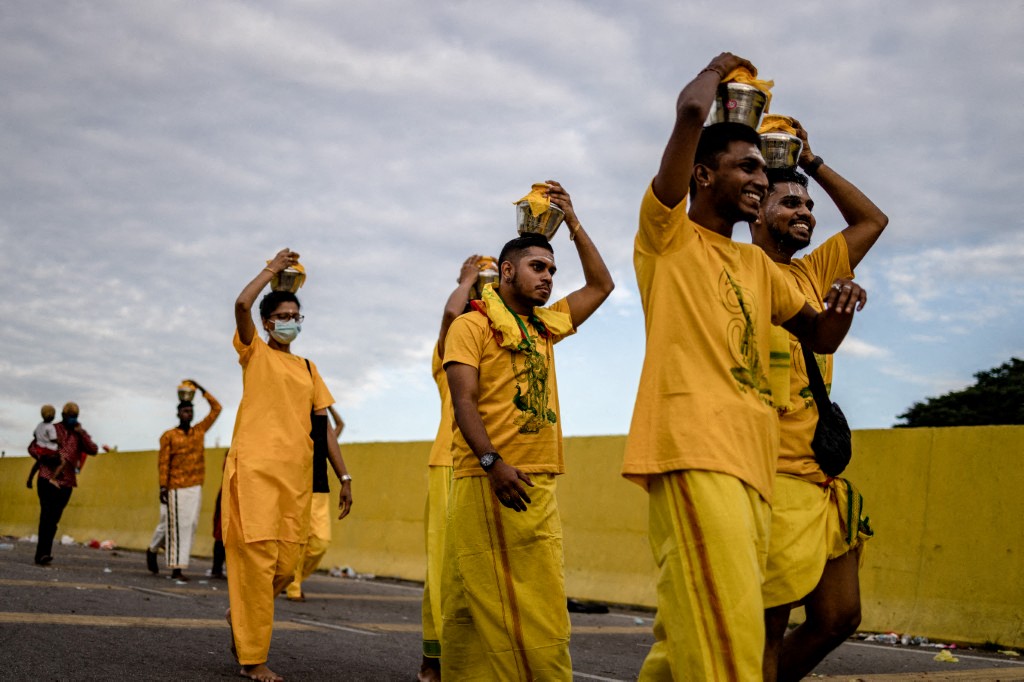
Hindu devotees carrying milk pots.
Image via Mohd Firdaus/NurPhoto/AFPBy the time she has reaches Batu Caves each year, tired but upright, she feels something many like her have experienced: a blend of exhaustion, faith, gratitude, and quiet triumph
According to Shanta, she has never argued religion with anyone. It is, afterall, a deeply personal practice. She simply walks her own path, year after year, surrounded by strangers who, for one night, are family.
And for those who don't understand why anyone would walk barefoot through the night, she has only one answer.
"This walk is splendid. Mind-blowing even. But nobody can be forced to understand. Whoever wants to walk will discover the beauty in it. Whoever doesn't — that is their path."
Through her stories, it becomes clear: Thaipusam is as much about personal connection and devotion as it is about following tradition.
For Shanta, her father's legacy wasn't just in the rituals he practised, but in the quiet, steady faith that she has carried along the same paths he once did. And now, her eldest daughter plans to carry on with her husband.
Satya Seelan's walk belonged to another time. He had been a schoolboy then, more than twenty years ago, when nights were long, and responsibilities were few.
He and his friends left the Sri Mahamariamman Temple after midnight, following the chariot through KL's sleeping streets. By the time Batu Caves appeared ahead of them, the sky had begun to brighten. They reached the temple at sunrise, barefoot, tired but satisfied.
He said the walk had felt more fun than tough.
He had fasted for a week before the walk. When asked if the journey had brought him into a spiritual state, he answered plainly: No.
He had walked because it was something he wanted to do for God. When he finally stood at Batu Caves, he felt fulfilled. He had completed what he set out to do.
He never did the walk again. School days gave way to work, commitments, and adult life. The memory remained, tied to a younger version of himself who had the time to walk through the night and greet the sunrise at the temple steps.
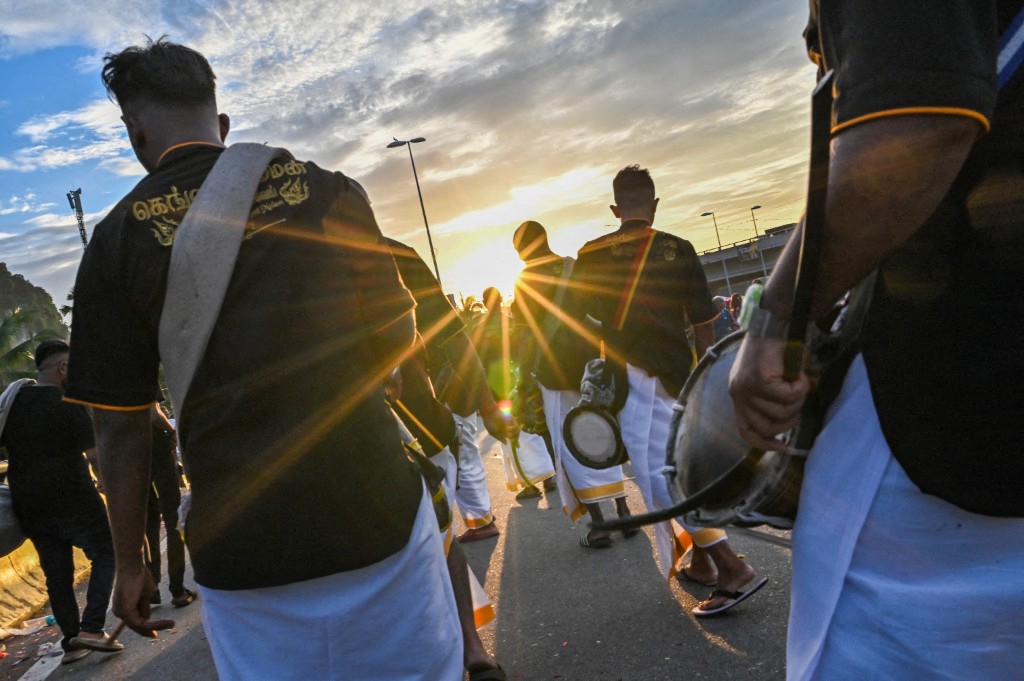
An Indian traditional percussion group performs during the Thaipusam celebration in Kuala Lumpur.
Image via Zahim Mohd/NurPhoto/AFPTwo decades later, several young Malaysian Hindus are now preparing to take that same road for the first time
Kitna, 27, is one such devotee.
She has attended the Thaipusam celebrations once, just to experience the atmosphere. This year, though, she has decided she would finally join the procession, walking with her boyfriend and family members.
Her reasons for walking are different.
She wants to understand why people keep returning to this walk, year after year. She wants to experience the "vibe", as she put it. And yes, she admitted with a laugh, she also wanted to make content.
In the weeks leading up to Thaipusam, she has prepared in small, practical ways, making sure she walks 10,000 steps every day. The distance from the edge of Chinatown to the limestone caves in Gombak would be the longest she has ever attempted.
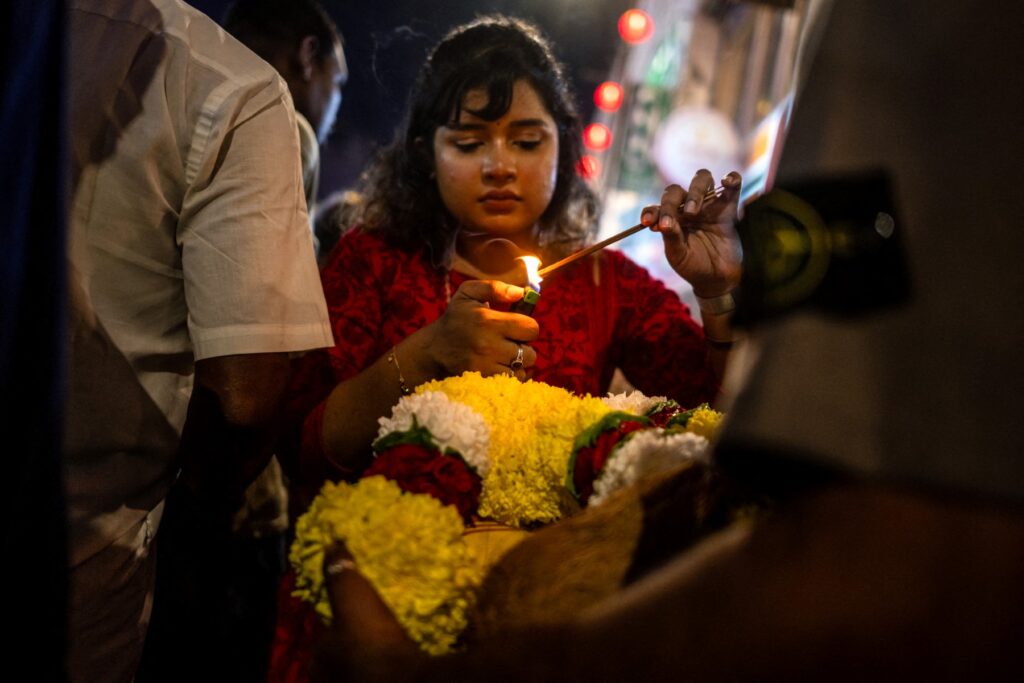
This picture, taken on 23 January, 2024, shows a Hindu devotee lighting up incenses as she prepares to make offerings in front of Lord Muruga's silver chariot, pulled towards the Batu Caves temple on the eve of the Thaipusam Festival.
Image via Mohd Rasfan/AFPBy the time the chariot reaches the temple steps, the reasons for walking often matter less than the act itself
As it has become clear from the stories, some come seeking healing, some come to fulfil vows, and some for tradition, curiosity, or simply because their parents once did the same. Along the road, distinctions blur. First-timers fall into step beside veterans. Teenagers walk beside grandparents. Strangers share water, food, encouragement, and a deep understanding that sustains beyond the period.
The barefoot walk is not only about endurance or devotion. It is also about belonging to a faith, to a community, to a shared experience that returns every year.
For some, the journey ends in memory. For others, it is just beginning. But every Thaipusam, across Kuala Lumpur, Penang, and towns throughout Malaysia, the roads fill again, and the walk continues.
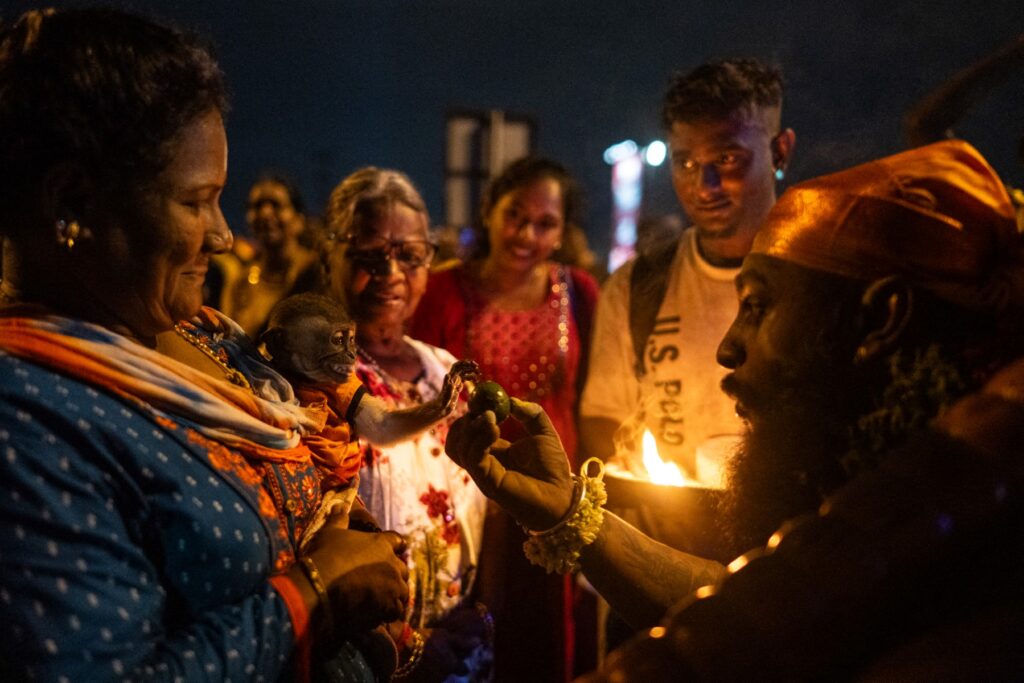
This picture, taken on 24 January 2024, shows a Hindu devotee giving a fruit to a pet monkey as he makes his way towards the Batu Caves temple to make offerings during Thaipusam.
Image via Mohd Rasfan/AFP