


 Cover image via
 Follow us on Instagram, TikTok, and WhatsApp for the latest stories and breaking news.
FIFA's disciplinary committee has now officially revealed that the Football Association of Malaysia (FAM) used forged documents to register seven foreign-born players as eligible Malaysians
This has resulted in a RM1.9 million fine, a year-long ban on the seven players, and the potential overturning of key Asian Cup qualifying wins.
The full FIFA report, made public yesterday, 6 October, detailed a paper trail involving forged documents, fast-tracked citizenships, and administrative "errors" that led to seven foreign-born footballers playing for Malaysia in a crucial Asian Cup qualifier.
All seven players — Gabriel Felipe Arrocha, Facundo Tomás Garcés, Rodrigo Julián Holgado, Imanol Javier Machuca, João Vitor Brandão Figueiredo, Jon Irazábal Iraurgui, and Héctor Alejandro Hevel Serrano — featured in Malaysia's 4–0 win over Vietnam on 10 June 2025.
Just days earlier, most of them had received Malaysian citizenship through what was promoted as the country's "heritage player" — or naturalisation — pathway.
Weeks after that match, FIFA received a complaint, triggering a full disciplinary investigation.
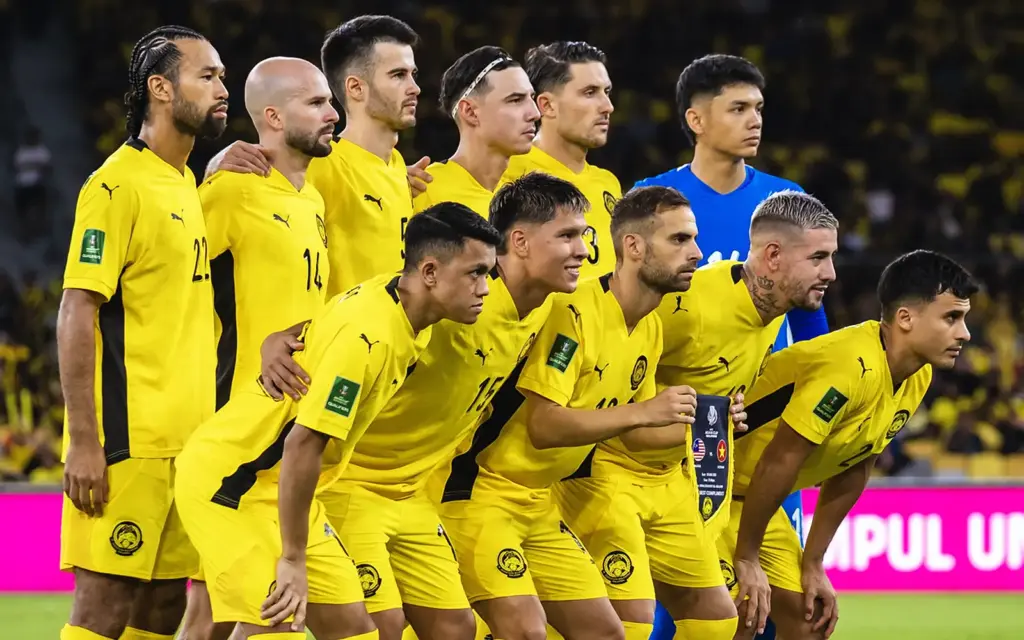
The naturalisation push had been hailed as a breakthrough strategy to boost the Malaysian football team's performance
Several foreign players were granted Malaysian citizenship within weeks of their first call-ups, based on claimed ancestral ties to Malaysia through grandparents.
For example, Facundo Tomás Garcés received his citizenship on 2 June this year — barely eight days before his debut against Vietnam — while Rodrigo Julián Holgado's papers were finalised on 4 June. Others, like Gabriel Felipe Arrocha, had been processed earlier in March, as detailed by FIFA's report.
On paper, these players were presented as Malaysians by descent, but FIFA says some of the supporting records were tampered with.

According to FIFA's disciplinary committee, FAM submitted doctored documents to get the green light for these players to represent Malaysia
The deputy chairperson of the FIFA disciplinary committee concluded that the documents submitted in seven separate player eligibility cases contained falsified birthplaces and other altered information.
The case centred on birth certificates and supporting documents that claimed the players' grandparents were born in Malaysia — claims that were later contradicted by the original civil records obtained by FIFA.
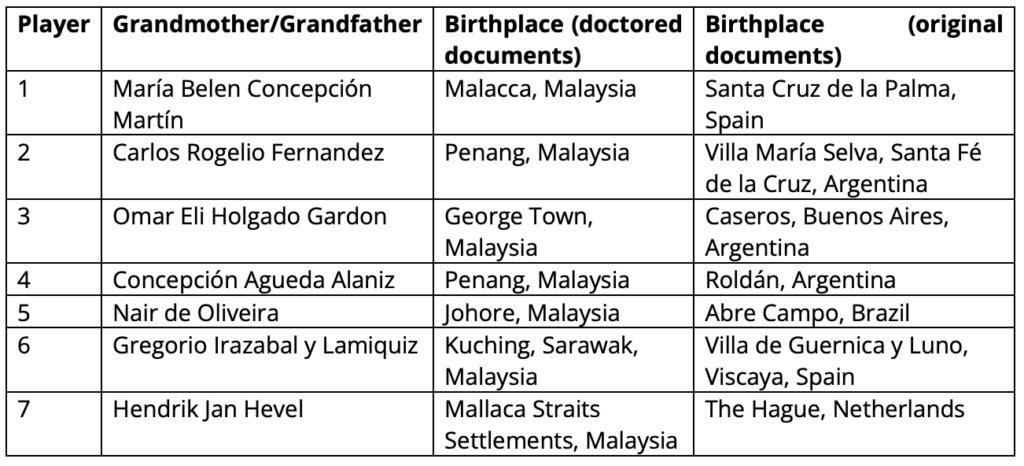
FIFA's final report includes a table showing the birthplaces listed on the documents FAM filed versus the birthplaces shown on the original birth certificates gathered by FIFA's Secretariat.
"The documents provided for these seven players were inconsistent with official records and raised significant authenticity concerns," the Secretariat noted in its findings.
"FAM must take responsibility for lapses in document verification, which allowed ineligible players to participate in official competitions," the Committee concluded.
According to the committee, FAM and the seven named players are responsible under Article 22 (forgery and falsification) of the FIFA Disciplinary Code.
According to FIFA, the fraudulent registrations followed a similar pattern
The case revolves around the "grandmother/grandfather rule," a provision in FIFA statutes that allows players to represent a country if they have a biological grandparent born there.
Between March and June 2025, FAM submitted inquiries to FIFA for each of the seven players, seeking confirmation of their eligibility to play for Malaysia.

To support these applications, FAM provided what appeared to be official birth certificates for the players' grandparents, claiming they were born in various Malaysian locations, including Melaka, Penang, and Sarawak.
The side-by-side comparison shows how each player had a false Malaysian birthplace listed to replace their grandparents' true place of birth in Europe or South America.
In its defence, FAM and the players claimed they were unwitting participants who had acted in good faith
They argued they were never aware that the documents might have been falsified and played no role in their preparation.
Their core argument was that they had relied on the Malaysian government's own verification processes and that the violation was "merely formal in nature" since the players were, after all, legal Malaysian citizens.
However, FIFA's disciplinary committee was unconvinced.
FIFA pointed out that its own investigators obtained the real documents "without hindrance", a fact that proved FAM and the players "did not exercise the necessary level of scrutiny or care".
Next, FIFA highlighted an admission from the National Registration Department (JPN), which FAM itself had submitted as evidence.
The JPN confirmed it never received the original birth certificates.
Instead, it had issued its own copies based on "the evidence adduced that a birth had occurred" and "secondary information and foreign documents" from Argentina, Brazil, and Spain.
The FIFA committee flatly rejected the notion that this issue was a mere "technicality"
The use of forged documents, FIFA ruled, was the "decisive factor in the [seven] players' eligibility" and had a direct impact on the integrity of the match they played in, in which all seven featured and two scored goals.
The committee stated that presenting fraudulent documentation to gain an advantage strikes at the core principles of fair play. In FIFA's own words, "pure and simple, a form of cheating, which cannot in any way be condoned".
FIFA also clarified that it never gave FAM a definitive green light.
Its earlier letters had cautiously stated the players only "appeared to be eligible" based on the information FAM had provided at the time.
FAM and the seven players have 30 days from notification to pay their fines. The 12-month suspensions take effect immediately from the date of notification. Any appeal would be handled by FIFA's Appeal Committee according to standard procedures.
FAM has since confirmed it will appeal the decision and invoked the Official Secrets Act (OSA) 1972 to protect its evidence from public view
In a statement released earlier today, 7 October, the national football body confirmed it has received FIFA's full written judgment and will immediately file a formal appeal through the proper legal channels.
FAM stated that all its supporting documents and evidence are complete and ready for submission.
Crucially, FAM is taking full responsibility for the administrative process while defending the players' intentions.
According to FAM, the players relied entirely on the verification and registration process that was "prepared, verified, and fully managed by FAM".
It strongly disputes FIFA's conclusion that the players knowingly "obtained falsified documents" or tried to circumvent eligibility rules.
FAM contends that FIFA's portrayal of the events is "inaccurate and unfair" and insists that FIFA has not presented any evidence to support its claims of deliberate forgery by the players.
Meanwhile, FAM has stated that it is legally bound by Malaysia's OSA and the Passports Act 1966, preventing it from publicly disclosing key evidence.
The association claims the case involves "official information regarding the Government of Malaysia's procedures for the issuance and verification of passports".
Due to these laws, FAM says any unauthorised disclosure is strictly prohibited, and it is "legally bound to maintain confidentiality".
As such, FAM will only share this information directly with FIFA during the appeal process.
