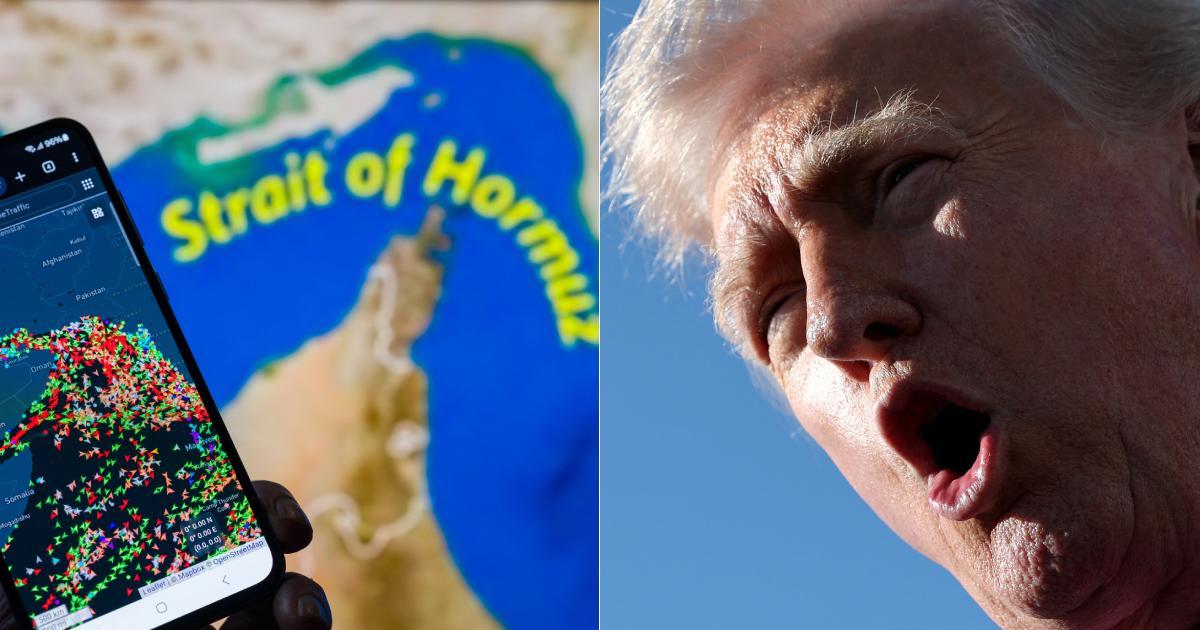
 Cover image via Jonathan Raa/NurPhoto/AFP & Win McNamee/Getty Images/AFP
Follow us on Instagram, TikTok, and WhatsApp for the latest stories and breaking news.
The Strait of Hormuz is a narrow strip of water, just 34km wide at its tightest point, sitting between Iran and Oman
It doesn't look like much on a map, but roughly one-fifth of the world's oil and liquefied natural gas passes through it every day.
For weeks, Iran has been restricting passage. Now the US has imposed its own blockade, and the fallout is being felt from Brussels to Bursa Malaysia.
Here's what's happening, who's on which side, and why it matters for us.
How did we get here?
The conflict didn't start at the Strait.
On 28 February, the US and Israel launched coordinated strikes on Iran under what has since been called Operation Epic Fury, targeting military facilities, nuclear sites, leadership, and civilian infrastructure. Iran retaliated, and then effectively shut down the Strait of Hormuz, choking off one of the world's most critical energy corridors and sending oil prices skyrocketing by around 50%.
A temporary "ceasefire" was reached in early April, with the understanding that Iran would reopen the Strait. It didn't happen.
Instead, Tehran began controlling traffic through the waterway and charging vessels tolls of over USD1 million per crossing, a move US President Donald Trump described as an "illegal toll".
A last-ditch round of talks was brokered through Pakistan, with US Vice President JD Vance leading the American delegation. After more than 21 hours of negotiations in Islamabad, the talks collapsed on 12 April.
The central sticking point: Iran's nuclear programme.
The US demanded Iran surrender its enriched uranium and commit to never developing a nuclear weapon. Tehran refused.
Hours later, Trump announced the blockade.
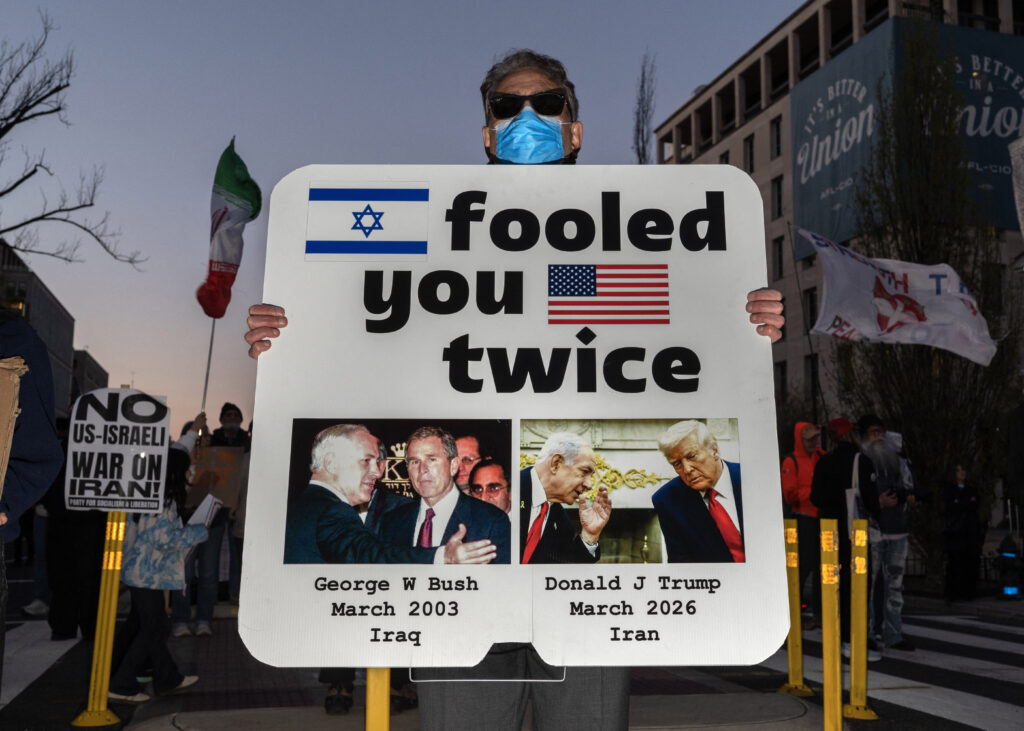
Demonstrators carrying anti-war signs gather outside the White House in Washington, DC.
Image via Probal Rashid/NurPhoto/AFPWhat exactly is the blockade?
On 13 April, the US Central Command (CENTCOM) began enforcing a blockade on all ships entering or exiting Iranian ports and coastal areas, covering both the Arabian Gulf and Gulf of Oman sides.
Crucially, CENTCOM clarified that vessels transiting the Strait to and from non-Iranian ports will not be impeded. So the blockade isn't shutting down the Strait entirely; it's specifically targeting ships doing business with Iran.
Trump, as is his style, went further.
In a Truth Social post, he warned that Iranian fast attack boats approaching the blockade would be "immediately ELIMINATED," adding: "It is quick and brutal."

The stated goal is to economically strangle the Iranian government into returning to negotiations, this time with a hard "no nuclear weapons" guarantee on the table.
President Donald Trump speaks to reporters before boarding Air Force One.
Image via Win McNamee/Getty Images/AFPWho's supporting the blockade?
The US: Initiating and enforcing it. Trump has called it "complete" and "all or none", meaning the blockade stays until Iran fully relents.
Israel: Prime Minister Benjamin Netanyahu publicly backed the blockade at a cabinet meeting yesterday, 13 April, saying: "Since Iran violated the rules, President Trump decided to place a naval blockade on them. We, of course, support this firm position, and we are coordinated with the US all the time."
Netanyahu has separately described the level of US-Israel coordination during this conflict as unprecedented, "not in the history of Israel, and not in the history of the Jewish people".

The Strait of Hormuz map shows where US Navy warships will blockade Iran.
Image via USA TodayWho's against the blockade, or refusing to join?
The UK: Firmly not participating, but framing its position carefully.
Speaking to the BBC, Prime Minister Keir Starmer said, "We are not supporting the blockade," adding that Britain has been working with allies to "keep the Strait open, not shut."
The UK, he said, will contribute mine-sweeping capability to keep international shipping lanes clear, but draws a hard line at anything that could be read as participation in the offensive blockade.
Still, Starmer has been unambiguous, saying, "Whatever the pressure — and there's been some considerable pressure — we're not getting dragged into the war. That's not in our national interest, because I'm not going to act unless there's a clear, lawful basis and a clear thought-through plan."
What the UK is doing, however, is leading a separate coalition of more than 40 nations, many of them NATO members, focused on reopening the Strait and protecting freedom of navigation. It's a mission explicitly framed as distinct from the US blockade.
France and Continental Europe: President Emmanuel Macron is organising a parallel European-led maritime mission, described as "strictly defensive" and aimed solely at protecting European tankers.
France, Germany, and Italy have issued a joint declaration refusing to participate in the US blockade, arguing it is an act of war they never voted for.
Spain: The most vocal opponent within NATO.
Madrid has closed its airspace to US military aircraft involved in the Iran campaign and barred Washington from using jointly operated Spanish bases, including Rota and Morón, for blockade-related missions.
The White House is reportedly furious. Trump has threatened to cut all trade ties with Spain in response.
Eastern NATO (Poland, Baltic States): Not opposed to the US per se, but deeply reluctant. These countries are primarily focused on the Russian border and fear that a drawn-out Middle East conflict will divert American military attention and resources away from Europe. Despite being among the most reliably pro-Washington members of the alliance, they have withheld support for the blockade.
Russia: Not sending warships, but making its displeasure known through economic warnings.
Kremlin spokesman Dmitry Peskov told reporters, "Such actions will likely continue to negatively impact international markets. This can be assumed with a high degree of certainty."
Russia has kept a de-escalation proposal on the table, centred on Iran's enriched uranium, though Peskov acknowledged it "has not been taken up".
Moscow has positioned itself as a voice for returning to diplomatic frameworks, while quietly benefiting from elevated oil prices.
China: Taking a soft resistance approach.
Beijing hasn't sent warships to challenge the US Navy, but intelligence reports suggest China has been accelerating the delivery of defensive military technology to Tehran to help Iran protect its coastline.
Iran: Has called the blockade outright illegal, with its armed forces describing it as "piracy".
The Islamic Revolutionary Guard Corps (IRGC) Navy has warned that any military vessel approaching the Strait will meet a "severe response" and that if the security of Iranian ports is threatened, "no port in the Persian Gulf and the Arabian Sea will be safe".
United Nations and the International Maritime Organization (IMO): Both have declared the blockade illegal under international law, arguing that no nation has the right to prohibit innocent passage through international Straits. The US, predictably, disputes this reading.
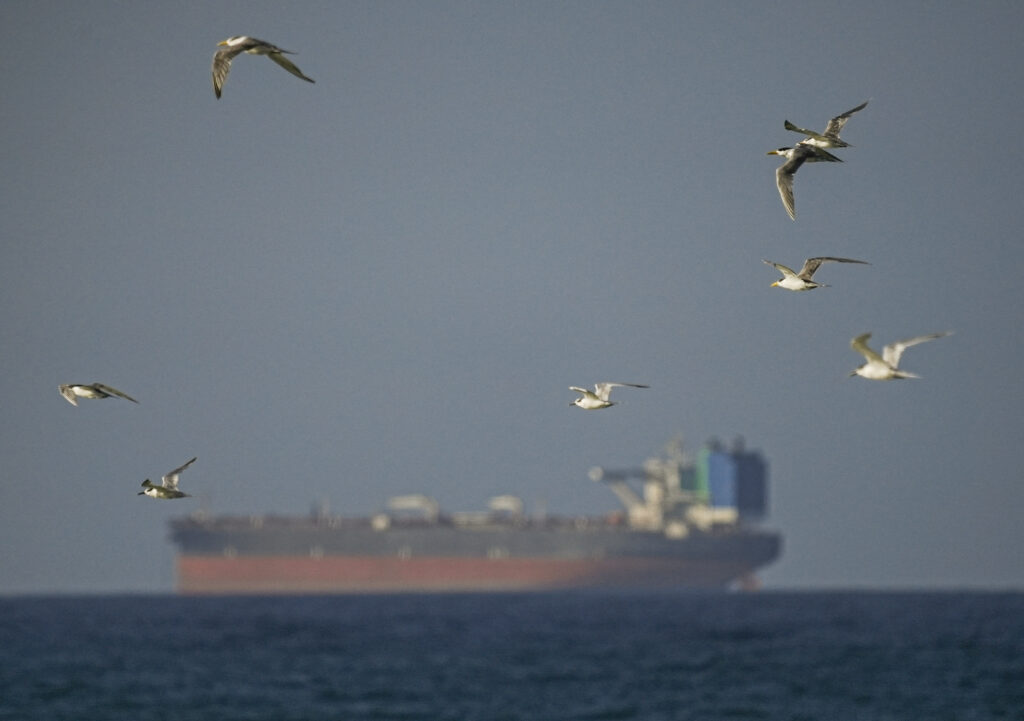
A view of the vessels passing through Strait of Hormuz following the two-week temporary ceasefire reached between the United States and Iran on the condition that the strait be reopened, seen in Oman.
Image via Shady Alassar/Anadolu/AFPWhere does Malaysia stand?
Malaysia doesn't take sides in great power conflicts; that's a long-standing principle of its foreign policy. But neutrality doesn't insulate a country from economic consequences, and the Strait of Hormuz is where that reality is being tested most sharply.
About 70% of Malaysia's crude oil comes from the Gulf region, and roughly half of that passes through Hormuz.
When the Strait first closed in late February, Brent crude surged. When the US blockade took effect on 13 April, prices jumped again, past USD103 a barrel when markets opened.
Bursa Malaysia closed lower yesterday, with analysts warning that the renewed escalation was keeping investor sentiment cautious and limiting appetite for equities.
The government has already flagged the possibility of reducing subsidised petrol quotas and introducing work-from-home arrangements for some public sector workers.
Officials have also warned of downstream effects on food prices and fertiliser costs, a reminder that a shipping crisis in the Persian Gulf doesn't stay in the Persian Gulf.
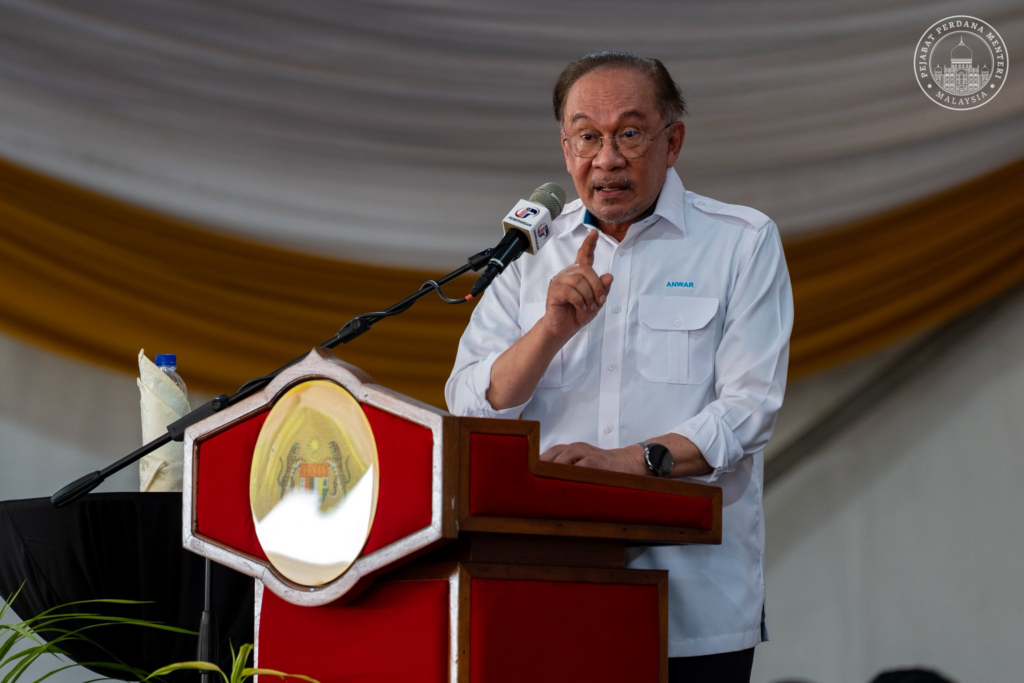
Before the US blockade complicated things, Putrajaya had actually managed a diplomatic win. In late March, Prime Minister Datuk Seri Anwar Ibrahim secured early clearance for Malaysian vessels through the Strait following direct talks with Iranian President Masoud Pezeshkian.
Anwar credited Malaysia's firm public stance, including its consistent opposition to US and Israeli strikes on Iran, as the reason Tehran extended that goodwill.
That goodwill, and what it means in practice under an active US blockade, is now less clear. With Washington and Tehran locked in a direct standoff, and Malaysia caught between its economic dependence on Gulf energy and its principled distance from military alliances, the government's room to manoeuvre is narrowing.
Anwar had already identified June as a critical pressure point for energy security. The blockade will now likely bring that timeline forward.