


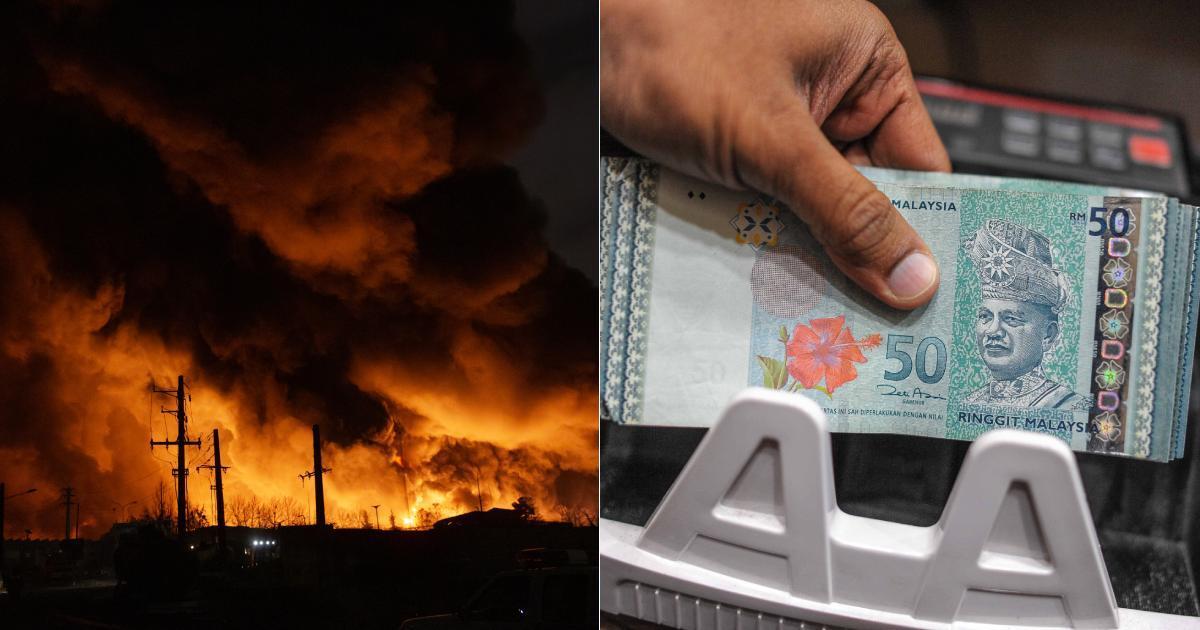
 Cover image via Hassan Ghaedi/Anadolu/AFP & AFP
Follow us on Instagram, TikTok, and WhatsApp for the latest stories and breaking news.
The National Security Council (MKN) held an emergency meeting on Tuesday, 24 March, to discuss the ongoing war in the Middle East
In a statement posted on Facebook last night, MKN warned that the country needs to prepare for a prolonged conflict in the Middle East and its potential economic impact.
The special meeting was chaired by Prime Minister Datuk Seri Anwar Ibrahim.
So what exactly is happening, why does it matter to Malaysia, and what should you expect?
What's actually happening in the Middle East right now?
The conflict — which began after the US and Israel launched a joint strike against Iran — is now in its fourth week. At the centre of the economic disruption is the Strait of Hormuz, a narrow stretch of water between Iran and Oman that is effectively the world's most important energy corridor. It normally carries around 20% of global oil consumption, about 20 million barrels of crude oil and oil products every day.
Retaliating to the attacks by the US-Israel, Iran has been targeting ships in the Strait, while also attacking energy infrastructure across the Gulf region. A nearly complete shutdown of shipping there means top oil producers — Saudi Arabia, the UAE, Iraq and Kuwait — have had to suspend shipments of as much as 140 million barrels of oil.
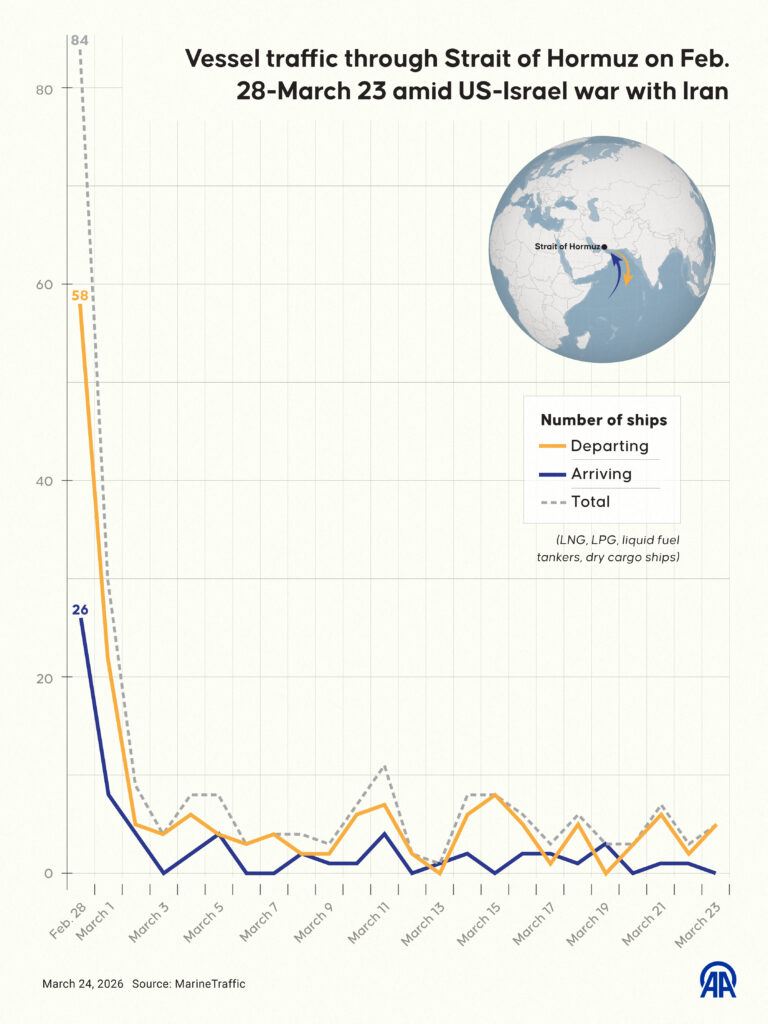
This infographic shows how dramatically vessel traffic through the Strait of Hormuz has dropped amid the US-Israel war with Iran.
Image via Mehmet Yaren Bozgun/Anadolu/AFPIn its statement, MKN referred to "all parties agreeing to halt attacks for five days", but the reality on the ground is more fraught.
What actually happened was that US President Donald Trump announced he was postponing any strikes against Iran's power plants for five days, citing what he described as "productive conversations" with Iran, just hours before his own deadline expired.
That deadline had threatened to "obliterate" Iran's power plants unless it reopened the Strait of Hormuz, which has been effectively closed to tanker traffic since the war began.
This is not a ceasefire.
Iran flatly denied that any direct talks had taken place, saying Trump's move was designed to lower energy prices and "buy time" for his military plans.
Iran's Revolutionary Guards warned they would completely shut the Strait of Hormuz if Trump follows through on his threats, while the Iranian parliament speaker declared that US and Israeli energy infrastructure across the Gulf would be treated as legitimate targets if Iran's power plants are hit.
Oil prices dropped on the news of Trump's postponement, which explains MKN's reference to declining international oil prices. But the underlying standoff remains very much unresolved, with both Israel and Iran firing missiles at each other, and that has direct consequences for Malaysia.
In brief, the situation as of this writing is:
- Active conflict: The US, Israel, and Iran have been in active conflict for four weeks.
- The Strait of Hormuz: Which carries 20% of the world's oil — has been effectively shut down.
- Trump's postponement: Strikes on Iran's power plants are delayed for five days, but this is not a ceasefire; no formal agreement exists.
- Iran's denial: Officials denied that any talks took place and have threatened to fully mine the strait if attacked.
- Oil prices: Prices dipped on the news of the delay, but the standoff remains far from over.
Oil prices: the most immediate shock
From 3 to 20 March, the Brent crude price jumped from USD81.40 (RM321.98) to USD106.41 (RM420.90), a rise of over 30%. The International Energy Agency (IEA) has called this the largest supply disruption in the history of the global oil market.
And Malaysians are already feeling this at the pump.
RON97 has risen from RM3.85 to RM4.55 per litre, while diesel in Peninsular Malaysia has surged from RM3.92 to RM4.72 per litre.
The government is spending over RM3.2 billion per month to maintain the RON95 subsidy at RM1.99 per litre for Malaysians, a significant fiscal burden that only grows if oil prices stay elevated.
At an average Brent crude price of USD100 per barrel, up from USD65 used in preparing the 2026 budget, an analyst writing for The Star estimates the government could collect an additional RM10.5 billion in federal revenue from oil and gas. But that gain would be more than wiped out by RM19.8 billion in fuel subsidy payments, pushing the budget deficit ratio up by about 0.4 percentage points from its targeted 3.5% of GDP.
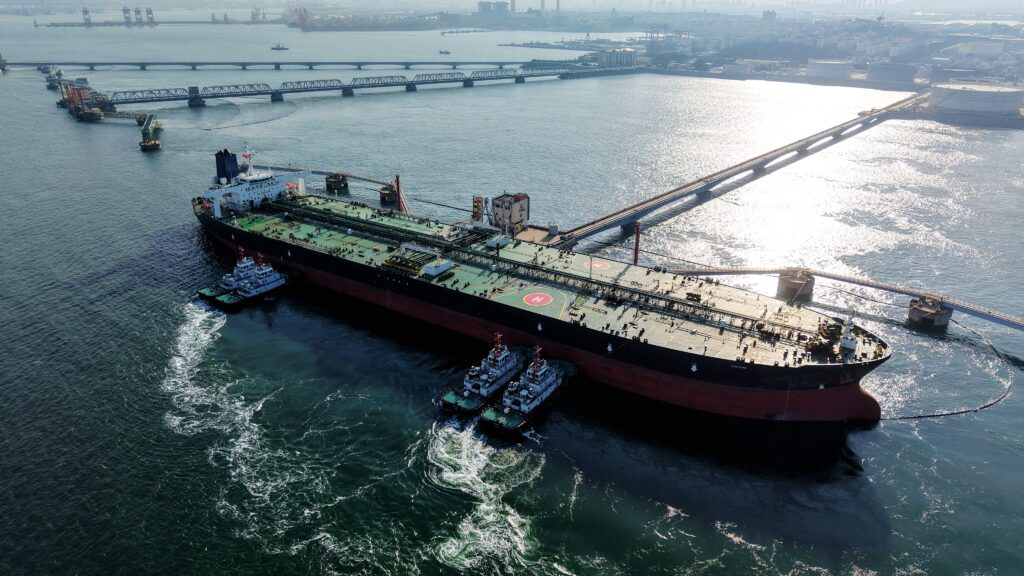
A tanker unloads imported crude oil at the Qingdao Port crude oil terminal in Qingdao, Shandong Province, China on 19 March.
Image via YFP/ CFoto/AFPMalaysia's complicated position: neither fully winner nor loser
Malaysia's situation here is genuinely two-sided, which makes it harder to summarise in a headline.
On one hand, Malaysia is a net exporter of oil and gas. Economy Minister Akmal Nasrullah Mohd Nasir acknowledged that higher oil prices may lift dividends for PETRONAS, and higher crude revenues do provide some fiscal breathing room. MARC Ratings, a prominent Bank Negara Malaysia (BNM)-accredited External Credit Assessment Institution, maintained its baseline 2026 GDP growth forecast at 4.6%, citing Malaysia's position as a net hydrocarbon exporter and its limited trade exposure to the Middle East.
On the other hand, Akmal Nasrullah noted that gains from higher oil prices would likely be offset by increased costs of imported refined petroleum products. While Malaysia produces crude oil, it imports a lot of its refined fuel, meaning the country pays more on the import side even as it earns more on the export side.
Mohd Redza Abdul Rahman, director of research at BIMB Securities Sdn Bhd, put it plainly to The Edge: rising refining costs and widening product spreads could create margin pressure across downstream industries even as upstream oil producers benefit from higher crude prices.
Malaysia's landmark Twin Towers and other buildings are silhouetted during sunset in Kuala Lumpur.
Image via Seth Akmal/NurPhoto/AFPWhat about everyday prices and the cost of living?
This is where the ongoing war's impact filters down most directly to ordinary Malaysians.
According to economist Mohd Sedek Jantan of IPPFA Sdn Bhd, the first impact is on logistics and transportation costs rather than directly on retail fuel prices, and the pass-through to households usually takes around three to six months, depending on how long the conflict persists, reported Bernama.
In plain terms, your grocery bill, your e-hailing rides, and the price of goods at your local store, these don't spike overnight. But if the war drags on, the high prices will creep up, because almost everything in the supply chain depends on transportation, and transportation depends on fuel.
Higher oil prices tend to raise global production costs, which may weaken demand in Malaysia's major export markets such as the US, Europe, and China, potentially reducing external demand for Malaysian exports, particularly in electronics and electrical products, according to an expert commentary in the Monash Lens.
Food security is another concern worth watching.
Fertiliser prices for urea, the most popular synthetic nitrogen fertiliser, have increased by about 30% over the past month, as the Gulf is a major supply artery for fertiliser inputs, noted The World Economic Forum.
The Agriculture and Food Security Ministry said it is working with the Finance and Economy ministries to formulate a strategy to address the impact on the food sector, while noting that supplies of basic foods such as rice, chicken, and vegetables are sufficient at least until May.
What this means for your daily life:
- Price hike timeline: Costs won't hit overnight — economists estimate a three- to six-month lag before they filter through to households.
- Consumer impact: Expect higher prices for groceries, transport, and everyday goods when the lag ends.
- Agriculture costs: Fertiliser costs are up 30%, which could eventually push up food prices.
- Current stock levels: Rice, chicken, and vegetables are said to be sufficiently stocked at least until May.
- Long-term risk: A slow, steady squeeze on purchasing power if the global conflict drags on.
What about the ringgit?
MARC Ratings widened its ringgit forecast to RM3.92–RM4.07 against the USD, reflecting heightened global risk aversion and reduced expectations of US rate cuts.
Mohd Sedek noted that the more immediate impact on Malaysians could come through currency movements, as emerging market currencies typically weaken during a geopolitical crisis, though the ringgit's strengthened fundamentals over the past two years provide some buffer against imported inflation in the short term.
A weaker ringgit matters because it makes imported goods more expensive, from machinery to electronics to the raw materials that go into things manufactured here.
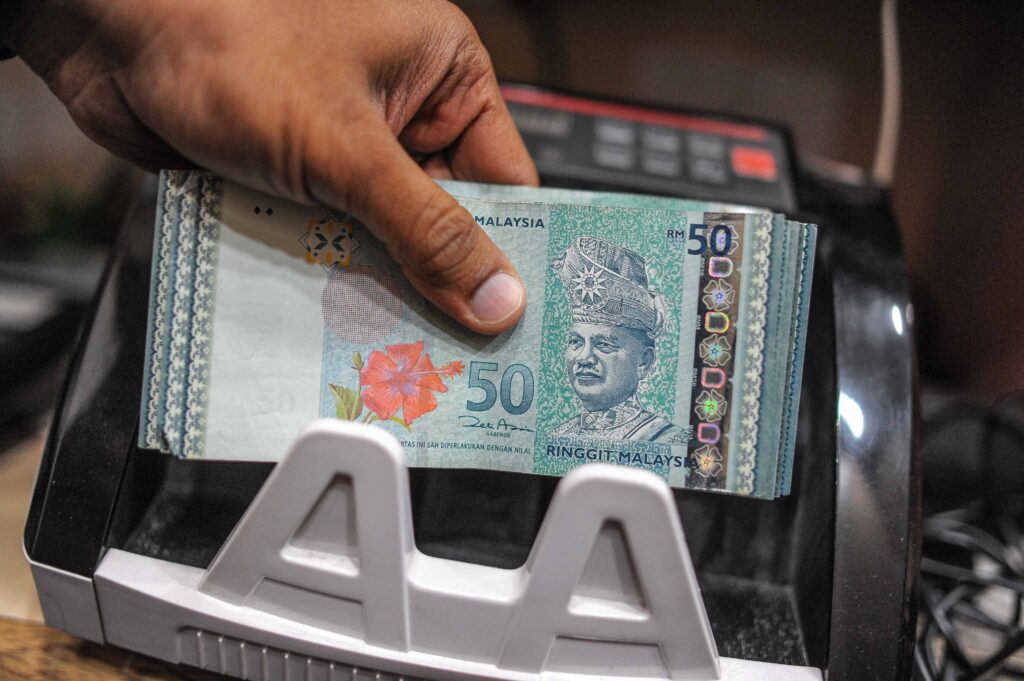
A money changer counts Malaysian ringgit banknotes for customers in Kuala Lumpur.
Image via Mohd Rasfan/AFPWhat is the government doing about it?
According to MKN, the government is taking a "comprehensive and coordinated approach".
The special MKN meeting on Tuesday will be followed by a Special National Economic Action Council (MTEN) meeting today, 25 March, also chaired by the prime minister.
On the diplomatic front, the statement noted that Anwar held phone calls yesterday with leaders from New Zealand, Japan, Bahrain, and the UAE, part of a broader effort to contribute to a resolution.

According to CNBC, economists at Nomura identified Malaysia as a "relative beneficiary" as a net energy exporter and expect it to potentially tighten interest rates, though Bank Negara Malaysia is expected to tread carefully. Analysts expect BNM to keep the overnight policy rate unchanged at 2.75% for now, monitoring whether oil-induced inflation is transitory before making any moves.
While the RON95 subsidy is being maintained for now, a report in The Star has warned that if Brent crude stays at USD90–USD100 per barrel for three months, the government may be compelled to raise the subsidised price to keep fuel subsidies manageable.
The bottom line
The MKN statement is measured and deliberate, as official statements tend to be. But reading between the lines, the government is clearly bracing for a scenario where the Middle East conflict doesn't end quickly.
What Trump's postponement of strikes actually bought was time, not peace. Iran hasn't reopened the Strait, except for occasional passage, which the country is allowing to friendlier nations. The threats on both sides remain on the table. And the five-day window the MKN statement cautiously welcomed could close just as fast as it opened.
A short-lived, low-intensity shock would inflict moderate economic friction. A prolonged, high-intensity conflict could trigger a severe inflationary shock, increased business costs, reduced consumer spending, and, in a worst-case scenario, contribute to a global recession.
For Malaysia, the stakes are real, at the pump, in the grocery aisle, and in the government's budget. The next few days will matter.
