


 Cover image via
 Follow us on Instagram, TikTok, and WhatsApp for the latest stories and breaking news.
Malaysia continues to grapple with the public health burden of smoking
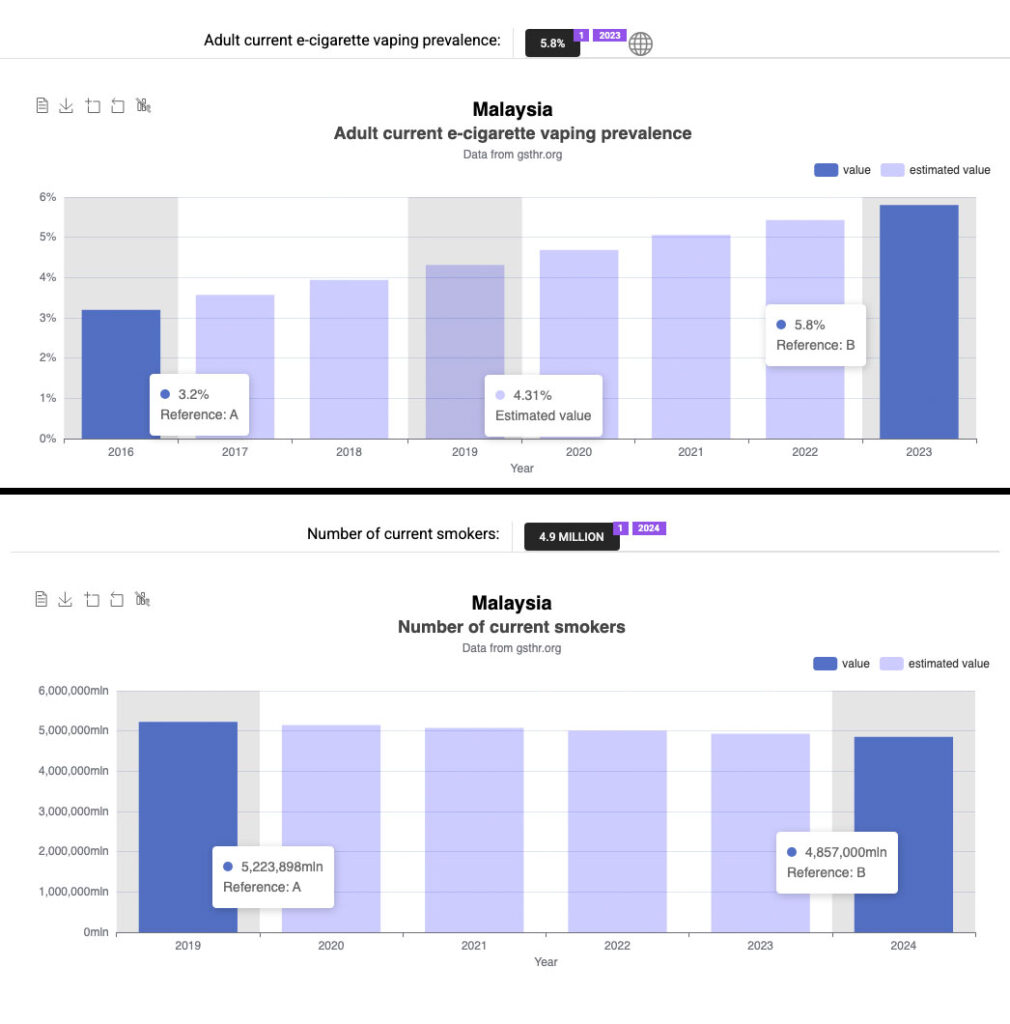
According to the Global Adult Tobacco Survey 2023, an estimated 4.8 million Malaysians were cigarette smokers in 2023, representing 19.5% of the adult population.
By comparison, 1.6 million adults used smokeless tobacco products and e-cigarettes, including about 1.4 million vapers and 200,000 smokeless tobacco users.
By contrast, e-cigarette prevalence among adults stood at 4.31% in 2019, rising to 5.8% in 2023.
Over the same period, the number of smokers declined from 5.2 million in 2019 to 4.8 million in 2023.
The figures suggest a gradual shift to less harmful nicotine products among the adult population.
On the flipside, youth vaping has grown at a much faster pace
Data from the National Adolescent Health Survey 2022 showed that youth smoking fell from 13.8% in 2017 to 11.5% in 2022.
However, e-cigarette use increased from 9.8% in 2017 to 14.9% in 2022.
This pattern, falling cigarette use alongside rising youth vaping, mirrors trends in many other countries.
Governments from the UK to New Zealand and the US are grappling with the same policy dilemma: reducing harm among adult smokers without driving up youth vaping.
This conundrum reflects a pendulum effect: overly restrictive approaches drive demand underground, while overly permissive ones weaken youth protections.
Tobacco harm reduction focuses on reducing risk rather than denying it
Health experts emphasise that tobacco harm reduction does not mean claiming vaping is safe. Instead, it recognises differences in risk between products.
Combustible cigarettes remain the most dangerous form of nicotine delivery due to the toxic by-products produced by burning tobacco. E-cigarettes and other non-combustible alternatives are widely regarded as less harmful — though not harmless — and are used in several countries as part of smoking cessation strategies.
In the local context, the Malaysian government has announced plans to ban vaping, with enforcement expected to begin in mid-2026. Health Minister Datuk Seri Dr Dzulkefly Ahmad has said that the urgency stems from concerns over vape liquids being mixed with synthetic substances and illegal drugs, which have been linked to psychosis and severe mental health disorders.
While many doctors support the intention to protect young people, some caution that a blanket ban may produce unintended consequences.
One of them is Dr Rashidi Mohamed Pakri Mohamed, a consultant family medicine specialist and smoking cessation practitioner
"The policies are good. However, what we need… what is lacking… is enforcement," he said.
"Despite having very strong, good policies, if the enforcement has a lot of room for improvement, then there's no point in having such fantastic policies."
Dr Rashidi warned that a complete ban could become a "double-edged sword" for adults attempting to quit smoking.
"There is a risk of reversion. Those who are actually trying to quit smoking combustible cigarettes by using e-cigarettes and other alternative modalities may end up going back to cigarette smoking itself."
He stressed that nicotine dependence should be understood as a clinical issue rather than a moral one.
"Nicotine addiction is not a lifestyle issue — it's actually a behavioural problem and it's an addiction, which is a mental health issue," he explained.
While emphasising that vaping is not harmless, Dr Rashidi said risk comparison is essential in public health decision-making.
"I'm not saying that vape is harmless. But if you conduct a risk comparison between combustible cigarettes and vapes or e-cigarettes, it is less harmful for the latter."

Dr Rashidi Mohamed Pakri Mohamed, a consultant family medicine specialist and smoking cessation practitioner.
Image via Fakulti Perubatan UKM (Facebook)A ban could fuel black markets and expose users to greater risks
Beyond health concerns, Dr Rashidi highlighted the risks of driving demand into unregulated channels.
"There is also the risk of a rising black market, with unregulated safety devices," he said. "The e-liquids could be laced, especially coming from those in the black market."
He warned that this could escalate into wider criminal activity.
According to him, similar outcomes have been observed elsewhere. Singapore and Thailand maintain strict bans on vaping, yet illicit markets continue to operate.
"Vape is still available in Singapore, and they can get it through social media and Telegram, and even the e-liquids can be laced.
"As compared to Thailand, where vaping has also been banned, but the black market in Thailand is rampant. Vapes are still being sold in Thailand."
The doctor added that Australia's medical-only access model has coincided with stagnant smoking rates and a growing black market.
Enforcement officials abroad have issued similar warnings. Kate Pike, lead officer for tobacco, vapes, and nicotine at the UK's Chartered Trading Standards Institute, has said fear-driven bans can empower organised crime.
"When you create fear without distinction, you create space for criminal markets," Pike said at the E-Cigarette Summit last month, echoing a point many experts agreed on: bans and panic-driven crackdowns often empower organised crime.
Illicit markets, she explained, are driven by the relentless pursuit of money, maximum profit for minimum risk, often exploiting vulnerable groups — including children — laundering money, and weakening public confidence in compliant products and public-health messaging.
"It costs lives, blights communities, and undermines confidence in legitimate regulation," Pike said.

CNA reported in July 2024 that Singaporean authorities seized RM1.1 million worth of vapes being sold on Telegram.
Image via @channelnewsasia (Threads)Policymakers worldwide are now caught between protecting youth and supporting smokers who want to quit
Dr Rashidi described current policy debates as a pendulum swinging between extremes.
"We cannot be safe on one side for a very long time," he said.
"We have to make a decision. Decisions may have repercussions, but which repercussion is the safest?
"Hence, the devil is in the details. We have to pick the 'lesser devil'," he said, suggesting that tightly regulating vapes as the most pragmatic option.
Taxation can be used to deter youth access while supporting harm reduction goals
Dr Rashidi pointed to taxation as a proven policy lever, saying Malaysia and many countries have long used pricing strategies to restrict cigarette access, while progressively increasing pack sizes and excise duties.
"If you see cigarettes, they moved from five sticks to 10 sticks, then 14 sticks, now 20 sticks.
"Which is a very good option so that the youth cannot afford them."
He suggested applying similar principles to vaping.
"There should be two-tiered taxation. Vape [cartridges] should be slightly cheaper than cigarettes, but still expensive enough that youth cannot afford them," he proposed.
He added that all revenue collected should be reinvested in public health.
"The money from the tax itself has to be channelled back into creating awareness on the dangers of smoking, and for treatment, and assisting those smokers to actually quit."
Rather than an all-or-nothing ban approach, Dr Rashidi outlined specific regulatory measures he believes would better protect youth while preserving cessation options
"If the government decides to allow vape or e-cigarettes as an option to quit, what Malaysia should do is to ban single-use vapes," he said, referring to devices that are disposable once the battery or e-liquid runs out.
He also called for restrictions on refillable devices.
"Open system pods should also be banned because those are the risks of being laced with the substances.
"What remains is a closed system that can be used repeatedly, sold only to adults aged 21 and above, and tightly regulated," he added, urging strict laws to prevent adults from buying vapes on behalf of minors.
Dr Rashidi said policies should also be in place to curb e-cigarette devices that appeal to children and teens, including candy-like flavours, flashy LED lighting, and built-in games.
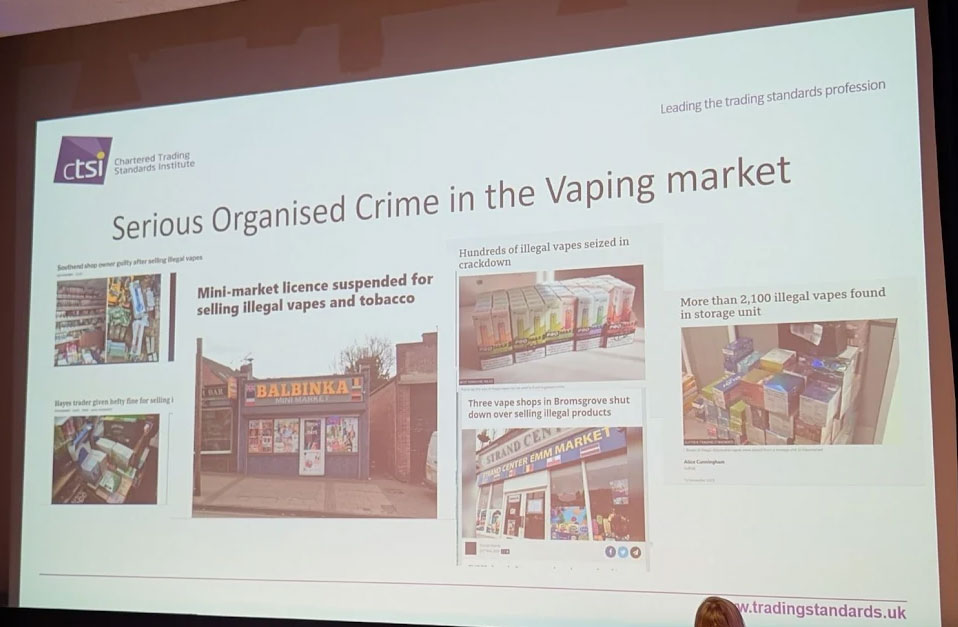
A presentation slide shown at the E-Cigarette Summit in London, UK last month.
Image via The E-Cigarette SummitThe end goal remains quitting nicotine rather than substituting it indefinitely
Dr Rashidi stressed that harm reduction is not about normalising nicotine use indefinitely.
"We don't want them to be hooked on nicotine for the rest of their lives," he stressed. "We want them to quit completely."
He cautioned against defaulting to familiar solutions without considering their limitations.
"If we keep on going back to one solution, we may lose a chance to actually help these people to quit, and we also face the devastating effect of the black market."
