


 Cover image via The E-Cigarette Summit
Follow us on Instagram, TikTok, and WhatsApp for the latest stories and breaking news.
Cigarette smoking remains one of the leading causes of preventable death worldwide
According to the Global State of Tobacco Harm Reduction, Malaysia recorded 4.9 million smokers in 2024, making up 17.9% of the adult population. In 2021, smoking-related diseases accounted for 10% of all deaths nationwide, amounting to 24,100 cases.
To understand tobacco harm reduction, it is key to understand what makes cigarettes dangerous. The American Cancer Society noted that cigarette smoke contains over 7,000 chemicals, including over 70 known to cause cancer.
Combustion produces carbon monoxide and other toxic by-products that can damage the lungs and bloodstream. When people stop smoking, carbon monoxide levels drop rapidly, a change driven by basic physical and chemical principles.
No combustion means far fewer toxicants entering the body.
However, public understanding of smoke-free alternatives remains deeply divided
At the E-Cigarette Summit in London, UK earlier this month, regulators, enforcement officers, behavioural scientists, addiction experts, and public-health researchers gathered to share why harm reduction remains one of the most polarising topics in modern health policy.
In Singapore, its harm reduction approach differs from the rest of the world, with stark anti-vaping posters plastered across the island city, framing nicotine as a personal moral failing. That contrast matters, especially as Malaysia considers an outright ban on vaping.
On 16 December, Health Minister Datuk Seri Dr Dzulkefly Ahmad said the urgency to ban vaping stems from concerns over vape liquids being mixed with synthetic substances and illegal drugs, which have been linked to drug-induced psychosis and severe mental health disorders.
Similar concerns have emerged in the US, the UK, New Zealand, and many parts of the world, where authorities are struggling to regulate rapidly evolving nicotine products.

Anti-vape posters in Singapore.
Image via Singapore Government via Branding In AsiaOne recurring theme at the summit was how far public perception has drifted from scientific consensus
Prof Sarah Jackson, a behavioural scientist at University College London, said confusion around relative risk continues to shape both behaviour and policy.
"The problem remains that trends in perception of harm are now going in the wrong way," Jackson said, highlighting a particularly stark statistic.
Citing collected data on youth nicotine use, Jackson showed that while smoking has declined sharply since 2020, overall nicotine use has increased by 11% within the last decade, driven mainly by vaping and, to a lesser extent, nicotine pouches.
Similar trends are seen among people aged 25-34 and 35-44, with these groups shifting from exclusive smoking to either exclusive vaping or dual use. In contrast, older age groups show a slower decline in smoking and weaker vaping uptake.
She warned that governments often treat harm reduction for adults and youth protection as competing goals, even though evidence suggests otherwise.
"Framing harm reduction and protecting young people as competing goals is a false dichotomy.
"There are direct and indirect benefits of harm reduction for young adults when smoking declines in families and communities," she said, noting that adults using less harmful nicotine alternatives can help reduce youth exposure to smoking, imitation, and secondhand smoke.
Jackson advised policymakers to find a "sweet spot" between minimising harm among smokers and preventing vaping uptake among youth, echoing the view shared by many of her peers at the summit that an outright ban on vaping is impractical.
"Policies should be proportionate, balanced, and reflect relative harms," she said, adding that vape packaging and marketing — often designed to appeal to younger audiences — can undermine efforts to help older smokers switch to less harmful e-cigarette alternatives.
Media narratives, speakers argued, play a powerful role in reinforcing misperceptions and misinformation
Headlines about extreme vaping-related harms, such as "popcorn lungs" and "zombie vape", often circulate without context, blurring the line between regulated products and illicit substances.
Many speakers said that framing vapes of criminal origin in this way ultimately casts non-combustible nicotine products in a negative light.
Kate Pike, lead officer for tobacco, vapes, and nicotine at the UK's Chartered Trading Standards Institute, a non-profit body working to protect consumers and promote fair trading, said fear-driven messaging can actively undermine regulation.
"When you create fear without distinction, you create space for criminal markets," Pike said, echoing a point that many speakers at the summit mentioned: bans and panic-driven crackdowns often empower organised crime.
"Serious and organised crime thrives on prohibition.
"It costs lives, blights communities, and undermines confidence in legitimate regulation," Pike said.
Illicit markets, she explained, are driven by the relentless pursuit of money, maximum profit for minimum risk, often exploiting vulnerable groups — including children — laundering money, and weakening public confidence in compliant products and public-health messaging.

Market behaviour itself, researchers noted, tends to follow predictable patterns
Dr Karl E Lund, a senior researcher at the Norwegian Institute of Public Health who studies nicotine markets and substitution behaviour, traced this trend through history.
"One nicotine product has never left the market without being replaced by another," Lund said, quoting Michael Russell, the late psychiatrist and public health scientist who pioneered addiction research and was a key figure in the development of the tobacco harm reduction concept.
In Scandinavia, he explained, snus — a kind of nicotine pouch with tobacco — has been used for around 200 years and now plays a significant role in reducing smoking rates, particularly in Norway.
"Snus [is] a product that's been on the market for 200 years in Scandinavia.
"[It] has been the most used method for successfully quitting smoking for decades. In fact, 45% of those who had successfully quit smoking sometime during the last 10-year period had used snus at their final quit attempt.
"It also reaches the hard-to-reach smokers who, for some reason, do not want to use the methods recommended from the help of therapists," he shared.
Regulatory approaches elsewhere remain sharply divided. Lund noted that in France, consumers can be jailed for possessing nicotine pouches, illustrating how polarised views on smokeless nicotine have led to vastly different policies across countries.
New Zealand's experience offered a contrasting case study
Ben Youdan, policy director at ASH New Zealand, described how the country adopted some of the most liberal vaping laws in the world as part of its Smokefree 2025 goal.
"Since 2018, the rise in vaping has correlated with unprecedented declines in smoking," Youdan said.
Youth smoking rates have fallen to historic lows.
"Almost no young people are starting to smoke," he said.
While New Zealand later repealed its endgame law following a change in government, Youdan said harm reduction still played a critical role.
"Vaping was the safety net for people who would otherwise have continued smoking," he said. "Net nicotine use increased, but smoking continued to fall."
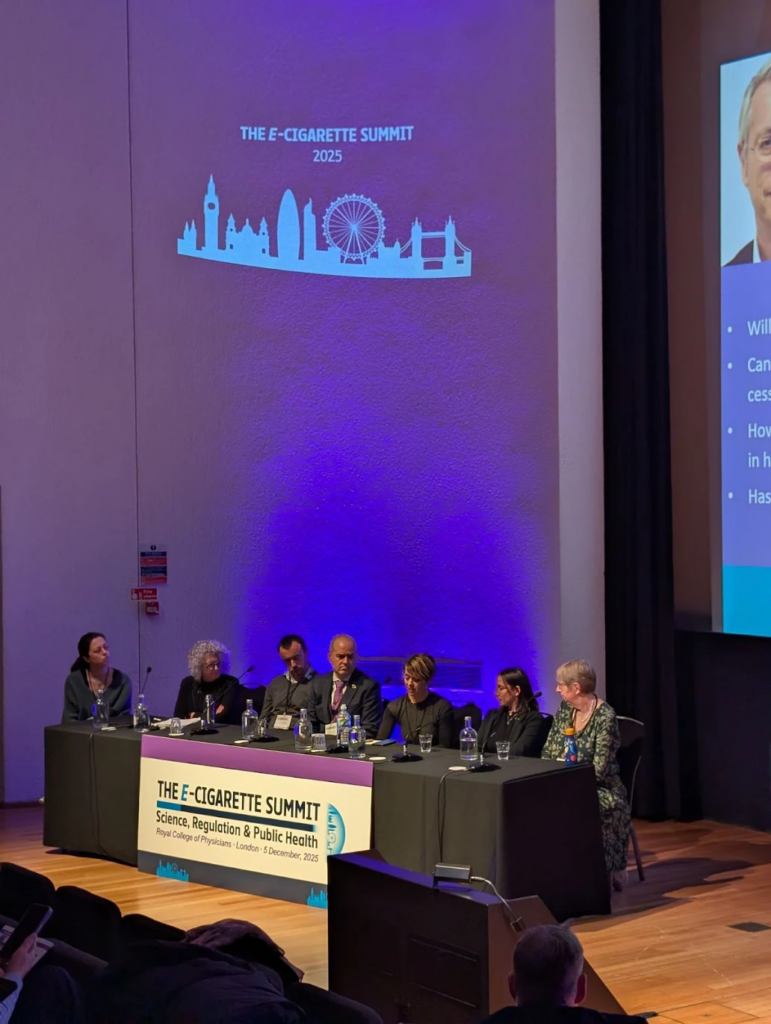
Speakers at the summit during a Q&A session.
Image via The E-Cigarette SummitThe US, meanwhile, offered a cautionary example of unintended consequences
Prof Jonathan Foulds, a professor of public health sciences at Penn State University, explained how the US Food and Drug Administration (FDA) responded to rising youth vaping and the EVALI outbreak in 2019: by banning cartridge- and pod-based e-cigarettes from the market.
"It was a knee-jerk response to a crisis," Foulds said.
He explained that by removing that specific category of vapes from the market, regulators shifted demand rather than eliminating it.
Banning cartridge-based products, Foulds explained, caused demand to move towards disposable products that were not regulated in the same way, meaning youth use simply shifted rather than disappeared.
The FDA appears to have learned from this regulatory experience. The agency now allows specific health communications to be marketed to the public, but only when companies provide sufficient scientific evidence showing that the product promotes public health.
In 2020, the FDA authorised IQOS, a heated tobacco product from Philip Morris International (PMI), as a modified risk tobacco product (MRTP), recognising that it differs fundamentally from cigarettes.
In 2025, the FDA approved the marketing of ZYN by PMI, making it the first and only nicotine pouches authorised in the US, further validating the role of non-combustible alternatives in the market.
The summit closed with reflections from Martin Dockrell, a former senior UK civil servant who spent more than a decade leading tobacco control policy
Drawing on his earlier work in HIV and AIDS prevention, Dockrell argued that technology often drives progress faster than messaging alone.
"In HIV prevention, technology made more progress than decades of messaging alone," Dockrell said, suggesting that innovation in smokeless nicotine products is the technological advancement that should be embraced and regulated rather than stigmatised.
He cautioned against policies that punish behaviour without accounting for how people actually live.
"Public health should be on your side, not on your back.
"Prohibition has a poor track record when it ignores human behaviour," Dockrell said.
That sentiment was echoed by Prof Hayden McRobbie, professor of population health at Queen Mary University of London, who warned against moral framing.
"When vaping becomes a moral issue, trust in science erodes.
"Moralising messages do not improve understanding; they polarise it.
"People hear 'vaping kills' or 'vaping saves lives', and both damage credibility when taken out of context," McRobbie said.
As Malaysia weighs its next steps, the experiences of the UK, Norway, New Zealand, and the US suggest the challenge is not eliminating nicotine overnight, but deciding how to reduce harm first without driving behaviour into less regulated, more dangerous spaces.
