Here’s How Malaysia’s Expat Policy Shake-Up Puts Locals First In High-Paying Jobs
Mandatory succession plans, higher expat salary floors, and a "local first" hiring requirement are designed to give Malaysian workers more opportunities to step into senior and specialised roles.


 Cover image via
Follow us on Instagram, TikTok, and WhatsApp for the latest stories and breaking news.
Malaysia's new expatriate employment policy, which doubles minimum salaries for foreign professionals and sets time limits on work passes starting 1 June 2026, is seen as an opportunity for local talent
The changes aim to provide Malaysians with clearer career pathways, higher earning potential, and greater access to specialised roles that were previously dominated by expatriates.
A key change in the policy is the introduction of a fixed tenure for employment passes, coupled with a mandatory replacement plan for expatriates in Categories II and III.
Previously, some expatriate roles were renewed indefinitely. Under the new rules, employers must treat an expat's tenure as a window to train a local successor.
This ensures a structured transfer of knowledge and skills, giving local employees a visible career path to step into senior or specialised positions once the expat's five- or 10-year tenure ends.
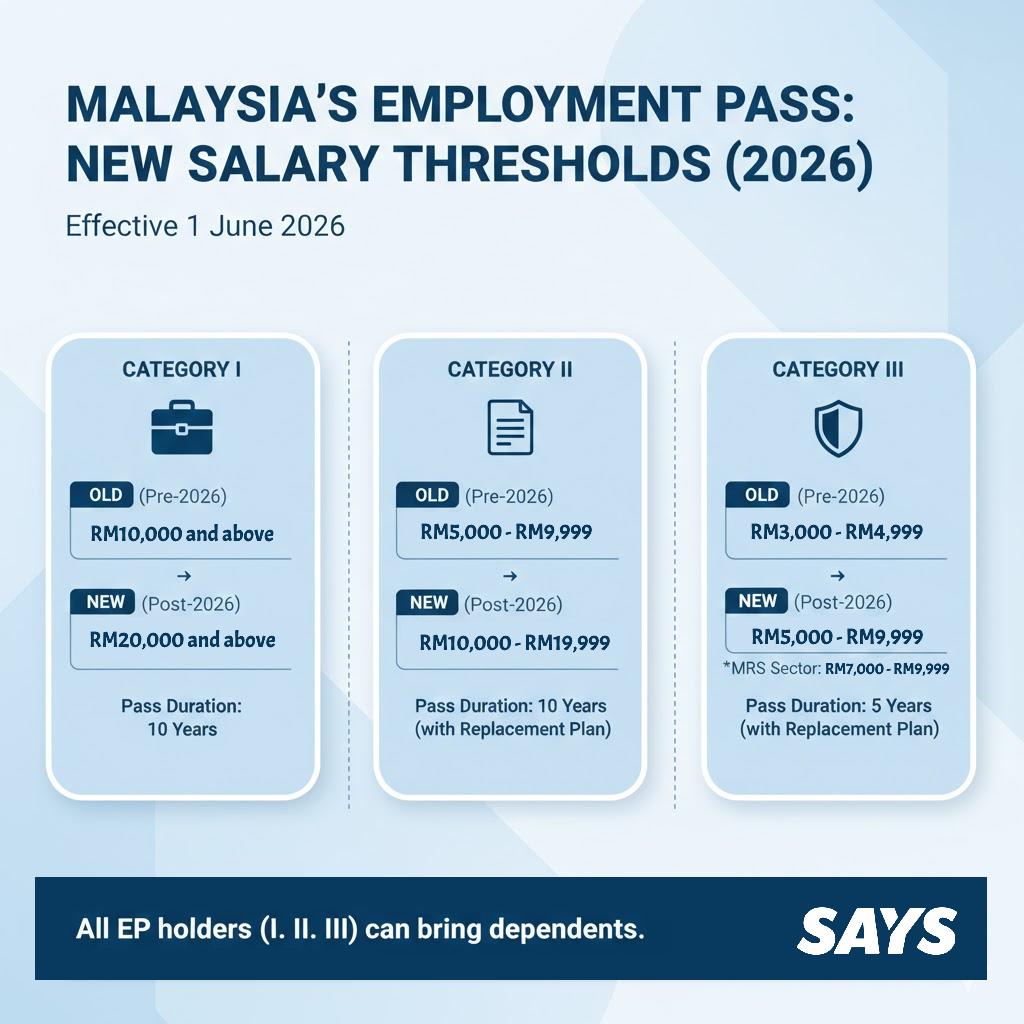
A comparison of the current and new salary thresholds for Malaysia's Employment Pass (EP) Categories I, II, and III, effective 1 June 2026.
Image via SAYSThe policy revamp also aims to reduce reliance on cheap foreign talent
By significantly raising the salary floors, the government is making it less "cost-effective" for companies to hire foreign talent for mid-level roles that Malaysians could fill.
For example, the minimum salary for Category II has been raised to RM10,000 from RM5,000, while Category III has been increased from RM3,000 to RM5,000, or RM7,000 for manufacturing and manufacturing-related services.
At these new levels, the government hopes companies will prioritise local hires, giving Malaysian graduates and professionals more opportunities rather than paying a premium for foreign talent.
The policy explicitly prioritises qualified local talent
Employers now need to perform a rigorous search for Malaysians before applying for an expatriate.
This reduces "crowding out" in the job market, ensuring Malaysians aren't competing with foreign labour for positions they are fully qualified to fill.
The higher minimum salary for expatriates indirectly sets a market benchmark, especially in sectors like manufacturing, where Category III salaries now start at RM7,000.
This upward pressure is likely to boost salaries for local engineers, technicians, and other professionals in the long run, benefiting the Malaysian middle class and improving earning potential.
The policy also supports Malaysia's shift from a low-cost labour hub to a high-income, value-driven economy. By reducing over-dependence on foreign labour, industries are encouraged to automate, innovate, and invest in the local workforce.