 Cover image via
Follow us on Instagram, TikTok, and WhatsApp for the latest stories and breaking news.
The government has announced a new policy that will significantly raise the minimum salary thresholds for expatriates working in the country
The policy also imposes time limits on how long they can hold work passes.
The changes, effective 1 June 2026, aim to reduce dependency on foreign professionals and prioritise the development of local talent, the Ministry of Home Affairs (MOHA) said in a statement on 14 January.
The Cabinet approved the new expatriate employment policy on 17 October 2025, which restructures the salary bands for Expatriate Employment Passes under Categories I, II, and III, and sets defined durations for how long expatriates can work in Malaysia.
Under the current system, which is based on a 20 December 2016 Economic Council meeting, there were no formal limits on the length of expatriate employment, and salary bands were lower.
Since 2022, the policy has been revised through a series of engagement sessions with industry stakeholders to balance attracting foreign expertise with prioritising qualified local talent, in line with the 13th Malaysia Plan (RMK-13).

People take pictures with Petronas Twin Towers and other commercial buildings from the KLCC Park in Kuala Lumpur.
Image via Agoes Rudianto/Anadolu/AFPThe key details of the new policy are:
Category I Expatriates: Minimum salary doubled to RM20,000 and above, up from RM10,000 and above previously; employment period capped at 10 years.
Category II Expatriates: Minimum salary doubled to RM10,000 to 19,999, up from RM5,000 to 9,999 previously; employment period capped at 10 years with a mandatory succession plan to replace expatriates with local talent.
Category III Expatriates: Minimum salary increased to RM5,000–9,999, up from RM3,000–4,999 previously, except for the manufacturing and manufacturing-related services (MRS) sectors, which are set at RM7,000–9,999; employment period capped at five years with a succession plan.
Dependents: All categories of expatriates are now allowed to bring dependents. Previously, only those in Categories I and II were allowed.
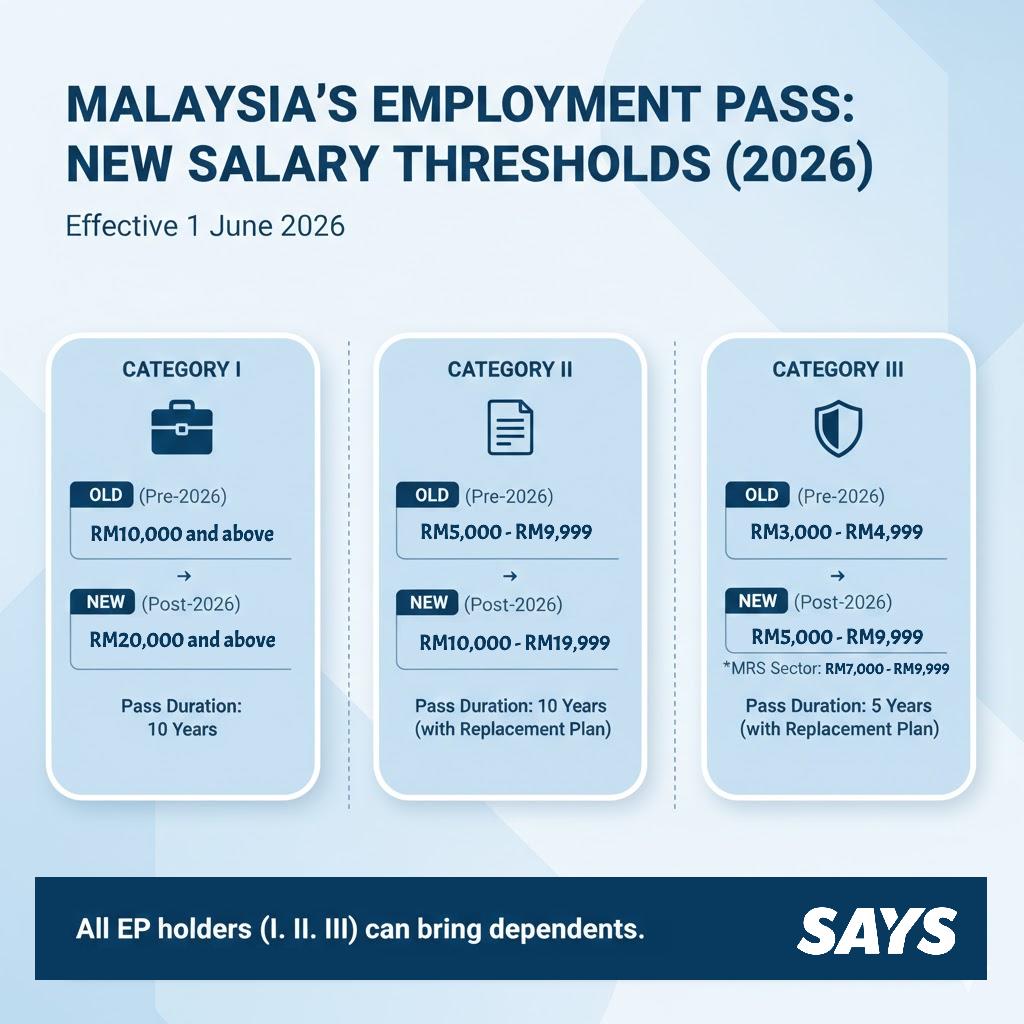
A comparison of the current and new salary thresholds for Malaysia's Employment Pass (EP) Categories I, II, and III, effective 1 June 2026.
Image via SAYSAccording to the government, the new policy is intended to reduce reliance on foreign labour while prioritising local talent
MOHA said the introduction of employment duration caps aims to both retain highly skilled expatriates who contribute to the country and provide a structured guide for employers to plan workforce replacement with local talent.
To give employers and the industry sufficient time to adjust, the new policy will only be enforced starting 1 June 2026.
MOHA also plans to hold meetings and engagement sessions with industry players, employers, and relevant agencies to explain the implementation mechanism, policy implications, and ensure a smooth and transparent transition that will not disrupt business operations.
While the policy targets professional-level expatriates rather than low-wage foreign workers, it is expected to have significant implications for hiring practices
Mid-sized firms that currently pay Category I expatriates between RM12,000 and RM15,000 may now need to either increase expatriate salaries substantially or accelerate localisation of key roles.
The introduction of mandatory succession plans for Categories II and III also signals that companies will no longer be able to retain expatriates indefinitely, and will need to transfer knowledge and responsibilities to qualified local talent over time.
The policy raises several questions, including whether existing expatriates will be subject to the new salary thresholds upon renewal, which sectors beyond manufacturing and MRS might be exempt, and how those already in Malaysia under the previous terms will be affected.
Overall, the policy represents a dual approach: making it more expensive to hire foreign professionals while simultaneously encouraging local talent development. It also raises the question of how Malaysia will maintain its competitiveness as a destination for highly skilled expatriates while reducing reliance on foreign expertise.
The Home Ministry said the government remains committed to implementing policy reforms gradually, transparently, and in the national interest, ensuring sustainable economic growth and long-term development of local human capital.