


 Cover image via
Follow us on Instagram, TikTok, and WhatsApp for the latest stories and breaking news.
Why does a spare parts shop stock an entire wall of engine oil?
If you've ever gone to a car service centre and the mechanic asks, "Boss, want mineral or fully synthetic?", you probably just nodded and picked whatever sounded safest or cheapest.
You see bottles with "0W-20" or "15W-40" and so many gold labels you'd think you're buying cooking oil.
We get it. It gets very confusing.
Let's break it down so you actually know what you're paying for.

Image used for illustration purposes only.
Image via Artem Podrez/PexelsHere are the three main differences in engine oils:
First off, you have basic mineral oil: simple, effective, and affordable. But because it's less refined, its molecules are uneven in size. It's great for older cars or "breaking in" a new engine, but breaks down quickly under high heat.
Next is the premium blend: fully synthetic oil. This oil is chemically engineered in a lab, with every single molecule is designed to be the same size and shape. It's incredibly smooth, handles extreme heat, and keeps your engine much cleaner.
Finally, there's semi-synthetic oil. As the name suggests, it's a mix of mineral and synthetic oils, giving you some of synthetic's protection at a lower price. For the average Malaysian driver, it hits the sweet spot.
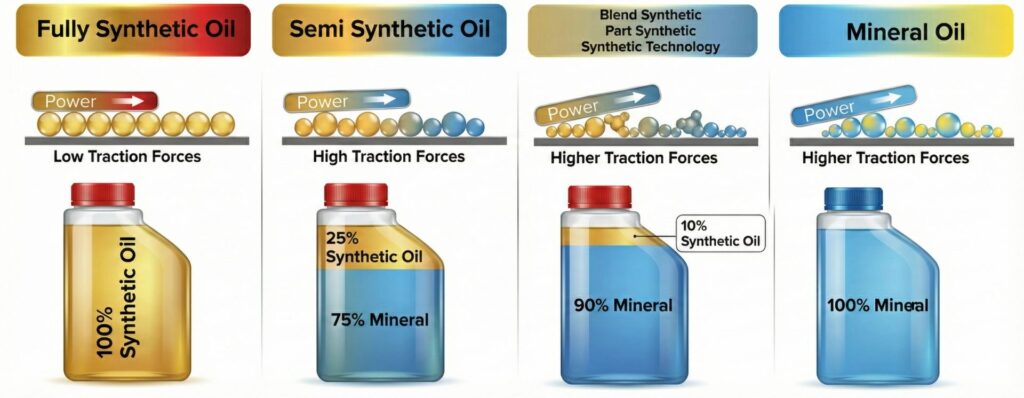
Here's an example of various engine oil blends.
Image via GeminiHow does this actually affect your daily drive?
You can actually feel the difference. If you switch from a basic mineral oil to a high-quality, fully synthetic one, the first thing you'll notice is how much quieter the engine is during a cold start.
Because synthetic oil is so uniform, it flows much faster. When you turn your key in the morning, the oil reaches the top of the engine in a second. Mineral oil, being "thicker" and more irregular, takes a few moments longer to get moving. That tiny delay is when most engine wear happens.
Also, better oil means less friction. Less friction means your engine doesn't have to work as hard, which can actually save you a bit of money at the pump, according to experts. It's not much — maybe a few extra kilometres per tank — but over a year, it adds up!
Another key piece of information to remember is the numbers, like 0W-20, 10W-40, and so on
This is the part that usually gives people a headache. These are called 'viscosity grades', which is just a fancy way of saying "how thick is this stuff?"
Here's what they mean:
The first number, the number with the "W", stands for Winter, or cold start. The lower this number, the better it flows when the engine is cold. A 0W oil flows like water even when it's chilly, while a 15W is like honey.
The second number determines how thick the oil stays when the engine is at operating temperature. A 40 is thicker and provides a "heavy cushion" of protection, while a 20 is thinner for better fuel economy in modern engines.
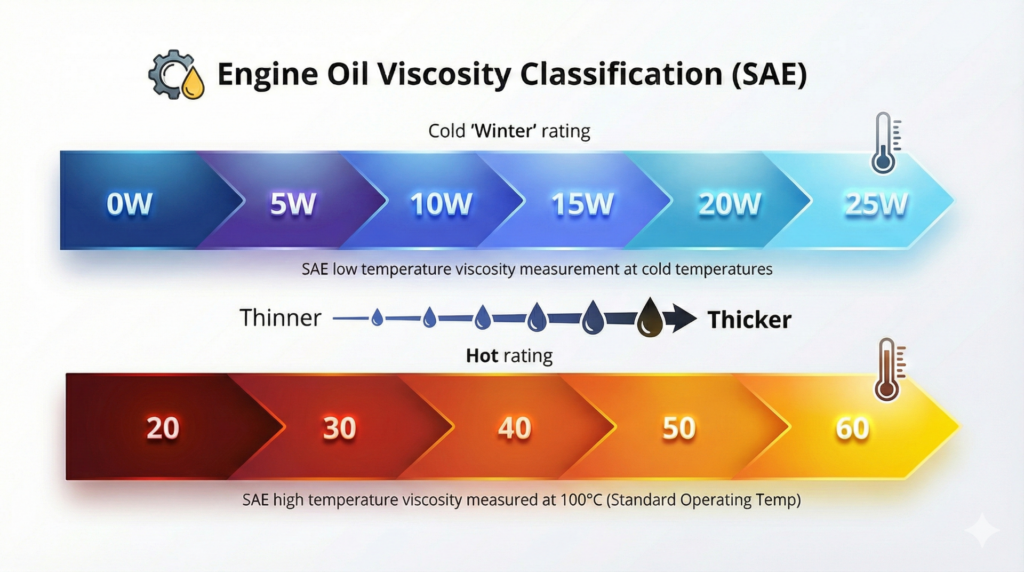
Here's the thing: experts say you shouldn't just pick the "highest" or "lowest" number. Modern cars have very tight gaps, or clearances, between their moving parts.
If you put a thick 20W-50 oil into a brand-new car that calls for 0W-20, the oil might literally be too "fat" to fit into the tiny lubricated spaces. That's a recipe for a very expensive repair bill.
So, which one should you choose?
If you're driving a car less than 10 years old and do a lot of stop-and-go driving in KL traffic, the premium fully synthetic blend is almost always worth the extra cost. It lasts longer — usually 10,000km versus 5,000km for mineral oil — and keeps your engine from turning into a "sludge factory".
However, if you're driving an older car or one that leaks a bit of oil, using mineral or semi-synthetic oil is perfectly fine. There's no point putting liquid gold into a vehicle that's going to drip it onto your driveway.
