


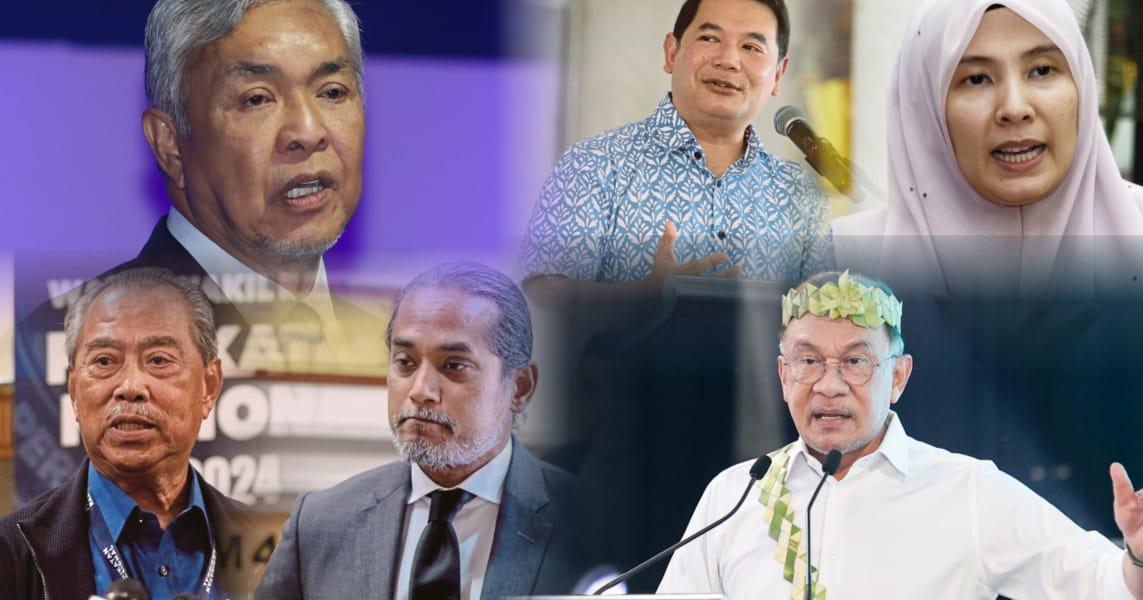
 Cover image via NSTP
Follow us on Instagram, TikTok, and WhatsApp for the latest stories and breaking news.
The government agreed on 31 January to a proposal limiting the prime minister's tenure to two terms, or 10 years
The move is seen as crucial to preventing an excessive concentration of power, strengthening democratic system, and enhancing public confidence in the nation's leadership institutions.
The Madani government held its first sitting on 19 December, 2022, and if it completes its full five-year term, Parliament will automatically dissolve on 19 December 2027, triggering an election within 60 days.
The 16th General Election (GE16) must therefore be held by 17 February, 2028.
This gives all parties about 740, as of 10 February, to prepare a potential candidate.
PKR
Nusantara Academy for Strategic Research senior fellow Dr Azmi Hassan said any term limit law would likely not apply retrospectively and would therefore not immediately affect the sitting prime minister.
"If the term limit becomes law this year, I don't think it will apply retrospectively, meaning Datuk Seri Anwar Ibrahim could still serve two more terms," he said.
However, Azmi said the more significant implication would be the longer-term impact on party leadership, warning that PKR could face challenges due to the absence of a clear succession line beyond the current leadership cycle.
He said the party's deputy president, Nurul Izzah Anwar, may still require more time and experience before being ready for the role.
"If Anwar serves another two terms, then Nurul Izzah may be ready by then," he said.
Nurul Izzah, 46, is the eldest daughter of Anwar and Datuk Seri Dr Wan Azizah Wan Ismail.
The PKR co-founder made her parliamentary debut in the 2008 General Election, winning the Lembah Pantai seat and defeating then-women's minister Tan Sri Shahrizat Abdul Jalil.
She has never held a ministerial portfolio but previously served as a senior economic and financial adviser to the prime minister.
Azmi said PKR has other senior leaders, including Datuk Seri Saifuddin Nasution Ismail, who also serves Pakatan Harapan secretary-general.
Saifuddin, the current Home Minister, has held various roles, including Domestic Trade and Consumer Affairs Minister during the Pakatan Harapan administration under former prime minister Tun Dr Mahathir Mohamad.
He also served as Dewan Negara Senator from December 2022.
Azmi said Saifuddin is well-liked by both Anwar and the majority of PKR members as well as the public, making him a strong contender for the next prime minister.
"At this juncture, I think Saifuddin is more widely preferred than Nurul Izzah and Rafizi Ramli, given his strong loyalty to PKR," he said.
Meanwhile, political analyst Prof Datuk Dr Sivamurugan Pandian said the next prime minister would likely be chosen from leaders with government and party leadership experience, proven in policy implementation, economic management, youth engagement, and reformist credentials.
On that basis, he said Anwar could be considered for another term, having met all the criteria.
"He should continue, given his proven ability to maintain political stability, drive reforms and ensure leadership succession when he eventually leaves office.
"For now, I don't think there is any clear candidate other than Anwar himself," he said.
PAS And Bersatu
Azmi said PAS would unlikely be a contender for the premiership due to a shortage of candidates.
Bersatu, however, has former prime minister and current party president Tan Sri Muhyiddin Yassin, as well as deputy president Datuk Seri Hamzah Zainudin.
But Perikatan Nasional is currently on shaky ground, with its two main components, PAS and Bersatu, at odds with each other — a situation that has eroded public confidence in the coalition.
"PAS and Bersatu are bickering right now. It does not help Perikatan Nasional, it does not help PAS, and it does not help Bersatu.
"These disputes, sometimes over very trivial matters or issues that could be resolved quickly, have been allowed to drag on due to the rivalry between Hamzah and Muhyiddin.
"As a result, Perikatan Nasional does not project the confidence needed to take over from the Pakatan Harapan–Barisan Nasional cooperation at this time," he said.
Muhyiddin had on 1 January resigned as Perikatan Nasional chairman.
Sinar Daily reported that PAS deputy president Datuk Seri Tuan Ibrahim Tuan Man has confirmed the party's intention to take over the position, with the matter expected to be finalised at a Perikatan Nasional Supreme Council meeting at the end of this month.
UMNO
UMNO, on the other hand, has plenty of options.
Azmi listed at least eight potential candidates capable of stepping up in, including party president and Deputy Prime Minister Datuk Seri Dr Ahmad Zahid Hamidi.
"Umno has many potential successors including Datuk Seri Mohamad Hasan, Datuk Seri Wan Rosdy Wan Ismail, Datuk Seri Mahdzir Khalid, Datuk Seri Johari Abdul Ghani, Datuk Seri Mohamad Hasan, Datuk Seri Khaled Nordin, Zambry Abdul Kadir, and even Pahang Menteri Besar, Datuk Seri Wan Rosdy Wan Ismail," he said.
UMNO, through Barisan Nasional, ruled the country from independence in 1957 until its historic defeat in the 14th General Election in May 2018.
However, political instability following the collapse of the Pakatan Harapan government in 2020 paved the way for UMNO's return through shifting alliances, first under Perikatan Nasional.
After the 15th General Election in November 2022, UMNO and Barisan Nasional joined forces with Pakatan Harapan to form a unity government, allowing them to return to federal power.
But what do the rakyat hope for?
Azmi said the rakyat may be looking for younger faces and a different style of leadership, beyond what existing political parties offer.
"I think people want something beyond the usual leadership from Barisan Nasional, PKR, PAS or Bersatu.
"The likes of Khairy Jamaluddin (former sports and health minister), Rafizi Ramli (former economy minister), perhaps Shahril Hamdan (former Economic Director at the Prime Minister's Office during Datuk Seri Ismail Sabri Yaakob's era), as well as Nurul Izzah.
"The public genuinely wants and trusts these types of leaders as potential future prime ministers, and that is what they envision at this time," he said.
He added that these preferences may stem from frustration with the leadership options previously offered by most political parties.
