


 Cover image via The Energy Collective
The [World Bank Data] (http://data.worldbank.org/country/philippines) states in the carbon dioxide (CO2) emission data that carbon foot prints are increasing in the Philippines
**What are the effects of the increased greenhouse gas levels? Apart from global warming, it causes ocean acidification (rise in sea level), smog pollution, ozone depletion as well as changes to plant growth and nutrition levels, according to [What's Your Impact] (http://whatsyourimpact.org/effects-increased-greenhouse-gas-levels).
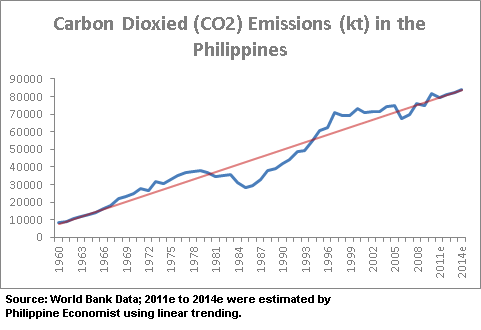
The red trend line indicates an upward sloping trend. It is estimated that carbon dioxide emission is increasing by 1.4%, on average, every year since 2006
Image via Philippine Economist
Last 21 April, Environment Secretary Ramon Paje signed the [international climate agreement] (http://www.cop21.gouv.fr/en/a-record-over-160-countries-expected-to-sign-the-paris-agreement-in-new-york-on-22-april-2016/) committing to reduce by 70 percent the Philippines's carbon emissions by 2030
The reduction will come from the energy, transport, waste, forestry and industry sectors. "Our contribution to the global problem on climate change is admittedly a droplet in the well, but streams, lakes and oceans are all composed of mere droplets. We cannot do this alone," said Environment Secretary Ramon Paje, according to [Philippine Star] (http://www.philstar.com/headlines/2016/04/22/1575599/philippines-signs-paris-climate-accord-un).

Image via Ang Kulet
But, it's never too late to take action towards carbon emission reduction! These five ways could help you reduce your own carbon footprints and help our country towards sustainable environment!

Image via Distractify
1. Walk or ride a bike
One of the easiest ways to reduce your carbon emissions is by walking or riding a bike. Whatever happened to those times that you just walk to the market with your *lola* or *nanay* every Sunday morning? Why not do it again so that you could spend some quality time with each other under the morning sun? 🙂

Image via Asia in the Heart

Image via Persis Flores
2. Use compact fluorescent bulbs
According to the Department of Energy (DOE), Compact Flourescent Lamps (CFL) last about 10 times longer and use about 75% less energy than Incandescent Bulbs. LED is even more energy efficient. Choose wisely.

Image via Facebook DEO

Image via Rebloggy
3. Unplug your chargers and appliances
**We know you're too busy to remember that you need to unplug your chargers after using it . . .**

Image via Facebook DEO

Image via Quick Meme
But did you know that even though you're not using the chargers, the fact that they are still connected to the main electricity supply, they are consuming .26 watts of energy? According to the [U.S. Department of Energy] (http://energy.gov/articles/are-energy-vampires-sucking-you-dry), unplugging your chargers from the outlet can save you $100 (almost P5,000!) each year on your energy bill — and that's just for unplugging your charger!
4. Choose laptop over desktop
Laptops are energy-efficient. According to [Bigli Bachao] (https://www.bijlibachao.com/appliances/laptop-and-desktop-energy-comparison.html), laptops typically consume 20 to 50 watts of electricity that can be trimmed down in power saver modes, while desktops on the other hand use about 60 to 200 watts!

Image via Ask Ideas
**Here's how a computer consumes electricity**:
**Active State**: The operating system is loaded and the user is actively working on the computer.
**Idle State**: The operating system is loaded and the default programs are running.
**Sleep Mode**: A low power state after a certain time of inactivity. The computer wakes up again in response to user actions.
**Standby Mode**: The computer is connected to the main electricity supply and the supply is switched on even though the computer is shut down (YES, the computer is still consuming electricity at this point).
5. Recycle your newspaper
Even in this digital world, we are still continuously producing newspaper prints every single day and that is something that we should all ponder about. The only wise thing to do at this point is to recycle these newspapers.
*Vermicomposting* is an easy and ideal way to recycle your newspaper. Vermicomposting refers to using worms to break down your organic waste. A standard vermicomposting system is made up of three key components: a bin, worms and a handful of bedding. Damp newspaper strips are the most common bedding material, meaning you can use all of your old newspaper at home if you have a worm bin set up, according to [Earth 911] (http://earth911.com/recycling-guide/how-to-recycle-newspaper/).
"The carbon content of a newspaper represents carbon dioxide that has been removed from the atmosphere," wrote Geoffrey A. Landis, a scientist at NASA's John Glenn Research Center. Countered Brad, another reader, who noted that the energy used to harvest the paper and deliver it to doorsteps must be accounted for: "The carbon footprint of a newspaper is negative.A tree does not magically transform itself into a newspaper," according to [New York Times] (http://www.nytimes.com/2009/04/20/technology/20green.html?pagewanted=all&_r=2).

Image via HP Wikia

Image via Giphy
