


 Cover image via New Straits Times
Malaysia may be poised to becoming a high-income nation as soon as 2020, but most of its rakyat will still be earning less than the national average income even when the country achieves the status
According to the Malaysian Economic Monitor (MEM) that was released yesterday, 14 December, the World Bank estimates that Malaysia's gross national income per capita will pass the high-income threshold of USD12,236 (RM50,014) sometime between 2020 and 2025.

Even then, more than half of Malaysians will still be earning less than RM50,014 per year because the distribution of income in Malaysia is skewed towards the rich
According to a report by The Edge Markets, the World Bank posits that ensuring income equality is and will remain the challenge Malaysia faces in the years to come.

Image via Cilisos
Be that as it may, World Bank director for Regional Partnerships, Malaysia, and Thailand Dr. Ulrich Zachau pointed out that the phenomenon "is not unusual or unique to Malaysia"
As for how Malaysia can work towards achieving the high-income target, the World Bank's analysis show that it will depend on various factors, including the exchange rate, population growth, and internal forecasts of gross domestic product (GDP).

Ulrich Zachau, World Bank Director for Regional Partnerships, Malaysia, and Thailand.
Image via The Phnom Penh Post
The World Bank also pointed out that lower-income households in Malaysia are most affected by rising inflationary pressures
"The poorest 10% of Malaysians spend almost 70% of their income on food and housing alone," he was quoted to have said by The Edge Markets, adding that increases in the cost of living have affected the urban poor the most.
Citing the 2016 Household Expenditure Survey Report, the MEM further highlighted that household expenditure across income brackets show that urban households face higher food price inflation compared to those in rural areas (see chart above).
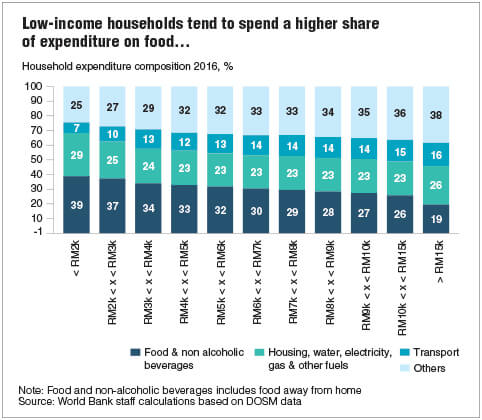
Image via The Edge Markets
