


 Cover image via
Follow us on Instagram, TikTok, and WhatsApp for the latest stories and breaking news.
Most Malaysians only have a narrow 26-year window to actively build their wealth, according to new findings by the Department of Statistics Malaysia (DOSM)
Chief Statistician Datuk Seri Mohd Uzir Mahidin said data from the National Transfer Accounts shows that income only significantly exceeds spending between the ages of 29 and 55, reported the Malay Mail.
"That period is about 26 years — your strongest earning phase, which is why you must use this window wisely by managing spending and delaying consumption now to increase your surplus for the future," he said today, 29 April.

The National Transfer Accounts framework compares labour income against consumption across a person's lifetime.
The data highlighted two extended deficit phases in a Malaysian's life — at the beginning and end of life — with a relatively short surplus period in between.
In other words, from birth to age 28, Malaysians are in a "life cycle deficit", where spending surpasses income. This gap is largely covered through public and private support, including family assistance and government education funding.
Even after entering the workforce, many young adults still do not earn enough to fully cover their expenses.
However, a turning point occurs at age 29, when individuals begin generating surplus income — earning more than they spend. This phase continues until age 55 and represents the core of economic contribution.
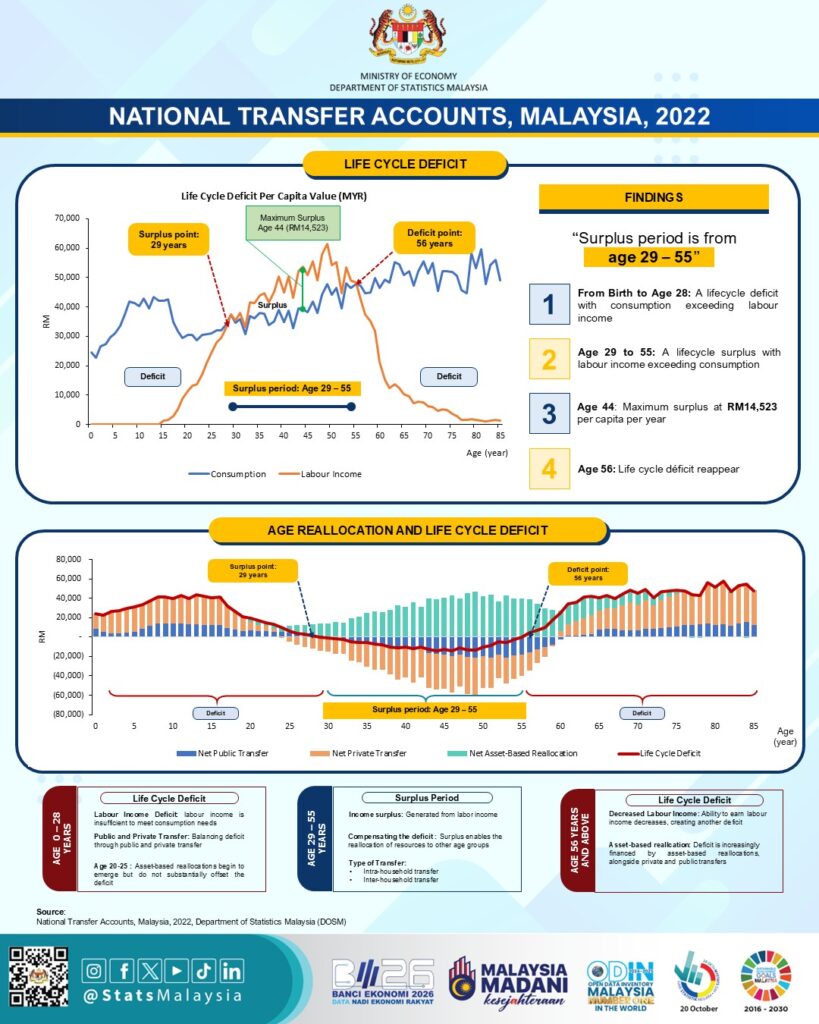
At its peak, the annual surplus reaches RM14,523 per capita at age 44, marking the most financially productive stage of life
"This surplus is not just for yourself — it is transferred to support other age groups," Mohd Uzir said, noting that it flows into both household support and broader economic contributions.
However, the window is short-lived. From age 56 onwards, Malaysians return to a deficit as income declines, increasingly relying on savings, investments, and transfers to support their expenses.
"As labour income reduces, individuals depend more on assets and support systems to sustain consumption," he said.

Mohd Uzir emphasised that these life cycle patterns highlight the importance of early financial planning and adopting a long-term approach to money management
He also warned against common financial pitfalls, particularly among younger workers who upgrade their lifestyles too quickly.
"Saving is about delaying current consumption for future use," he said. "But it must be done wisely, especially with inflation in mind."
He added that major early expenses — such as buying expensive cars — can significantly reduce one's financial surplus, stressing the importance of continued investing to build savings over time.
