


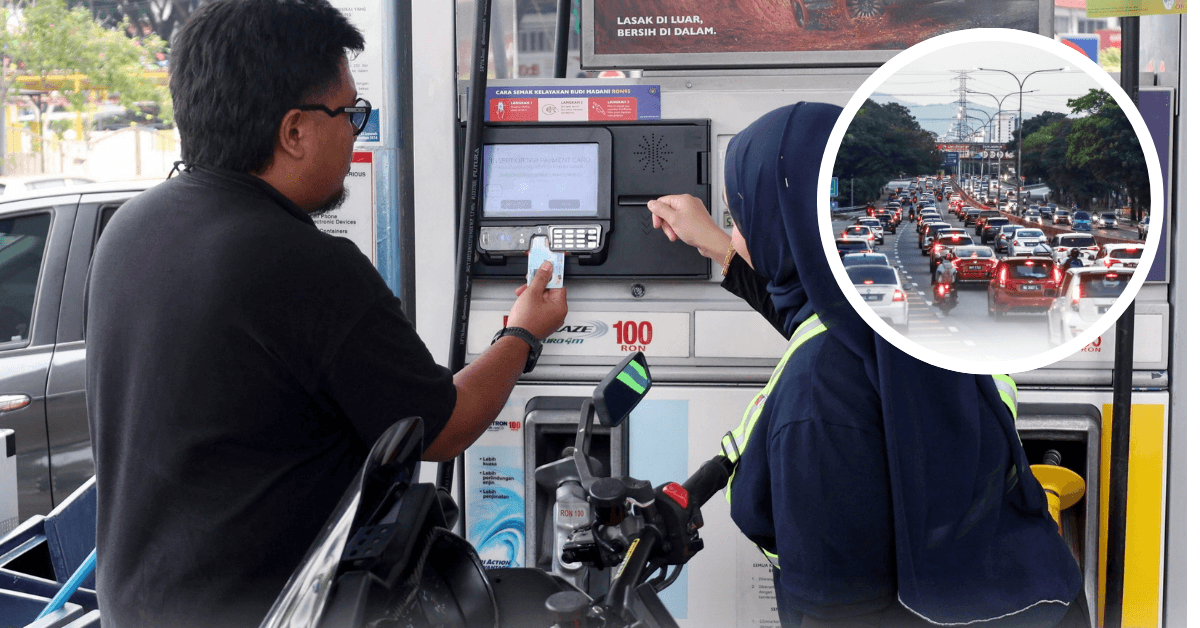
 Cover image via NSTP
Follow us on Instagram, TikTok, and WhatsApp for the latest stories and breaking news.
Starting from 1 April 2026, Malaysians will see their petrol subsidy slashed from 300L to 200L
The government said the move is necessary to manage rising subsidy costs amid rising fuel prices caused by the Middle East conflict.
It was reported that only 10% of Malaysians, or about 1.6 million, are expected to be affected, as 90% of the population consumes less than 200L per month.
So, how far can 200L take you?
Using findings from a study conducted by researchers at Universiti Teknologi Malaysia (UTM), automotive expert Dr Mohd Azman Abas outlined what drivers can expect.
For compact passenger vehicles with 1.3L and 1.5L engines, mileage varies depending on road conditions.
Drivers in rural areas are expected to see the lowest range, between 2,500 and 2,600km por 200L.
Driving in rural areas typically requires higher alertness, as drivers must watch out for unexpected hazards such as wildlife, slow-moving agricultural machinery, narrow lanes, and poor road conditions — all of which can affect fuel consumption.
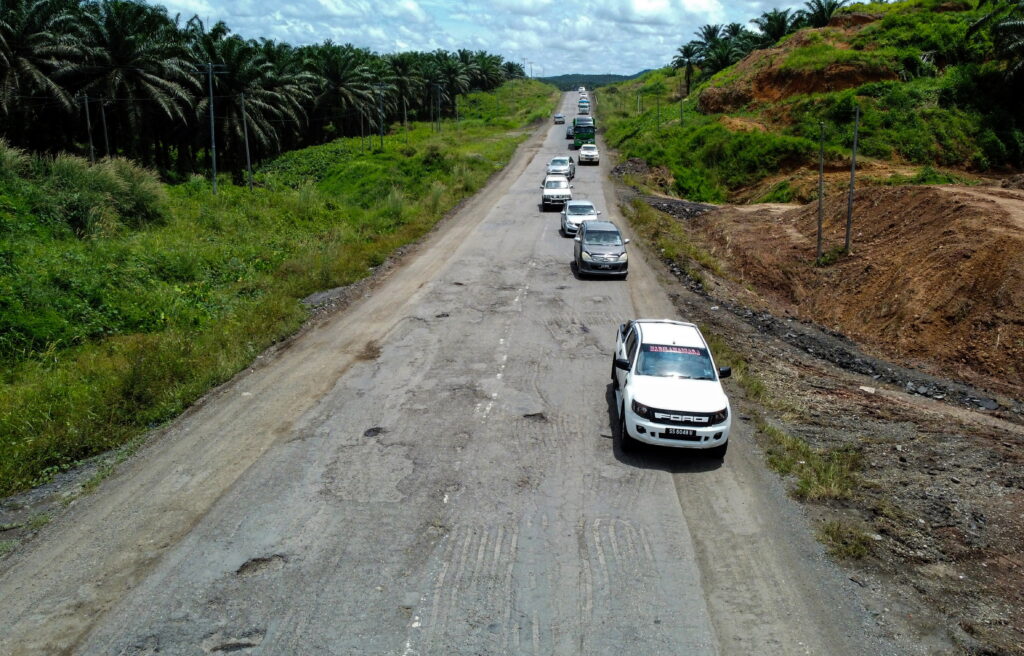
In rural areas, drivers would see the lowest range of between 2,500 and 2,600km.
Image via NSTPMohd Azman also said frequent acceleration consumes more petrol.
In urban areas, drivers can expect a higher range of 2,500km and 3,300km per 200L.
Those who stick to motorway driving — maintaining high concentration, adhering to speed limits, and keeping left unless overtaking — could stretch their distance to 2,200km and 3,400km.

Dr Mohd Azman says driving safely on the highway, following speed limits, can help you go further.
Image via Dr Mohd Azman Abas (Provided to SAYS)The UTM Mechanical Engineering senior lecturer said these estimates are based on the study's finding that a 1.3L car recorded fuel economy of between 7.46L and 8.98L per 100km under normal driving conditions.
The study also found that 1.5L a car performed slightly better, with fuel economy ranging from 5.74L to 7.74L per 100km.
So, what do these numbers actually mean for your daily commute?
If you take the urban range provided by Mohd Azman, averaging around 2,900km per month, the 200L quota is surprisingly generous for the average city dweller.
For a 'Budak Shah Alam' living in Seksyen 7 and working in the heart of KL, a daily round trip is roughly 50km.
With the new limit, you could make that drive 58 times a month, enough to cover your commute to work, your weekend grocery runs, and still have plenty of room for those late-night mamak sessions.
If you're the type to head outstation on weekends, the motorway stats are even more reassuring.
Using the higher end of the study's motorway range of 3,400km, you could drive from Shah Alam to Penang (about 700km round trip) and back nearly five times before you ever have to worry about paying the market price of RM3.87.
Driving a turbo SUV? The difference can be huge
For those travelling in a 1.5-litre turbo SUV, the distance varies greatly depending on terrain.
Drivers going uphill may only reach approximately 1,200km, while downhill travel could stretch up to 4,300km, Mohd Azman said.
What about MPV users?
For MPV users, urban driving could provide around 1,800km.
However, this drops slightly to about 1,600km in rural driving.
Motorway driving offers better efficiency, with distances reaching up to 2,100km.
Here's how much you should be driving daily
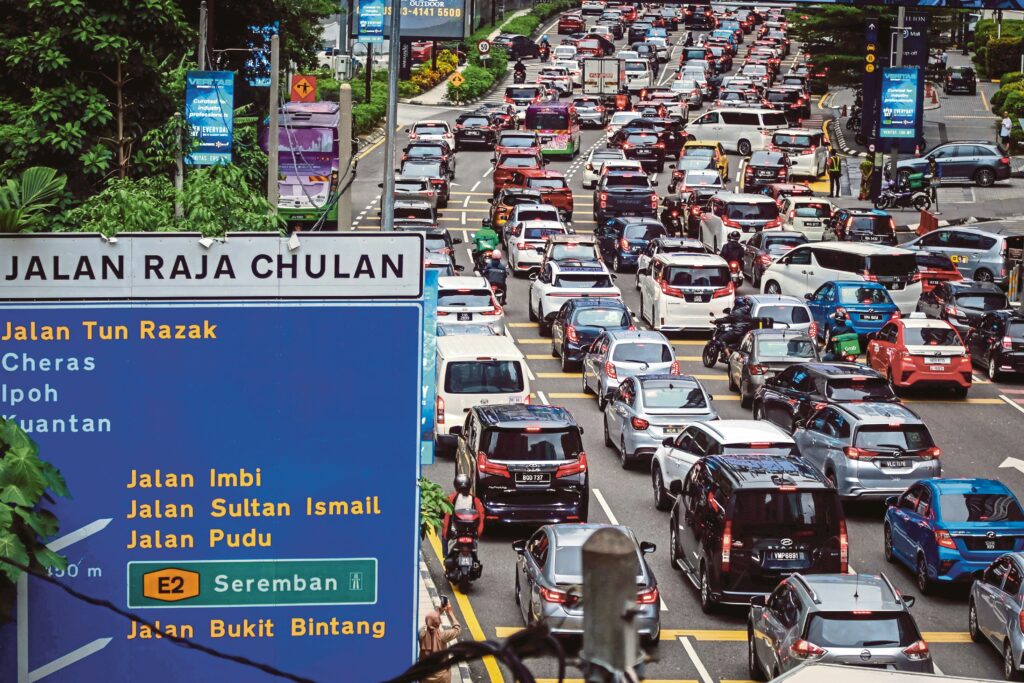
Daily travel can range roughly from 60 km to 100 km, depending on vehicle size.
Image via NSTPBased on the findings, compact vehicle users should aim to limit their daily travel to around 80km to 100km to remain within the 200L monthly threshold.
For larger vehicles such as SUVs and MPVs, the recommended daily travel is slightly lower, at around 60km to 80km per day due to higher fuel consumption.
But real-world driving is a different story
Mohd Azman noted that these calculations represent an idealised scenario, and actual driving conditions can significantly affect fuel consumption.
One major factor is traffic congestion, where vehicles spend long periods idling without moving.
"Based on our experimental observations, a typical passenger car consumes approximately one liter of fuel per hour simply while idling. This means that hours spent stuck in traffic can quickly reduce the available fuel reserve without contributing any additional travel distance.
"The stop-and-go traffic conditions which require drivers to frequently accelerate from a complete stop and each acceleration demands a richer air-fuel mixture, which further increases fuel consumption and reduces the overall distance the vehicle can travel," he said.
Driving behaviour also plays a crucial role
Image for illustration purposes only.
Image via AI Generation/GeminiAggressive habits such as rapid acceleration, hard braking, and maintaining high speeds can significantly increase fuel usage.
"Smoother driving — maintaining steady speeds and anticipating traffic flow — can help improve fuel efficiency and extend the vehicle's travel range," he added.
Mohd Azman also noted that the study was based on a limited sample of vehicle types and engine configurations, and should be used as a general reference rather than a reflection of all vehicles in the Malaysian market.
