


 Cover image via
Follow us on Instagram, TikTok, and WhatsApp for the latest stories and breaking news.
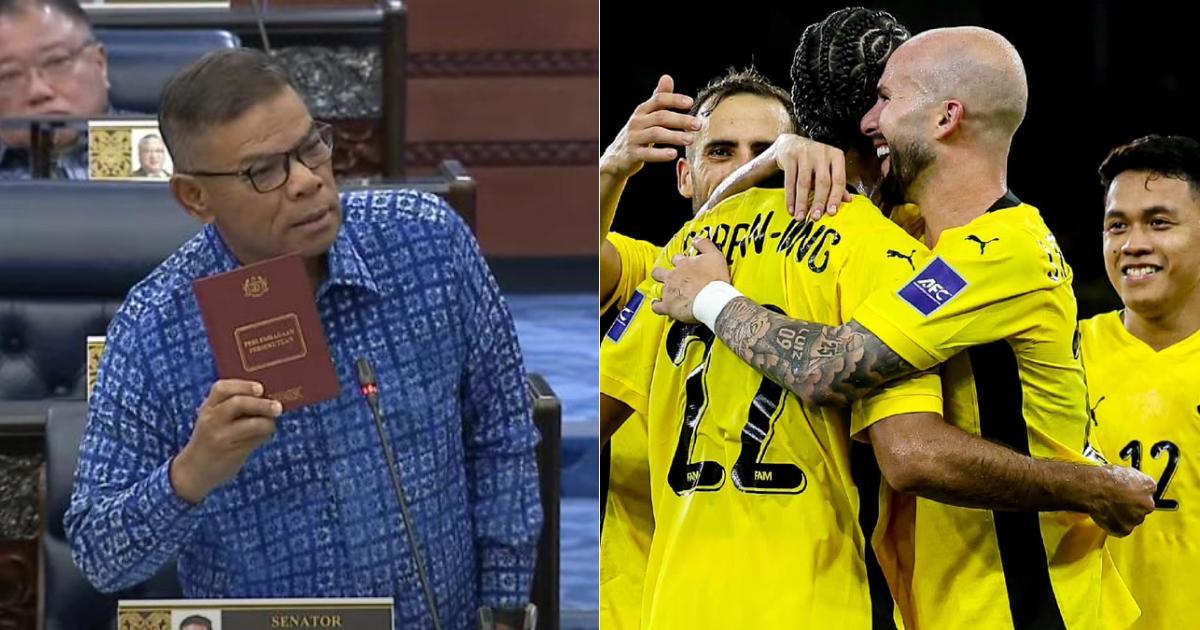
Home Minister Datuk Seri Saifuddin Nasution Ismail told the Dewan Rakyat that he used his constitutional discretion to waive the residency requirement for the seven heritage footballers whose Malaysian citizenship has come under scrutiny
Speaking during Minister's Question Time today, 9 October, Saifuddin said Article 20(1)(e) of the Federal Constitution allows the home minister to consider an applicant as a resident in Malaysia even if they had spent time abroad.
"In the constitution, there is a section called 20(1)(e), where the minister can use his discretionary powers.
"The power under 20(1)(e) means that the definition of 'residency' in the constitution allows for the applicant's presence outside the country to still be considered as being within the country," he said.
"That is the legal language used in this book, in this text. I applied Article 20(1)(e) to fulfil the residency requirement," he said while holding up a copy of the Federal Constitution.

What is Article 20(1)(e)?
The provision cited by Saifuddin is found under the Third Schedule, Part III of the Federal Constitution, which outlines the interpretation of residency for the purpose of citizenship applications, according to Malaysiakini.
It reads, "In calculating, for the purposes of Part III of this Constitution, any residence in the Federation, a period of absence from the Federation for any other cause prescribed generally or specially by the Minister, shall be treated as residence in the Federation."
This means the minister has the discretionary power to consider certain applicants as meeting the residency requirements, even if they were not physically present in Malaysia for the full prescribed period.
Saifuddin said all seven players were granted citizenship through naturalisation under Article 19 of the Federal Constitution
Under Article 19, which governs the process for foreigners seeking to become Malaysian citizens, applicants must:
- Apply personally — not through an agent;
- Have resided in Malaysia for a minimum period of 10 years within the 12 years immediately preceding your application;
- Be of good character and behaviour;
- Demonstrate sufficient proficiency in Bahasa Malaysia; and
- Go through the full process outlined under the Citizenship Rules 1964.
"For a foreigner to be considered for Malaysian citizenship through naturalisation, they must make the application personally, demonstrate good behaviour, and have proficiency in Bahasa Malaysia. The application then goes through a process as stipulated under the Citizenship Rules 1964," he said.
Saifuddin stated that the seven footballers had met all the requirements under Malaysian law, including demonstrating an adequate command of Bahasa Malaysia.
"They have enough Bahasa Malaysia knowledge — or as described by Jerlun (MP Abdul Ghani Ahmad), sufficient. Meaning that they can understand what we say," he told the Dewan Rakyat.
He added that their proficiency was evaluated through a basic language test conducted by the National Registration Department (JPN).
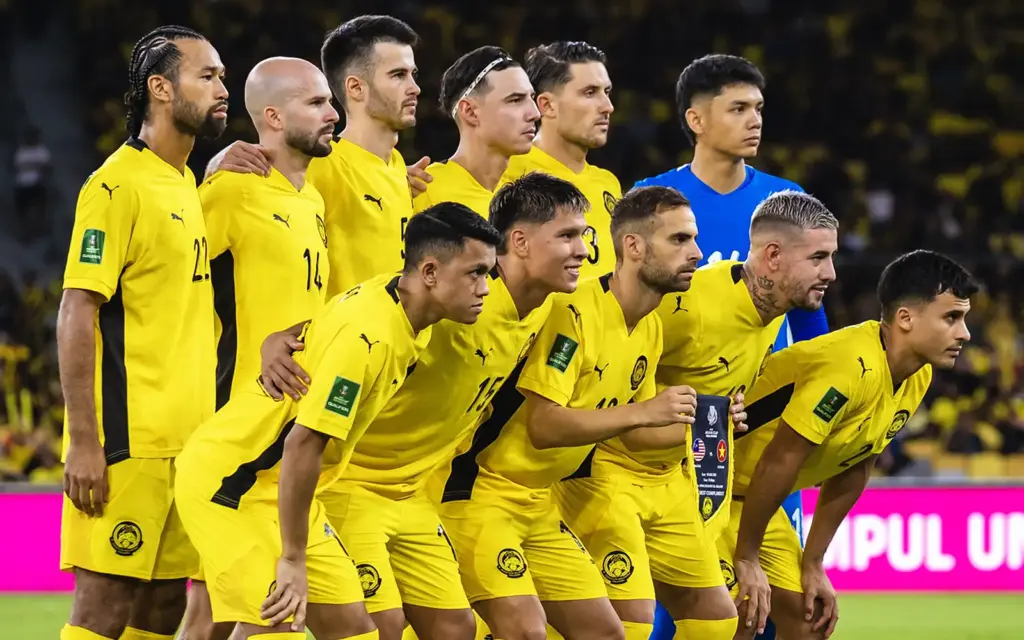
Addressing FIFA's findings that alleged falsified documentation was used to naturalise the seven players, Saifuddin stressed that no falsification occurred on the government's side
He explained that JPN issued birth certificates for the players' grandparents in accordance with Section 10(a) of the Births and Deaths Registration Act 1957, which empowers the Registrar-General to register births if satisfied with the evidence provided.
"For this case, information on the grandparents' births was submitted to the birth register after the director-general approved the evidence and details presented during interview sessions," he said.
He reiterated that JPN had found no evidence of falsification in its verification process, as all information for the birth certificates had been submitted by the players themselves.
The controversy began when FIFA sanctioned the Football Association of Malaysia (FAM) and seven Harimau Malaya players on 26 September, citing violations of Article 22 of the FIFA Disciplinary Code, which pertains to forgery and falsification
FIFA's disciplinary committee found that falsified documents had been used to confirm the players' eligibility to represent Malaysia in the 2027 Asian Cup Qualifiers against Vietnam on 10 June, which Malaysia won 4-0.
As a result, FIFA sanctioned FAM and imposed a fine of RM1.9 million, while also fining each player RM10,500 and suspending all seven players for 12 months from football-related activities.
The players are:
- Gabriel Felipe Arrocha
- Facundo Tomas Garces
- Rodrigo Julian Holgado
- Imanol Javier Machuca
- Joao Vitor Brandao Figueiredo
- Jon Irazabal Iraurgui
- Hector Alejandro Hevel Serrano
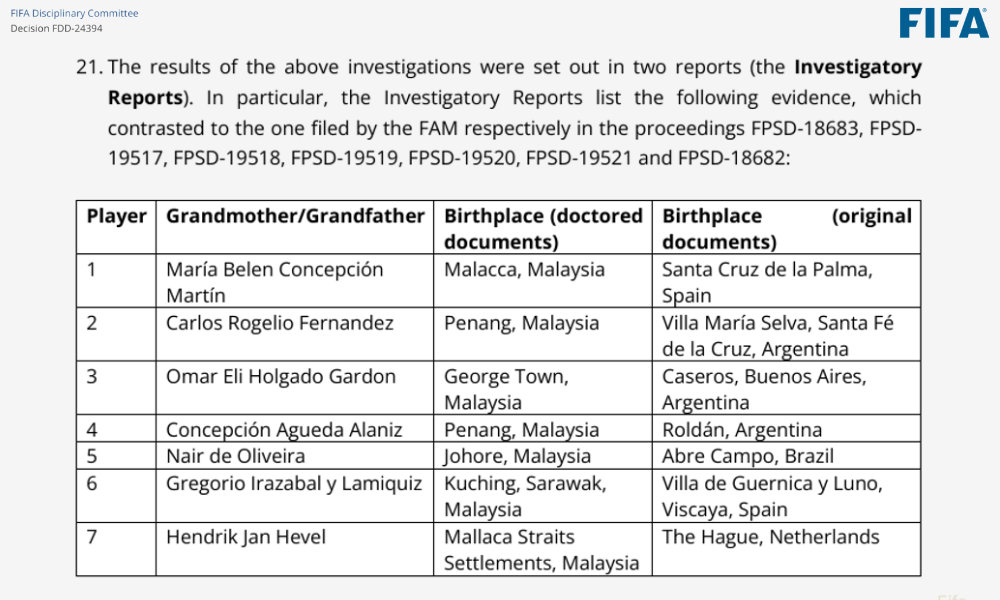
In its ruling made public earlier this week, FIFA said it had obtained the original birth documents of the players' purported Malaysian-born grandparents, which contradicted the documents submitted by FAM. This discrepancy formed the basis of its conclusion that falsified information had been provided.

However, Saifuddin said that the requirements imposed by FIFA, particularly the need to prove a player's ancestral link through birth certificates, do not apply under Malaysian citizenship law
He clarified that under Article 19 and the Citizenship Rules 1964, applicants are not required to submit grandparents' birth certificates when applying for citizenship.
"When we processed the applications, everything was verified according to the Form C checklist. The birth certificate is not even a required document under this category of citizenship application.
"When FIFA claimed there was document forgery, it did not mean the documents came from us. On our side, the only document issued is the birth certificate," he said.
The birth certificates, he stressed, were lawfully issued under Section 10A once the Registrar-General was satisfied with the supporting evidence provided during the verification process.
"I used authoritative sources. To obtain citizenship, there's no requirement for grandparents' birth certificates," Saifuddin added.
The home minister said the confusion arose because FIFA's eligibility statutes, which determine whether a player can represent a country, have separate criteria from Malaysia's naturalisation process
Under FIFA's statutes, a player may represent a country if they:
- a) Were born in that country
- b) Have a biological parent born there
- c) Have a grandparent born there, or
- d) Have lived continuously in that country for at least two years.
Saifuddin said this distinction is key as Malaysia's constitution governs who becomes a citizen, while FIFA's statutes determine who qualifies to play for a national team.
"FIFA has its own statute, which relates to heritage players and their eligibility. That is for FIFA and FAM to resolve," the Home Minister said, adding, "From a constitutional point of view, it is very clear."
However, sports lawyer Nik Erman Nik Roseli told the New Straits Times that the path to a successful appeal for FAM and the seven sanctioned players appears fraught with legal hurdles.
He explained that FIFA's case hinges on strict liability, meaning FAM bears full responsibility for verifying player eligibility, regardless of whether it relied on government validation.
Nik Erman also dismissed FAM's view that the breach was merely "technical", saying the issue isn't about the players' citizenship status but the means used to prove their heritage.
"This is not a question of whether they are Malaysians under national law. FIFA is not questioning the JPN for granting nationality. It is questioning the eligibility of players to play for Malaysia under FIFA statutes," he said.
He added that even if the players can prove their Malaysian lineage through legitimate documents, FIFA's decision would likely stand, as it was based on the allegedly forged documents originally submitted.
Saifuddin also revealed that since 2018, 23 football players have been granted Malaysian citizenship through naturalisation under Article 19
"Since 2018, 23 football players have been granted citizenship through naturalisation under Article 19," he said.
He disclosed that the Home Ministry currently has 49,000 citizenship applications on record, with 6,000 still pending a decision since he took office.
He reiterated that the decision to approve the seven players' citizenship was made in full compliance with the Federal Constitution and the Citizenship Act, and exercised with due ministerial discretion under Article 20(1)(e).
