


 Cover image via
Follow us on Instagram, TikTok, and WhatsApp for the latest stories and breaking news.
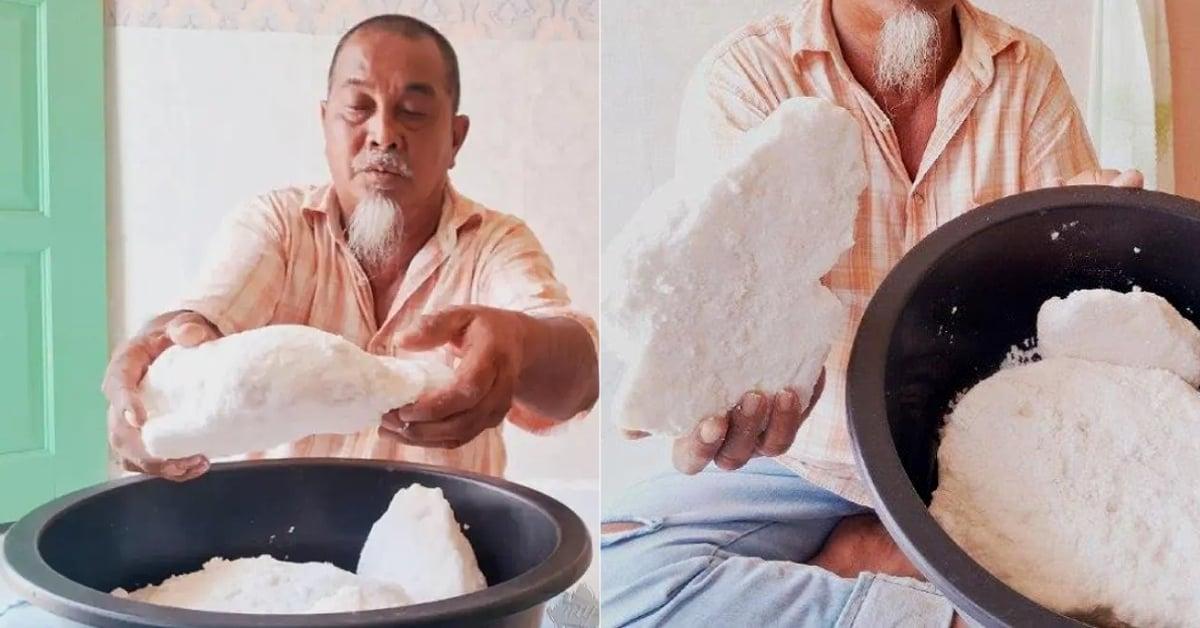
A fisherman in Terengganu has claimed he found a lump believed to be whale vomit, or ambergris, floating in the sea off Kuala Kemasik last week
According to Harian Metro, Mohd Raffi Yusoff, 58, discovered the wax-like object while squid jigging about four nautical miles off the coast at around 6pm last Thursday, 30 April.
"During the trip, I saw a white object floating up and down. At first, I thought it was a buoy.
"I approached it and found that it was a heavy, waxy lump," he said when met at his home in Kampung Gong Chengal.

Mohd Raffi said the object weighed around 20kg, but he only managed to retrieve about 5kg after cutting a portion of it and bringing it onto his boat
"It was very heavy. When touched, it was quite soft and smelled pleasant. I only took about 5kg, while the rest was carried away by the water. I was curious about the object, but also a bit worried since I was alone on the boat," he said.
He added that the object continued giving off a strong, pleasant fragrance throughout the evening while he was out at sea.
After returning home at around 11pm, he showed the lump to his wife, Zuliza Harun, 39, who searched online to identify the mysterious substance.
"From the search, we found that it might be whale vomit. I burned a small piece of it, and it released a fragrant smell," he said.
The fisherman has since agreed to send the object to Universiti Malaysia Terengganu (UMT) for testing to verify whether it is genuine ambergris
"If it is truly whale vomit, I am very grateful and willing to sell it to any interested parties," he said.

What is ambergris?
Ambergris, often referred to as "floating gold", is a rare substance produced in the digestive tract of sperm whales, an endangered species.
As squid makes up a large part of a sperm whale's diet, the whale produces a compound called ambrein to help protect its digestive system from sharp squid beaks.
Over time, the digested material is expelled either through regurgitation or as faecal matter before floating in the ocean for months or even years.
As it ages and oxidises in seawater, the substance hardens into a waxy lump and develops a unique scent prized by perfume makers for its ability to help fragrances last longer.
According to South China Morning Post, ambergris can reportedly fetch up to USD40,000 (about RM160,000) per kg depending on its quality and purity.
However, experts say not every waxy object found at sea is genuine ambergris
In 2021, a woman in Marang, Terengganu also found a floating wax-like lump she believed to be whale vomit and sent it to UMT for testing.
According to a 2026 Kosmo! report, laboratory analysis later confirmed that the object was merely a compound of organic material with no commercial value.
The sample did not contain the three key active compounds found in genuine ambergris — ambrein, epicoprosterol, and coprostanone.
A UMT expert previously said ambergris needs to contain specific levels of the three active compounds to be considered of high value.
