


 Cover image via Jakub Porzycki/NurPhoto/AFP
Follow us on Instagram, TikTok, and WhatsApp for the latest stories and breaking news.
UPDATE, 6 MAY:
NUMed Responds After UK Law Shut Malaysian-Based Medical Students Out Of NHS Training
On 5 March 2026, a piece of UK legislation called the Medical Training (Prioritisation) Act 2026 received Royal Assent and drastically changed the career trajectories of nearly 850 medical students in Malaysia
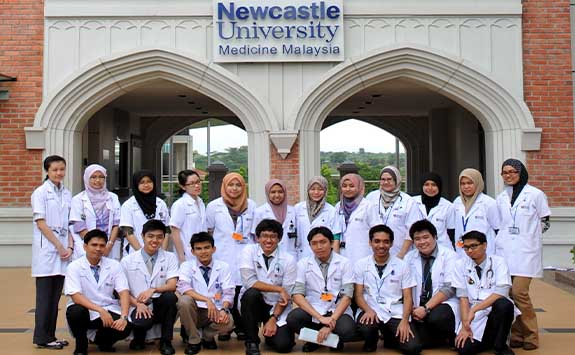
Those students are enrolled at Newcastle University Medicine Malaysia (NUMed) in Gelang Patah, Johor.
It is the only medical programme in Malaysia recognised by both the Malaysian Medical Council (MMC) and the UK's General Medical Council.
Their degrees are conferred by Newcastle University in the UK.
Their curriculum is identical to what students study on campus in England. And yet, under this new law, they are now effectively shut out of the very healthcare system their degree was designed to connect them to.
So what does the law actually do?
The Act was created in response to growing concerns that UK-trained doctors are facing increasing competition for training posts from overseas-trained doctors.
Applications for speciality training had risen from 12,000 in 2019 to nearly 40,000 this year, according to NHS Employers, the employers' organisation for the National Health Service (NHS) in England.
UK Health Secretary Wes Streeting, who introduced the Bill in the House of Commons in January, framed it as a workforce sustainability issue, arguing that the NHS should not be poaching staff from countries desperately short of their own medical practitioners while leaving a domestic pool of willing recruits without jobs.
The law works by creating a priority queue for two critical entry points into UK medical practice: the UK Foundation Programme (UKFP) and speciality training.
The UKFP is the mandatory two-year training programme that bridges medical school and full GMC registration; without it, you cannot practise as a fully qualified doctor in the UK.
Under the Act, places on the UKFP must first be offered to UK medical graduates and defined "priority groups" before any other eligible applicants, according to the British Medical Association (BMA), the trade union and professional body for doctors in the UK.
Those priority groups include graduates from Ireland, Iceland, Liechtenstein, Norway, and Switzerland — countries with existing international agreements with the UK — as well as certain applicants based on immigration status, such as those with indefinite leave to remain or EU settled status.
NUMed graduates are not in any of those groups.
| Priority Level | Included Student Groups |
|---|---|
| Top Priority |
UK Medical Graduates Graduates from Ireland, Norway, Iceland, Liechtenstein, and Switzerland |
| Non-Priority (Reserve List) |
NUMed (Malaysia) QMUL (Malta) All other International Medical Graduates (IMGs) |
Source: Medical Training (Prioritisation) Act 2026 / UKFPO Eligibility Guidelines
What does "UK medical graduate" mean under this law?
The UK government clarified during parliamentary debates that "UK medical graduate" under the Act excludes anyone who spent all or the majority of their training time outside the British Isles.
NUMed's five-year MBBS programme is based in Iskandar Puteri, Johor.
The degree is British.
The physical training is not.
The new law requires physical presence in the UK.
Training posts are now reserved exclusively for students who complete their studies within the UK.
For the current graduating cohort of 107 NUMed students, and the 750 following them, this creates what one commentator has called a "policy wall", relegating them to a reserve list that is effectively a career dead end in a system where UK-based graduates fill available slots.
The money involved
Malaysian students at NUMed pay almost RM500,000 for the five-year programme.
International students pay nearly RM700,000.
These are fees paid for a qualification that has, until now, functioned as a credible pathway into UK medicine. That pathway has not been abolished, but it has been made substantially harder to walk.
The UK parliament noticed the problem, but passed the law anyway
The issue of UK branch campus students did come up during the Bill's passage through the UK parliament.
Health and Social Care Committee chair Layla Moran raised it in the Commons, pointing out that graduates of institutions such as NUMed, Queen Mary University of London in Malta, and St George's in Cyprus are excluded from the Bill.
She noted that a vice chancellor had written to her to say that graduates of these programmes "complete the same medical degree, receive the same accreditation, and the majority then go on to train and work in the UK".
The government's position was that extending priority to all UK nationals regardless of where they trained would create a different problem.
Minister of State for Secondary Care Karin Smyth argued that doing so "would risk a significant increase in the pool of prioritised doctors who would compete with UK-trained doctors" and "would incentivise the expansion of the market for overseas medical schools".
The amendment was rejected, and the Bill passed largely unamended.

What NUMed said
A NUMed spokesperson said the university recognises that the changes are "deeply distressing and unsettling" for students who had hoped to pursue careers in the UK.
The spokesperson acknowledged that NUMed had "consistently been clear that access to postgraduate training is not guaranteed" but that "the ability of many graduates to progress into the UK Foundation Programme in recent years has understandably shaped student expectations".
The university said its immediate priority is helping students "explore all available options".
The double bind for international students
The situation is more acute for NUMed's international student intake.
For the 40% to 50% of students who are not Malaysian citizens, there is no straightforward alternative, excluded from the UK system by the Act, and barred from the Malaysian healthcare system due to citizenship requirements for local housemanships.
This is despite Malaysia currently having over 5,000 vacant housemanship positions in the Ministry of Health system.
What happens now?
The Act itself doesn't use cut-off dates; anyone who comes to the UK and gains "significant NHS experience" will, in time, be able to apply for training on equal footing with UK graduates.
What "significant NHS experience" means is still being worked out ahead of the 2027 intake.
For now, NUMed graduates who want to practise in the UK will need to find another route in, one that, for many, will require relocating, additional funding, and years of waiting that were not part of the original plan when they enrolled.
