


 Cover image via SAYS.com
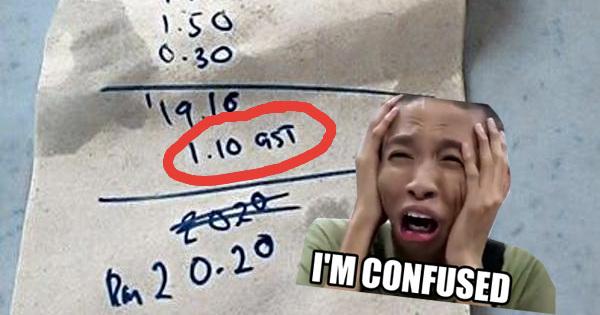
With the new GST tax implemented, many are still confused over the calculations of their bills

To avoid further confusion, we attempt to crack the GST code by breaking down the receipt.
1. This will help you understand the different components of the receipt:
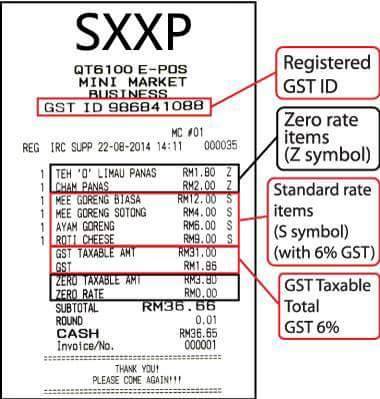
If the retailer is registered, great. The 6% tax is applicable and you are not being cheated. However, if the retailer is **not** found in the registry, the next measure should be to lodge a report with the [Ministry of Domestic Trade, Co-opperatives and Consumerism](http://e-aduan.kpdnkk.gov.my/).
2. The GST ID code is to know if a retailer is officially GST registered with the Customs Department
3. 'S' and 'Z' are the acronyms of what they stand for, standard-rated supply and zero-rated supply
'S' are **standard rated** supplies that are taxable goods and services. 'Z' stands for **zero-rated** supplies which are goods and services that are not taxed upon consumers. The GST is not charged on consumers because companies pay for it beforehand and claim it from the government as Input Tax Credit.
**Input Tax** is the GST charged on the purchase of goods and services used in the business stage. The input tax means it is claimable by businesses registered under the GST registry.
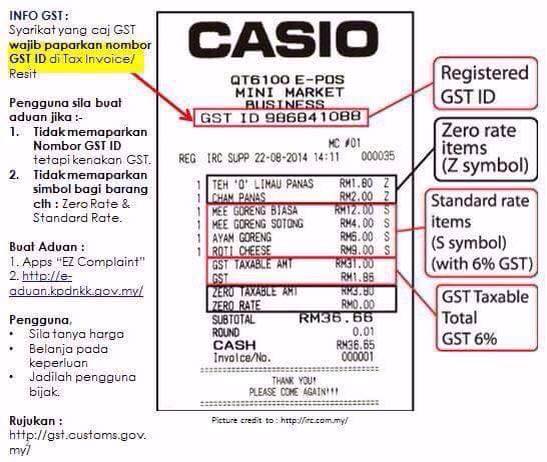
Image via Sharina Shariff via Facebook
4. Places like restaurants and hotels apply service charges to the bill. In the case of an eatery, besides the 6% GST taxed on food, another 6% will also be taxed on the service charge.
The difference is caused by the 6% GST on service charge. For example, using the first item on the left receipt that costs RM19.50:
**Old way of taxing**
The 10% Sales and Services Tax and 6% Government Tax are each calculated separately on the RM19.50.
Sales and Service Tax 10% of RM19.50 = RM1.95
Government Tax 6% of RM19.50 = RM1.17
Total Tax = 1.95 + 1.17 = RM3.12
Hence, your grand total will be RM19.50 + RM3.12 = RM22.62
**New way of taxing**
The same is applied for the new way and with the addition of applying the GST on the service charge as well.
Service Charge 10% of RM19.50 = RM1.95
GST 6% of RM19.50 = RM1.17
GST 6% on top of Service Charge = RM0.117 (roundup RM0.12)
Total Tax = 1.95 + 1.17 + 0.12 = RM3.24
Hence, your grand total will be RM19.50 + RM3.24 = RM22.74
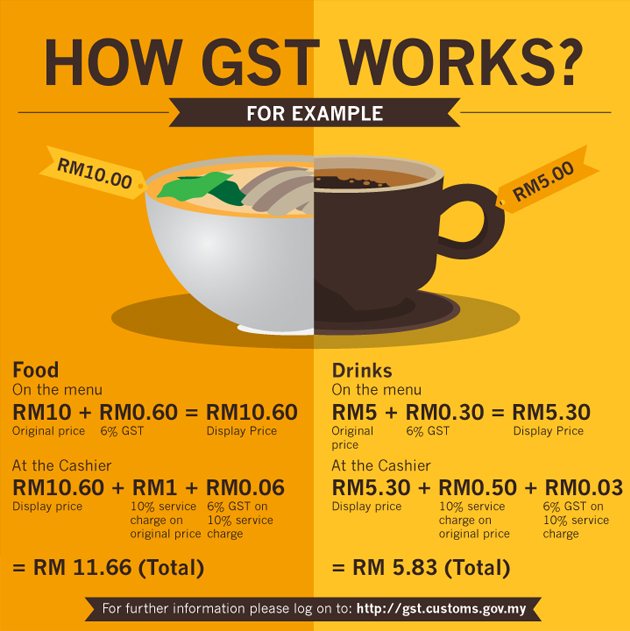
Image via Astro Awani

5. Another example of a GST receipt would be Najib's grocery shopping from Giant hypermarket
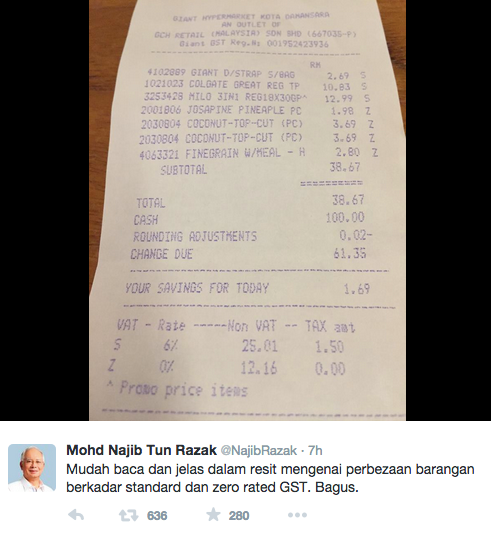
Image via Twitter via Datuk Najib Tun Razak
Below the receipt, **VAT** stands for Value-Added Tax, which is another name for GST**.
Items 'S' (standard-rated supply) and 'Z' (zero-rated supply)** are separated to their respective categories. Item S is calculated with the 6% GST and the total amount of RM1.50 is the tax for the groceries.
With all the confusion, some retailers are taking advantage of the situation. Here are 4 tips to avoid being a victim of GST fraud:
I) Always check for the GST ID code on the receipt as only registered retailers are allowed to implement the 6% tax
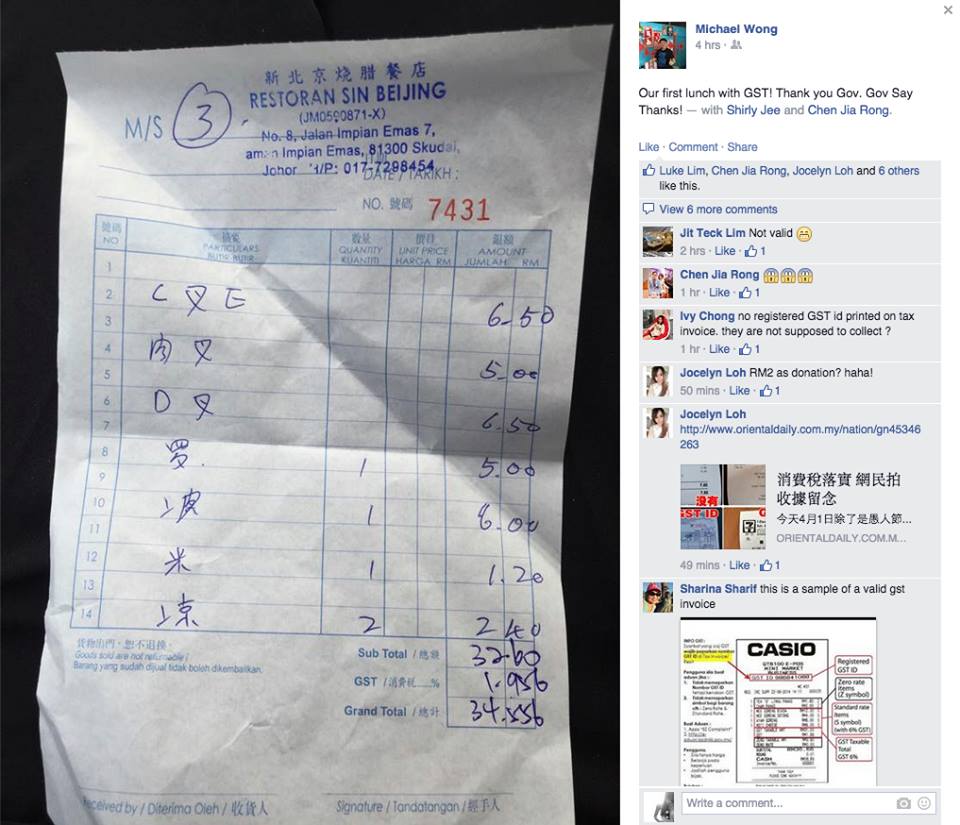
Image via Michelle Soh via Facebook
II) Check if the receipt is printed. Calculating GST requires a computerised audit system, handwritten receipts are not allowed.
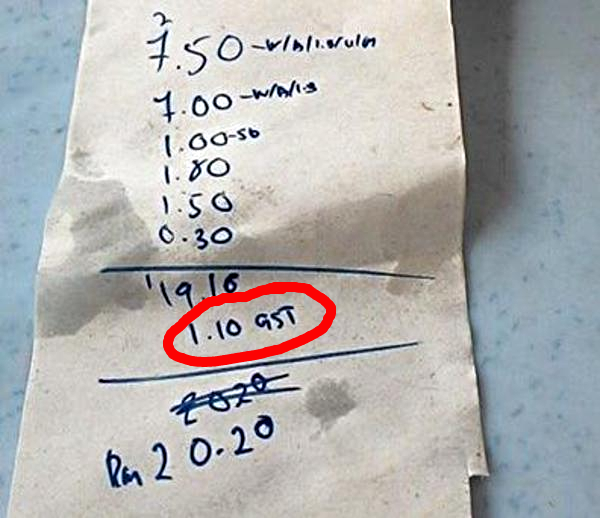
Image via FizGee Dak Pizs
III) Roughly estimate the annual income of the retail
According to GST.com, retailers have to earn a minimum of RM500,000 per annum before they are GST-taxable. This is to ensure that small businesses can survive by being GST-free and are not required to bear the costs of registration. However, retailers that have not reached the minimum amount can also voluntarily apply to be GST registered.
IV) You can check the legitimacy of a GST ID code at the Customs Department website, by entering:
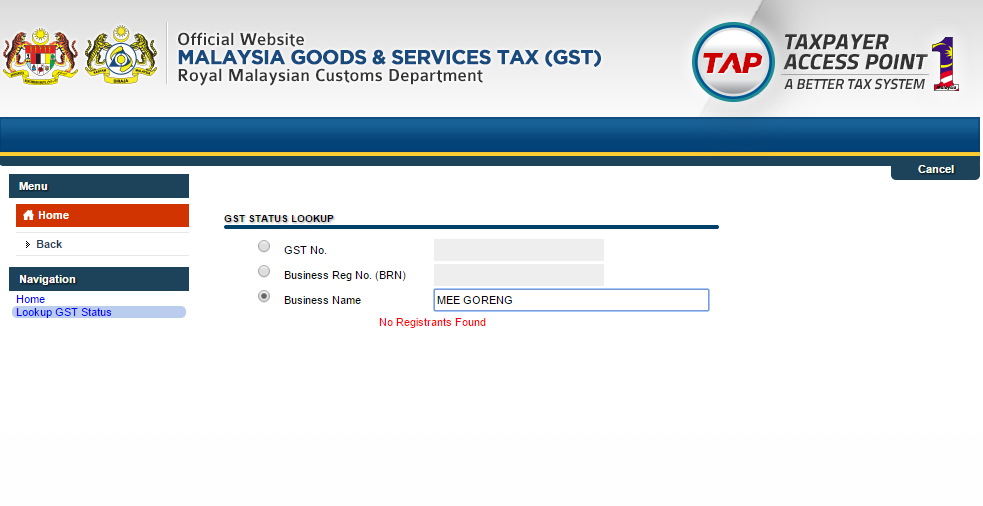
i. Business name
ii. Business registration number
iii. GST registration number
If you feel like you have been a victim of GST fraud you can lodge a report here:
At [Ministry of Domestic Trade, Co-operatives and Consumerism](http://e-aduan.kpdnkk.gov.my/eaduan/aduanbaru.php?lang=1) or use the [MyKira GST](http://says.com/my/tech/4-gst-apps-to-help-you-calculate-compare-prices-and-file-complaints) app is also available to make a report.
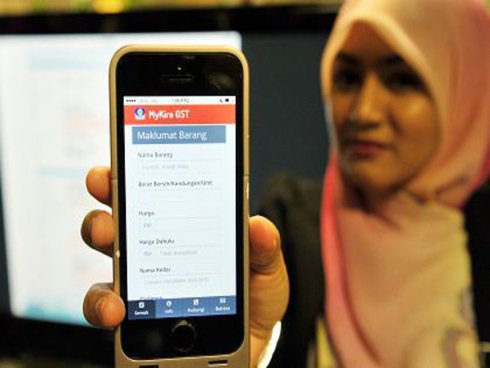
Image via GST Malaysia Info
