


 Cover image via
Follow us on Instagram, TikTok, and WhatsApp for the latest stories and breaking news.
Did you know that Hari Raya Aidilfitri will coincide with Chinese New Year in 2029?
Before that happens, Ramadan will overlap with the 15-day Chinese New Year celebrations in 2026 and the following two years.
The first day of Ramadan is expected to fall on 19 February, pending official confirmation by the Keeper of the Rulers' Seal of Malaysia.
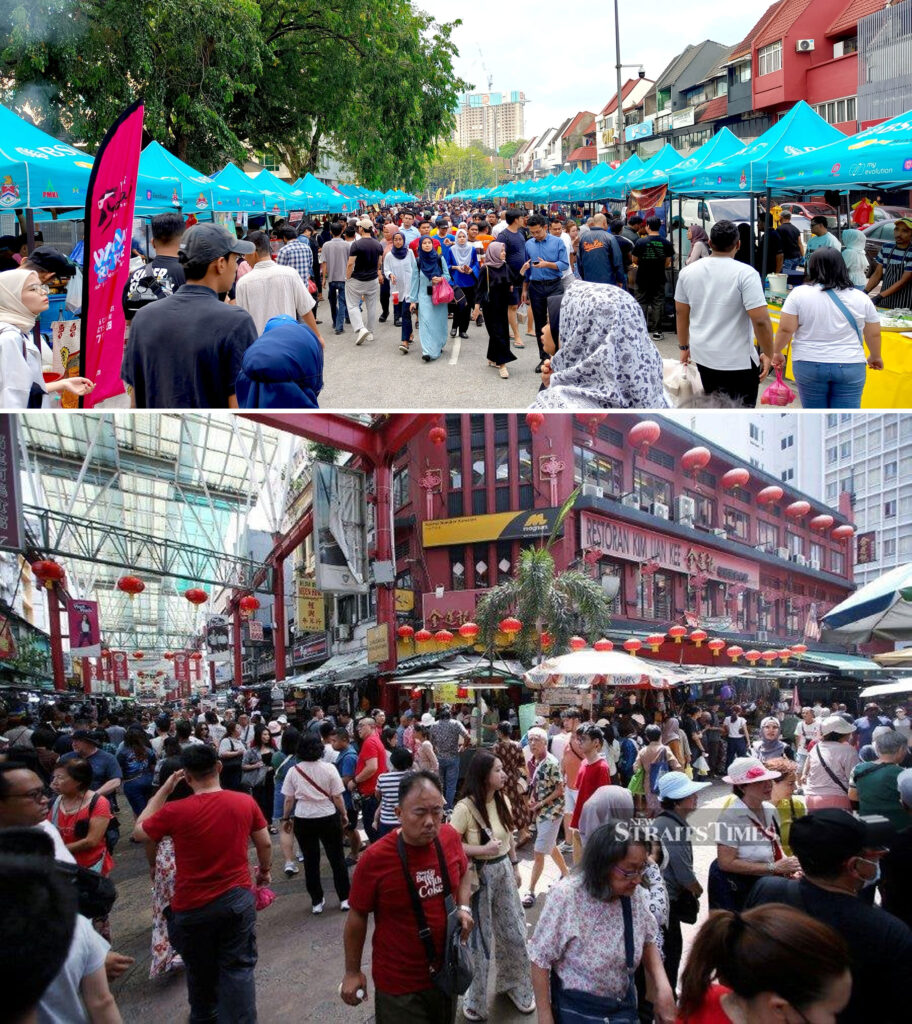
That Thursday marks the third day of Chinese New Year, meaning Malaysians can expect Ramadan bazaar food from the third day of the festive season onwards, creating a unique cultural overlap and, more importantly, an even wider variety of food to enjoy during both occasions.
However, have you ever wondered how the Islamic and Chinese calendars work, and how they bring both cultures together every few decades?
Understanding the Islamic calendar
– The calendar is cyclical, repeating itself every 30 years
– It is also solely lunar-based
– Within the 30-year cycle, 11 years have 355 days and 19 years have 354 days
– This makes the calendar about 11 days shorter than the Gregorian calendar
– It takes approximately 33 to 34 years for the Islamic calendar to cycle through an entire Gregorian year and return to the same season
– Ramadan is the ninth month, while the first day of Syawal, the 10th month, is Hari Raya Aidilfitri
– Fun fact: By 2030, Ramadan will be observed twice within the Gregorian calendar
Understanding the Chinese calendar
– Contrary to common belief, the Chinese calendar is not entirely a lunar calendar: it is a hybrid lunisolar calendar, tracking both the moon and the sun
– The calendar has 354 days in a year
– However, once every three years, there is a 13th month, also known as a leap month
– This makes the leap year about 383 to 385 days long
– This intercalation ensures the seasons occur at roughly the same time each year
– In other words, unlike the Islamic calendar, the Chinese calendar never cycles through the full Gregorian year, and the Chinese New Year celebration always falls between January and March
If all this sounds confusing, think of it this way: Imagine three cars driving around a roundabout indefinitely, each representing the Gregorian, Chinese, and Islamic calendars. Each 'car' is moving at a different speed.
The Chinese 'car' sometimes pulls slightly ahead of the Gregorian 'car' and sometimes falls slightly behind. The Islamic 'car', however, always races past both because its 'year' is shorter, making it the fastest of the three.
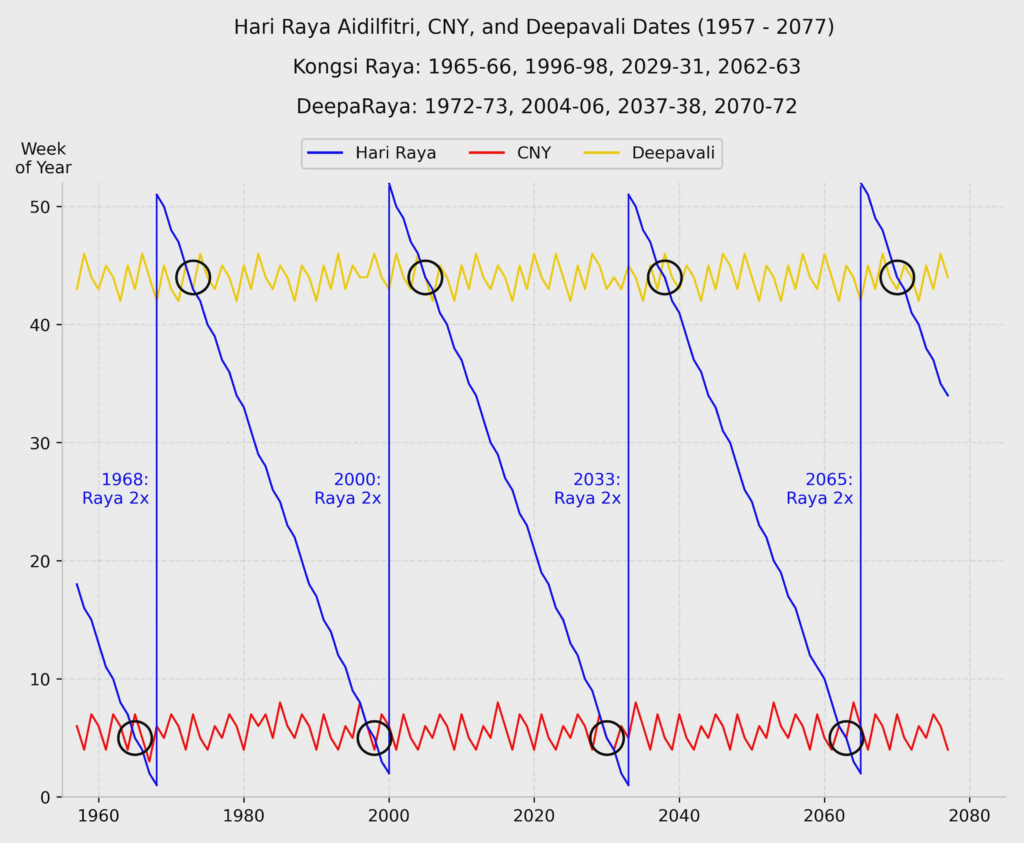
This is why we get KongsiRaya, the rare coincidence of Hari Raya and Chinese New Year falling in the same week, roughly every 30 years.
Below is an image from the r/Malaysia Reddit page showing how the three major cultural celebrations in the country coincide over the years:
Learn more about KongsiRaya here:
