


 Cover image via Poplistic
The English language can be rather perplexing at times. Who knew that a single word, repeated 8 times, can make a complete and 100% grammatically correct sentence?
Yep, you read that right. There is absolutely nothing wrong with the sentence, "Buffalo buffalo Buffalo buffalo buffalo buffalo Buffalo buffalo".

Image via ReplyGIF.net
The sentence was first used in 1967 by Dmitri Borgmann in his book 'Beyond Language'. It gained widespread attention in 1972 when the sentence was used by William J. Rapaport, who is a professor at the University of – ahem – Buffalo in New York.
How does that even work, you wonder? First, you have to understand that the word "buffalo" serves three purposes – noun, adjective, and verb – in the sentence's context.
**NOUN** (the name of a person, place, thing, or idea): Used **in the plural form** instead of "buffaloes" to avoid articles (e.g. "the"). Buffalo are **also known as bison**.
**ADJECTIVE** (words that describe or modify a noun): referring to **the city of Buffalo, New York**. When placed before the noun i.e. "Buffalo buffalo", it means buffalo from the city of Buffalo, New York.
**VERB** (a word used to describe an action, state, or occurrence): meaning **to bully, confuse, deceive, or intimidate**.
Next, we're gonna try to find out what that sentence is trying to say. To help you understand better, we're gonna break the sentence down and mark each "buffalo" marking each "buffalo" with its part of speech.

Note that "buffalo" marked as "a" and "n" are always placed side-by-side. They should **always be read as "Buffalo buffalo"**, meaning buffalo from the city of Buffalo. As there are three "Buffalo buffalo" in this sentence, that means **three separate groups of buffalo from the city of Buffalo are involved**.
If you have been paying attention to everything we've said so far, then you will have very little problem understanding what the sentence is trying to say. It's actually pretty simple:
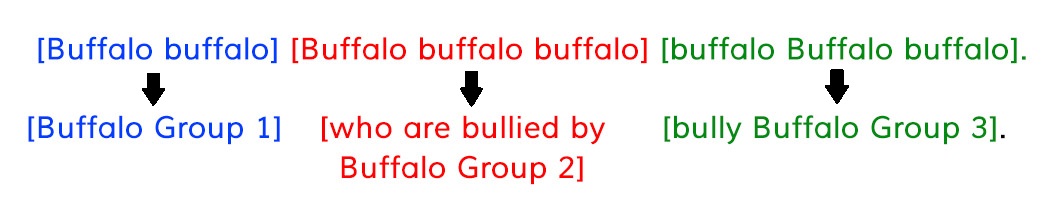
Image via SAYS.com
Basically, the sentence means – "A group of buffaloes from Buffalo, who bully another group of buffaloes from Buffalo, actually bullies ANOTHER group of buffaloes from Buffalo".
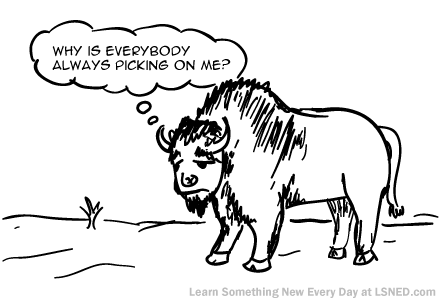
Image via Ryan Pilling / LSNED.com
TL;DR, the bullied are also bullies *lah*.
Still don't get it? Maybe substituting the word "buffalo" with similar words (e.g. "bison" for the animal "buffalo", "bully" for the verb "buffalo", and "New York" to refer to the state of the city Buffalo) to create sentences of similar meaning may help. For example:
1. [Those] bison from Buffalo [that are bullied by] bison from Buffalo [also] bully bison from Buffalo.
2. Bison from Buffalo who are bullied by other bison in their community also happen to bully other bison in their community.
3. Buffalo bison, whom other Buffalo bison bully, themselves bully Buffalo bison.
We'll throw in an illustrated explanation too!
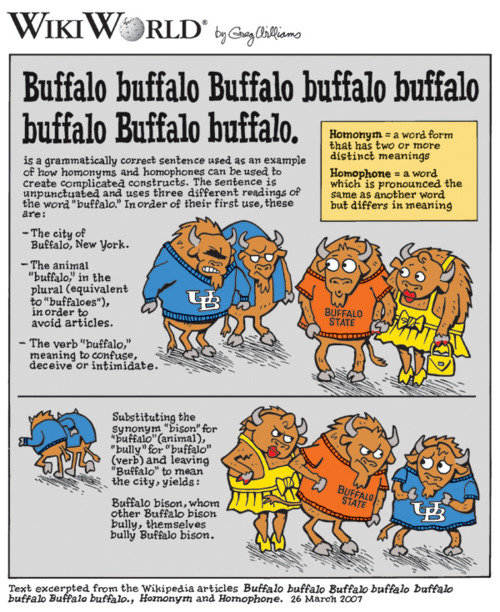
Image via Greg Williams


