


 Cover image via
Follow us on Instagram, TikTok, and WhatsApp for the latest stories and breaking news.
If you've ever wondered why your take-home pay is less than your actual salary, you're not alone

In Malaysia, employers are legally required to make a few mandatory deductions from your salary every month.
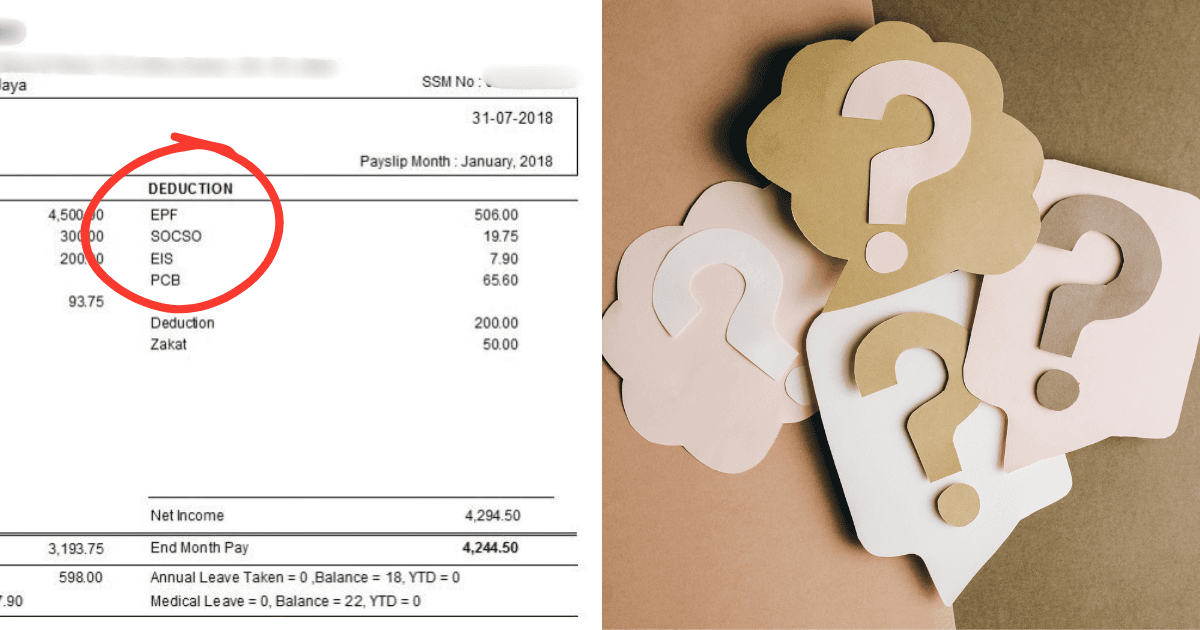
So before you panic or head straight to HR, take a closer look at your payslip. You'll see your basic salary listed at the top, followed by deductions like the Employees Provident Fund (EPF), Social Security Organisation (SOCSO), and Employment Insurance System (EIS).
These may make your paycheck look smaller, but they're actually important contributions that protect and benefit you in the long run.
Once your salary hits around RM3,000 to RM3,500, you might also notice potongan cukai bulanan (PCB), which is your monthly tax deduction.
First, EPF is a long-term savings plan for when you retire

It's managed by the government to make sure you still have savings when you've retired.
Both you and your employer contribute monthly. The standard rate is 11% from you, while your employer chips in 13% if your salary is below RM5,000, or 12% if it's above RM5,000.
Here's how your EPF contributions might look depending on your salary range:
| Gross Salary | EPF | SOCSO | EIS | PCB | Take-Home Pay |
|---|---|---|---|---|---|
| RM3,000 | RM330.00 | RM14.75 | RM5.90 | RM0 | RM2,649.35 |
| RM5,000 | RM550.00 | RM24.75 | RM9.90 | RM110 | RM4,305.35 |
| RM10,000 | RM1,100.00 | RM29.75 | RM11.90 | RM929.20 | RM7,929.15 |
While EPF may seem like one of the most "painful" deductions every month, you can rest assured that it's going towards securing your future. There are different accounts you can withdraw from, but the full amount will only be made available once you hit age 55.
Next, SOCSO covers you if something unexpected happens, affecting your work

It covers things like an accident, injury, or illness that affects your ability to work.
There are two main schemes under SOCSO:
1. Employment Injury Scheme
This scheme protects you if you get injured while working or commuting to work.
2. Invalidity Scheme
This supports you if you're unable to work due to a non-work-related illness or disability.
If something happens, SOCSO can help cover medical bills, rehab costs, or even pay a monthly allowance to replace lost income. Your contribution is usually between 0.5% and 1.75% of your monthly salary, depending on the scheme and your income bracket, while your employer contributes a higher percentage.
Last but not least, EIS helps people who've lost their jobs

It's a fairly new system that was introduced in 2018 to give people financial support while they look for new jobs.
EIS contributions are minimal, just 0.2% from you and 0.2% from your employer each month. If you ever get laid off, or your company closes down, EIS provides temporary financial aid. They also provide job search assistance, and even career counselling or retraining programmes.
In order to qualify, you must have contributed to EIS for a set period and lost your job involuntarily — resignations don't count. It won't replace your full income, but it helps keep you afloat while you find your next opportunity.
If you're just starting out your career, make sure to learn more about EPF, SOCSO, and EIS today!
For more #lifestyle stories:
- How Does Withdrawing RM1,000 From Your EPF Today Affect Retirement? We Did The Math
- How Many Malaysians Have Reached EPF's Basic Savings Threshold This Year?
- EPF i-Akaun: How To Register, Log In & Check Your Balance Online
- Here's How Much EPF Savings You Should Have According To Your Age. Are You On Track?
