


 Cover image via Saurabh Sirohiya/NurPhoto/AFP
Follow us on Instagram, TikTok, and WhatsApp for the latest stories and breaking news.
India has introduced a mandatory digital entry requirement for all foreign travellers, replacing its long-standing paper arrival form with a new e-Arrival Card system
The Indian Bureau of Immigration (BoI) confirmed that from 1 April, every foreign passport holder, including Overseas Citizen of India (OCI) cardholders, must complete the online form before boarding any flight to the country.
The move marks the first major rollout under India's upcoming Immigration Visa and Foreigners Registration & Tracking 3.0 (IVFRT 3.0) modernisation programme, which aims to digitise and streamline border control processes.
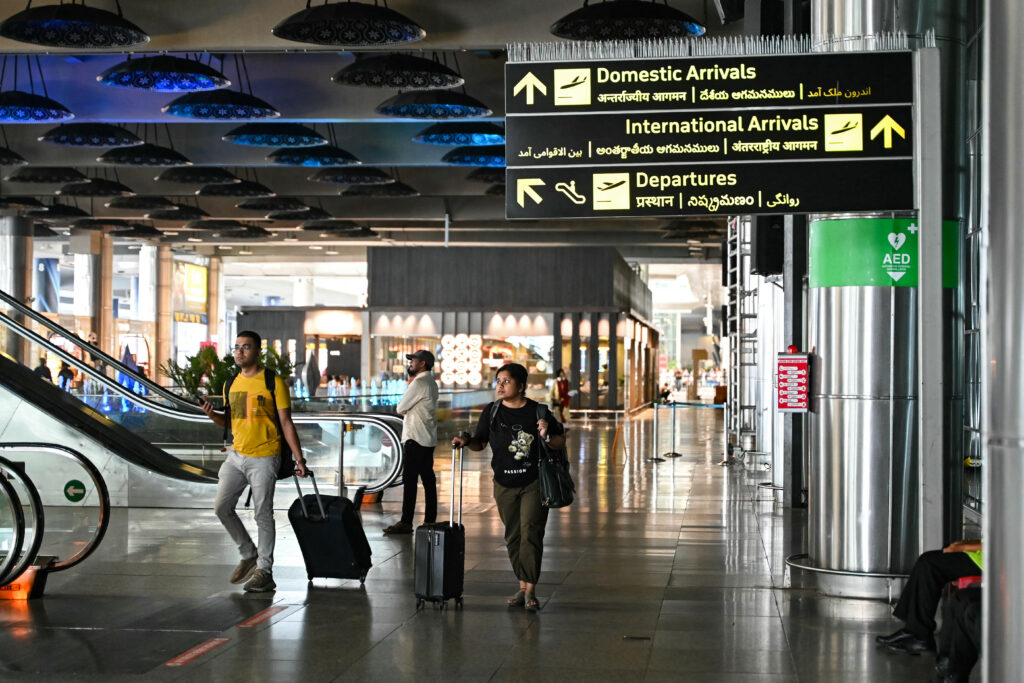
Passengers carry their bags at the arrival terminal of Rajiv Gandhi International Airport in Hyderabad.
Image via Noah Seelam/AFPWhat the e-Arrival Card requires
The e-Arrival Card replaces the paper disembarkation form that has been used since the 1960s, and is not a visa.
Travellers must now submit details online before departure, including passport information, flight details, purpose of visit, intended address in India, and a short health declaration.
No document uploads are required.
Once submitted, passengers receive a QR code that must be presented at immigration upon arrival, either digitally or as a printed copy.
The form can be completed via the Bureau of Immigration website, the Indian Visa Online portal, or the Indian Visa Su-Swagatam mobile app.
Who must complete the form?
The requirement applies to all foreign nationals travelling to India, including tourists, business visitors, and OCI cardholders.
Indian citizens are exempt.
Families of up to five people can submit a single combined form, a measure designed to simplify the process for group travel.
Travellers are advised to complete the submission within 72 hours before arrival, with authorities recommending completion before boarding to avoid delays.

Tourists enjoy a scenic sunset view of the Taj Mahal from Mehtab Bagh in Agra, Uttar Pradesh, India.
Image via Saurabh Sirohiya/NurPhoto/AFPAirlines to enforce compliance at boarding
Airlines have been instructed to verify the QR code at boarding gates, effectively making the form a pre-travel requirement.
In the first week of implementation, passengers who fail to complete the form will not be denied boarding automatically. However, they will be directed to kiosks upon arrival, where they must complete the process before proceeding through immigration.
Officials warn this could lead to delays, particularly during peak arrival periods at major airports such as Mumbai, Delhi, and Bengaluru, where a large share of inbound passengers are foreign nationals.
Pilot trials conducted at Delhi and Bengaluru airports in February showed that processing times dropped from around five to six minutes to under three minutes using the digital system
BoI says the e-Arrival Card will support faster passenger clearance and help introduce "fast lanes" for compliant travellers at airports.
The data collected will also feed into risk-based screening systems intended to pre-clear low-risk passengers and improve border efficiency.
The introduction of the e-Arrival Card is part of India's wider push to modernise its immigration infrastructure and move towards paperless border processing.
Officials say the system aligns with global best practices and is designed to improve passenger flow while reducing manual paperwork at entry points.
However, privacy advocates have raised concerns about expanded data-sharing provisions under updated immigration rules, which allow greater coordination between government agencies.
