


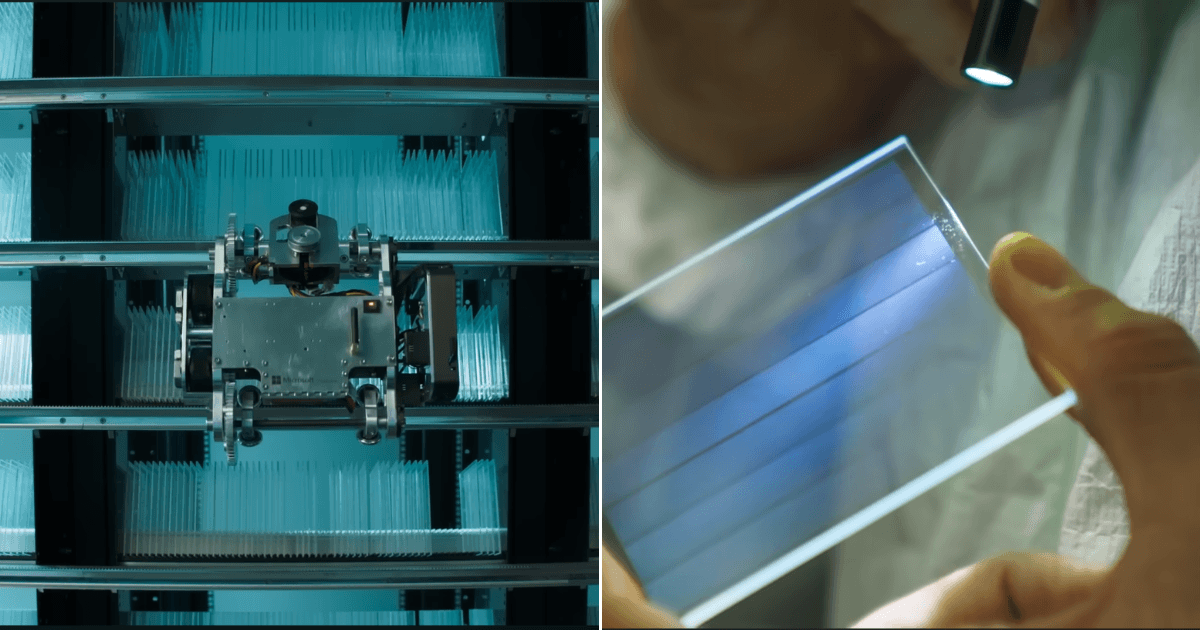
 Cover image via @microsoft (YouTube)
Follow us on Instagram, TikTok, and WhatsApp for the latest stories and breaking news.
Microsoft claims that data written into silica glass using lasers could be preserved for more than 10,000 years
This initiative, known as Project Silica, encodes data on glass plates reminiscent of early photography negatives.
In a study published on 18 February, Microsoft claimed that the system uses common silica glass, a material famously resistant to moisture, electromagnetic interference, and extreme temperature shifts.
This offers a sustainable alternative to energy-hungry data centres that currently require constant backups.

The process begins by turning bits of data into three-dimensional pixels called voxels, which a high-powered laser pulse then writes into square glass plates roughly the size of a CD.
"The symbols are written layer by layer, from the bottom up, to fill the full thickness of the glass," the study explained.
To retrieve the information, a special microscope scans the layers before they are decoded by an artificial intelligence algorithm.
Researchers estimate the glass can survive for 10,000 years at 290°C, suggesting it will last even longer at room temperature. Beyond longevity, these plates are unhackable and don't require climate-controlled environments.

One single plate can hold the equivalent of 5,000 ultra-high-definition 4K films, or about two million printed books
Shandong University researchers Feng Chen and Bo Wu, who were not involved in the study, noted the tech could be a milestone for knowledge storage.
The pair likened the potential impact to "oracle bones, medieval parchment, or the modern hard drive".
They added that "one day, a single piece of glass might carry the torch of human culture and knowledge across millennia".
