


 Cover image via
Follow us on Instagram, TikTok, and WhatsApp for the latest stories and breaking news.
 Image via Cwmbran Life
A Welsh journalist found out firsthand that Internet humour and AI don't always mix. What began as a harmless April Fool's joke ended up exposing how easily AI can absorb and spread false information as fact.
Every April Fools' Day, Ben Black, a journalist for the community news site Cwmbran Life, enjoys creating elaborate pranks for his readers. His past hoaxes have ranged from amusing to the downright ridiculous.
In 2020, he published a fabricated story claiming that Cwmbran, a town in Wales, broke a world record for having the highest density of roundabouts. Although he clarified the next day that it was a joke, a larger news outlet picked it up and reported it as fact. Despite Black's request, the outlet refused to retract the story.
Black was surprised to discover this year that Google's AI Overview had cited his prank story as fact, presenting the fake information in its summary. While this particular instance didn't spread harmful misinformation, it highlighted how easily AI can propagate fabricated news, even when it originates from seemingly reliable sources.
Image via BBC
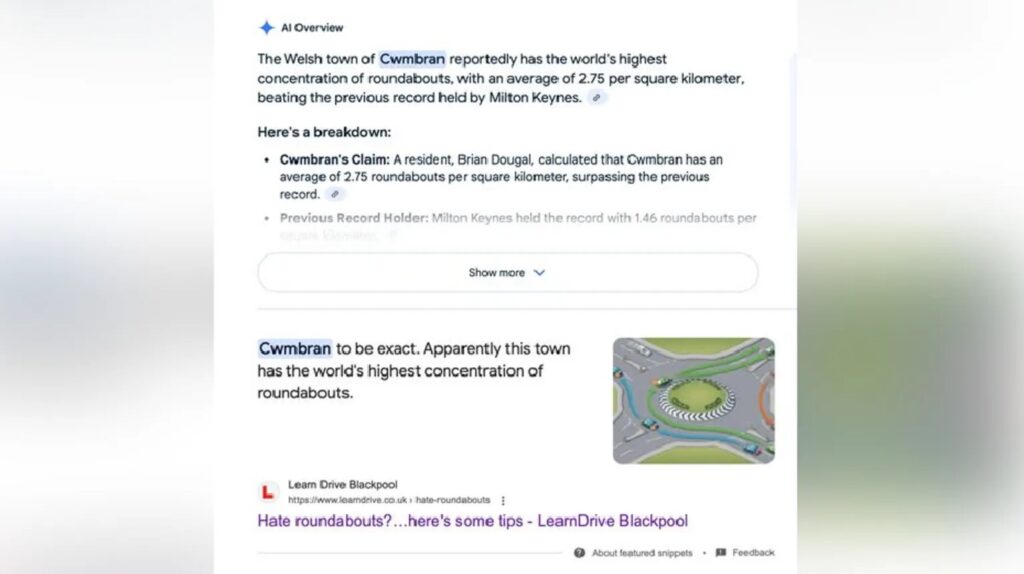

Black had completely forgotten about his bogus article until he searched for his past stories earlier this year
He was shocked to find that Google's AI Overview, as well as a website about learning to drive, were using his fabricated story as fact, claiming Cwmbran had the world's highest concentration of roundabouts.
He expressed concern to the BBC, saying, "It's really scary that someone in Scotland could Google 'roads in Wales' and come across a story that just isn't true. It's not a dangerous story, but it shows how fake news can easily spread even if it's from a trusted news source. Even though I changed it all the same day, it shows down the line the Internet can do its own thing. It's just crazy."
Since then, Black has vowed to stop his April Fools' tradition
Satirical news websites like The Onion and The Babylon Bee have been an Internet staple for a long time. Large language models (LLMs) such as ChatGPT are likely trained on this content, enabling them to recognise and differentiate between satire and real news from these established sources.
However, because Cwmbran Life is a legitimate news website, the AI struggled to distinguish between its genuine reporting and the fabricated April Fools' article. Consequently, the AI treated the prank as factual information.

MOST READ
