


 Cover image via
Follow us on Instagram, TikTok, and WhatsApp for the latest stories and breaking news.
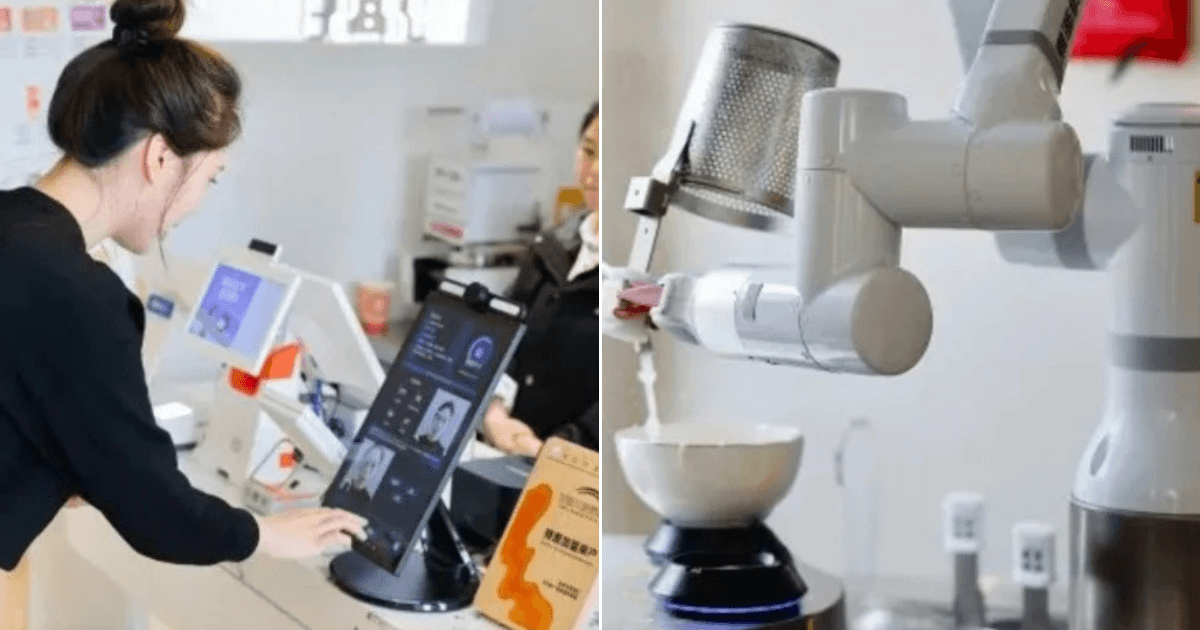
Imagine walking into a restaurant where, instead of a human greeting you, a robot asks to scan your face and tongue. In Hangzhou, China, that sci-fi scenario is already serving up dinner to hundreds of residents every day.
According to South China Morning Post, at least three eateries in Zhejiang province have replaced a significant portion of their staff with artificial intelligence (AI) systems.
One establishment — 24 Jieqi Robot Restaurant — currently uses eight robots to manage ordering, serving, and stir-frying.

These machines can handle 60% of the total kitchen workload
Before a customer places an order, the robots perform an "AI analysis" by scanning their physical features to generate a health report and recommend seasonal dishes.
The restaurant's manager, Cai Haitang, said the robots can cook more than 100 dishes, including Three Cup Chicken, Crab Roe Tofu, and Pian Er Chuan (soup noodles) — a local Hangzhou speciality.

Zhu Qi, an engineer who developed the machines, said the robots store data on fire settings and mimic human movements
This allows them to standardise food quality regardless of who is operating the stove.
For human chef Deng Xuhui, the technology has been a massive relief. Deng said the machines save him half his energy, allowing him to focus on inventing new dishes and managing raw materials.

The efficiency of these robots has also helped reduce prices for consumers
At one community canteen, the cost of a meal dipped from 20 yuan (RM11.60) to approximately 15 yuan (RM8.70) after the robots were introduced.
Customers also said the dishes tasted no different from those prepared by humans.
According to a 2026 white paper, the stir-fry robot sector was worth an estimated 3.8 billion yuan (RM2.2 billion) in 2025. This market is expected to grow to 12.5 billion yuan (RM7.2 billion) by 2030.
